South of the border: Latvians in Akmenė

Latvians of Akmenė

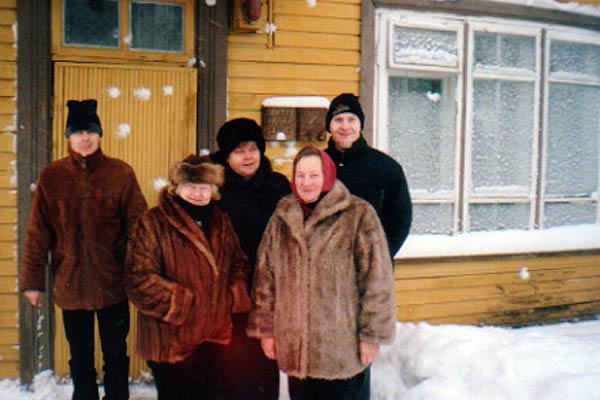
Some members of the Akmenė Latvian community pose for a wintery photograph. Back row from left to right: Tomas Pliuskys, Alvīne Jankauskiene and Valdis Bogavičius. Front row: Valda Pliuskiene, and Spodra Bogavičiene. (Photo by Philip Birzulis)

While most Latvian diaspora communities are thousands of kilometres from their ancestral homeland, Akmenė in Lithuania is almost within walking distance. Latvians have lived in and around this small town, just 20 kilometers from the current border, for two centuries.

The first settlers were farmers from Zemgale, Latvia’s southernmost province, who arrived in the early 1800s to buy cheap land. Although assimilation and Stalinist terror have reduced their numbers, today there are still 30 Latvian families in the town of 3,500, for a total of about 360 people in the Akmenė District. These are some of the roughly 4,700 Lithuanian citizens with the nationality “Latvian” written in their passports. Based on the number of out-of-country voters at the last Latvian parliamentary elections in 1998, the Latvian embassy in Vilnius estimates that there are additionally 120 citizens of Latvia residing in Lithuania.

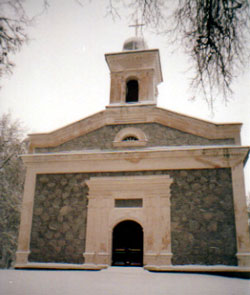
Unlike their Catholic Lithuanian neighbours, the Latvians of Akmenė still observe the Lutheran faith of their ancestors. A wooden Lutheran church was erected in 1829 in the village of Alkiškiai, 7 km from Akmenė, and a stone one built in its place in 1841 is still used for services. A cemetery adjacent to the church contains numerous Latvian names and inscriptions. One of the headstones is dedicated to Edvīns Švāģeris, a parish priest who served seven Latvian parishes along the border, even under Soviet rule, until his death in 2001. Today, a Latvian minister from Kaunas, Lithuania’s second city, makes frequent visits.

The Latvians in Akmenė say that before the war there was a thriving community based around the Alkiškiai church, which supported two choirs and two Latvian societies. There were even two Latvian schools that closed when the teachers were shipped off to Siberia in 1951. The local people were successful farmers, a quality that brought tragedy for many of them during the mass deportations of 1949. Some hid with relations in Latvia to escape persecution, while others who returned from Siberia were banned from resettling in their old homes. Others moved to Latvia after the war because life there was more orderly than in Lithuania, say the locals, leading to a sharp reduction in the numbers of Latvians.

Life is not easy today either. During the Soviet era, several factories making cement and construction materials provided a relatively high standard of living, but the closure of these plants after independence has led to high unemployment.

These economic worries make it hard for Akmenė residents to travel to Latvia. They are especially annoyed at rules forcing them to buy insurance every time they cross the border. Furthermore, they complain that while the Lithuanian government builds houses, sends teachers and help its co-nationals living in Latvia in other ways, Rīga doesn’t do much for its own people. They would like a Latvian teacher to visit them at least occasionally.

Despite these frustrations, the community is still active. Unlike Lithuanians, the Latvians celebrate Jāņi (Midsummer’s Eve) and enjoy singing Latvian songs. The local council gives them free use of two rooms in a community centre where books, maps of Latvia and other items demonstrating the pride they have in their origins are displayed. Several hundred Latvians come together at the annual kapu svētki, the day for the remembrance of the deceased, at Alkiškiai. While intermarriage with Lithuanians has been taking place for at least two generations, some young people in their 20s and 30s still speak Latvian, although their own children may be assimilated.

This process is reflected in the life story of Valda Pliuskienė. Her grandmother and mother moved from Rīga to live with relatives in Akmenė during World War I, while her father, who was born in Auce in Zemgale, joined his family in Akmenė before 1914. Pliuskienė married a Lithuanian, and while her son Tomas Pliuskys speaks Latvian, he thinks of himself as a Lithuanian. Only one of Pliuskienė’s four grandchildren speaks Latvian.

Nevertheless, the community still maintains contacts with its ethnic homeland. Choirs and folklore groups from Dobele, a town in southern Latvia, often visit Akmenė to give performances. The Akmenė Latvians also have strong ties with their compatriots in Klaipeda, Joniškis, Kaunas, Vilnius and elsewhere in Lithuania. And they show off their Latvian language and culture at festivals in the local district.

It seems likely that this southern Latvian outpost will be around for a while yet.
Latvian church near Akmenė

The Latvian Lutheran Church at Alkiškiai, near Akmenė. (Photo by Philip Birzulis)
Album offers peek at a dark metal future

These days, admitting that you are a heavy metal fan is not an easy thing to do. Unfortunately, heavy metal has gotten a bad reputation, associated with cheesy bands in the 1980s sporting absurd hair and bad makeup, or for supposedly “influencing” people to either commit suicide or worship Satan.

When I was younger, I listened to quite a bit of metal myself. I would frighten friends and family with the music I listened to: band with names like Metallica, Megadeth and Iron Maiden and songs with titles like “Harvester of Sorrow,” “Wake Up Dead” and “The Number of the Beast.” The album covers would reflect the titles, with pictures of skeletons, demons, graveyards and similar imagery.

Most people figure that it is just a teenage thing and it passes, but I enjoy listening to heavy metal whenever possible. And I am glad to say that I have neither committed suicide, nor do I worship Satan. I like the aggressive music, the bleak lyrics and the blunt attitude of many of the bands. This kind of music helps get out your own aggression, or close off the rest of the world when you want.

Heavy metal is quite popular in Latvia. Most every time I walk around Vecrīga, I see many posters advertising heavy metal bands that are playing in the area. Their shows are well attended, too. Most of their recognition comes through word of mouth. Though heavy metal is popular, many of these bands don’t have the resources to put together a complete album. Thankfully, Gailītis G (of all labels!) has provided an outlet for many of these bands to reach a wider audience.

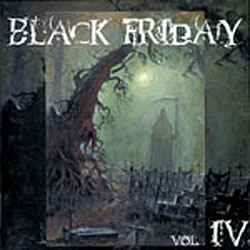
The fourth volume of the Black Friday metal compilation album collects 15 tracks (totaling about 70 minutes of music) by a wide variety of bands from Latvia. Most of the songs are in English, some are in Latvian and some I can’t tell what language they are in!

The quality of the songs is quite varied. Some are still in the demo phase, but some are release-quality recordings. Regardless, it is still an interesting journey through the rugged landscape of Latvian heavy metal.

The album begins with “Angel’s Tears” by the band Heresy from their EP Heresy. The song begins with a disembodied female voice chanting some Latin words in the style of the “industrial metal” sound of groups like White Zombie. The only words I can make out are the chorus of “God is dead, and no one cares!” It’s a good song.

Also in the industrial metal vein is Huskvarn’s “Save Your Soul,” but the song reminds me a bit too much of Marilyn Manson, although the vocals are hard to hear.

Next is Skyforger with “Sešas ārprāta dienas” from the album Latvian Riflemen. Skyforger’s claim to fame is that they sing songs about Latvian warriors and even dress the part, judging by their picture in the liner notes. Their Web site lists them as being “deeply inspired by their native folklore and pagan heritage” and their lyrics being “poetry based upon the stories from times of the World War I.” Very good guitar work in this one, especially aggressive music, but the lyrics are too far down in the mix for me and I can make out few words.

“Autumn” by Sanctimony, from the album Eternal Suffering, is up next. This is a rather generic “death metal” song. Death metal is characterized by bludgeoning, extremely distorted guitars and drums, along with growled, incoherent vocals (sort of like an angry Cookie Monster). Fans of the genre (bands like Cannibal Corpse and Carcass) will probably like this, but it’s a bit dull for my tastes. The same applies to the group Preternatural with their song “Presence” from a demo tape of the same name. I like the guitar work, but the high-pitched guttural growling makes this song sound like any other death metal song.

Plenty of death metal is found on this album. Songs include Brute Chant’s “Olympiad” from their album Killer Each of You, The track sounds like the production was intentionally made muddy, as the vocals are routinely drowned out by the noisy guitars.

Moving further back to the mainstream is Fatum’s song “We Are Dreaming of Peace.” The hard driving bass line and the harmonies in the guitars remind me of Iron Maiden. Once again the vocals are mixed too far back, making it hard to understand the words. I liked this song, though. Hopefully, Fatum will be releasing more some day.

One of my favorites on the album is Rainmaker’s “Lietus dziesma.” From the great opening bass line, to the rythmic assault of the guitar, to the menacing (and understandable!) vocals, this is one of the standouts of the album.

Heresiarh’s “Higher Than Hills,” from the album Mythical Beasts and Mediaeval Warfare, is what the band on its Web site calls “Latvian dragon metal.” This is due to the fantasy themes that are throughout its songs. One of the latest trends in the metal world is to add female vocalists, perhaps to counterbalance the roughness of the male vocal. However the female vocals in this one are indecipherable as well.

Another favorite on the record is the Dzelzs Vilks song “Ledus,” which balances an extremely rough guitar part with a lighter keyboard part (sounding like raindrops!), as well as a techno beat and howling vocals. This is the most professional sounding song on the record, but that is no surprise, as Dzelzs Vilks’ lineup is just about the same as Deus (S)ex Machina (who released the soundtrack of the rock opera “Fausts”). They have just released an album, Lai arī tu būtu ar mani, that I will assuredly be purchasing next time I am in Latvia.

“Tu jūti” by Apēdājs is another good, straight-forward metal song, with some great guitar effect work. The Quarks’ song “Dziesma par reklāmu” starts off with an extremely deep bass sound, then brings in some crunching guitars as well. Sounds a bit like the grunge-metal style (a la Stone Temple Pilots). Moral Free’s “Bangin’ on the Radiators” is another straightforward song.

Sliede’s “Vēl prasīts” starts off with a very Van Halen-ish guitar intro but then becomes a Black Sabbath-ish (slow and deliberate guitar riff) song.

The most bizarre track on the collection has to be the last one, “Māt, es gribu būt nevainīgs” by the hardcore band Inokentijs Mārpls. Flying along at 100 miles per hour, the song features a rather unearthly falsetto shriek by the lead vocalist. I presume that they are not trying to be serious in this song, but I’m not entirely sure. Unique, for sure, but an assault on the nerves of the listener.

Liner notes are pretty sparse: a picture of the bands but not much else. For these kinds of compilations, information about who is in the band or a Web site address would be useful. Having the lyrics would have helped, too, especially for the unintelligble death metal songs.

Quite a few tracks here are very good. However, many of the tracks are highly derivative and sound very similar to other, more popular bands from the United States and Europe. And a number of the tracks would benefit from a bit more polishing of the sound and music. However, the album does provide a thorough snapshot of the world of Latvian heavy metal. From listening to this record, the future of this style is very bright (though I’m sure most of the groups would prefer to say that the future looks very dark!).

Details

Black Friday, Vol. IV

Various artists

Gailītis-G,  2001

Egils Kaljo is an American-born Latvian from the New York area . Kaljo began listening to Latvian music as soon as he was able to put a record on a record player, and still has old Bellacord 78 rpm records lying around somewhere.

Emotion gets the better of soldier’s tale

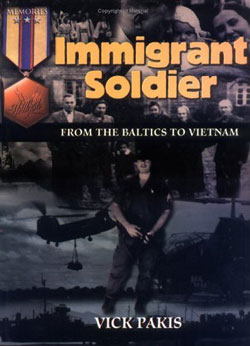
Immigrant Soldier

Immigrant Soldier: From the Baltics to Vietnam is a very personal story that is told with heartfelt conviction and sincerity. Unfortunately, it never develops beyond an oversimplified look at history through the prism of personal experience.

As the title suggests, the memoir attempts to span the historical era from Latvia’s independence through Vick Pakis’ own experiences fighting in the Vietnam War. That is a Herculean task. It includes the Soviet occupation of Latvia and the family’s flight to the West, their experiences in a Displaced Persons camp in Germany, and their arrival and adjustment to life in the United States, eventually culminating in Pakis’ own experiences in the Vietnam War.

Similar approaches were used by Agata Nesaule in A Woman in Amber and by Modris Eksteins in Walking Since Daybreak. The problem is that Pakis has neither the literary skill nor the historical backgrounding of Nesaule or Eksteins. His story seldom goes beyond simple narrative in which all the good guys wear white and all the bad guys, in this specific case, wear red. The writing often reads like ledger entries.

Small nagging errors are hard to ignore after a while. Pakis refers to his grandfather as Khrisjanis. The Latvian pronounciation of the name would most likely be Krishjanis (Krišjānis). Another character is referred to as Mr. Ozoles; in Latvian it would be Ozols. The family members are referred to by first name only, which can be confusing. The book’s jacket claims that the book "…reveals how his personal history would ultimately influence Vick Pakis’ own confrontation with Communism—as a soldier in the U.S. Army." However, the only character in the book who serves in the U.S. Army is named Karl. The only Vick in the book is Viktor, Karl’s father.

These are to be expected in a book from a small publishing company, Hellgate Press, specializing in books that claim to look "through the eyes of someone who has experienced war" and written by a novice writer who feels strongly about his subject matter. Ultimately, it’s the strength of feeling that is the downfall of Immigrant Soldier.

The story of the incredible hardships that the Pakis family had to endure works, even if one suspects that it might be a bit self-serving. It’s the recounting of history that exposes the book’s shortcomings. It’s not that Pakis’ family did not go through hell and that the Soviets were responsible. It’s not that the Vietnam War wasn’t as simple as the war protesters tried to make it out to be. It’s just that he tries to put it all into such a narrow historical perspective that even the staunchest conservatives might blink.

The Reds are to be blamed for everything. In the fight for Latvia’s independence all of the bad guys are Reds. During Latvia’s independence the Reds cause all of the problems. In German labor camps the bad guys are all Reds, or Russians. During the Vietnam War period it’s the Red media. And if they are not Reds, then they are obviously malcontents and idiots. The book is peppered with passages like “…experiences of the past created a hatred for hypocrites, liars, thieves, and most of all, the so-called experts…Viktor’s success was based on hard work, but it did create a few enemies for him. Envy and jealousy came his way from several older writers in the section…It’s not going to be tomorrow or the day after that, but eventually they will be able to say, ‘I told you so’ to all of these Commie lovers and Socialists."

Pakis’ life, the experiences of his family’s flight from the Soviet occupation of Latvia and—by extension—the lives and experience of countless other Latvians, those who left and those who stayed behind, deserve to be heard. Unfortunately, Vick Pakis was probably not the best person to tell them.

Details

Immigrant Soldier: From the Baltics to Vietnam

Vick Pakis

Central Point, Ore.:  Hellgate Press,  2000

ISBN 1-55571-512-5

Where to buy

Purchase Immigrant Soldier: From the Baltics to Vietnam from Amazon.com.

Note: Latvians Online receives a commission on purchases.