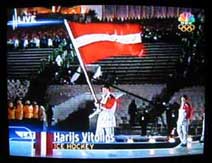
With all the buzz in Salt Lake City these days about Team Latvia, who needs a medal in the Winter Olympics? Come Friday evening, Feb. 8, that buzz may just turn into a roar as Latvians across the United States watch the opening ceremony on the NBC television network.
If the indications from Salt Lake City are true, the national TV audience finally will get to see the Latvian team march into Olympic Stadium.
Unlike other recent games, the run-up to the 2002 Winter Olympics has seen an unprecedented amount of attention focused on Latvia—in Salt Lake City and beyond.
"There’s buzz on the street. People stop me and ask me about Latvia," Bruce Lindsay, a news anchor for local station KSL-TV, told Latvians Online. That’s because the station has been giving Latvia nightly coverage ever since Salt Lake City resident Pēteris Stāks told Lindsay how the country’s athletes repeatedly have been passed over during the opening ceremony telecast.
In Washington, D.C., and in Boston, meanwhile, Gunārs Zāgars has generated his own buzz. It started with an opinion piece he wrote for The Washington Post, which resulted in a story about him in The Boston Globe.
Across the United States, many Latvian-Americans now know the names of Lindsay, Stāks and Zāgars. In Latvia, the news that Latvia is in the news is once again news.
And, of course, getting a medal or two wouldn’t be bad for Latvia’s image, either.
TV station adopts Latvia
It all started in January, when Stāks e-mailed KSL and noted that during the past five Olympics, Latvia’s team has not been shown on network broadcasts of the opening ceremony. In each case, commercials have replaced the Latvian team’s appearance on millions of television sets around the United States.
KSL called Stāks to the studio Jan. 17 and Lindsay interviewed him on the air. Lindsay also promised KSL viewers that the station would broadcast regular updates about Latvia.
Since then, KSL has frequently highlighted some aspect of the Latvia story, including a look at the hockey team, an item on a recent survey that found Latvia is among the most optimistic countries in the world and a piece on sixth graders at a local elementary school who made lap quilts for the team, according to the broadcast monitoring service Utah News Clips. Also planned, according to Lindsay, is an interview with President Vaira Vīķe-Freiberga, who will be in town to cheer the Latvian team. The Rīga-based Latvian Institute, among others, has been providing information to the TV station.
Responding to KSL’s frequent "Latvia Update" segments, and perhaps aware of continued complaints about Latvia’s disappearing act, NBC Sports Chairman Dick Ebersol told Lindsay in a televised Jan. 31 interview that the Latvian team indeed will be shown this year. NBC, which owns the rights to broadcast the Winter Olympics in the United States, will still break for commercials before the Latvians enter the stadium, Lindsay said, retelling the interview with Ebersol. But as soon as the commercials are over NBC will air videotape of the Latvian team.
A spokesperson for NBC Olympics in Salt Lake City could not be reached to confirm the plan.
Although KSL is an NBC affiliate, Lindsay said the station’s jabs at the network have not caused trouble. "They seem to roll with it," he said.
Stāks admitted to being a bit surprised at how easy it was to get NBC to bend.
"We tend to grouse, we tend to complain, rather than trying to get things done," he said of Latvians. The Salt Lake City community of Latvians totals about a dozen, according to Stāks. He and three others are volunteering at the Winter Olympics.
For his part, Lindsay said, he’s been surprised at how much response the station’s commitment to Latvia has received. KSL’s broadcast signal is received throughout Utah as well as in parts of Idaho, Wyoming and Arizona, while a satellite signal is available in places like Portland, Ore. But e-mails have come from far and wide.
"You have a very supportive community," he said of Latvian-Americans.
Although he’s never visited Latvia, Lindsay is no stranger to the country. "My eighth grade geography report was on the Baltic republics," the news anchor recalled.
"The eminent pride in the nation is really astounding," he added.
Stopping the rain
In the Boston suburb of Westford, Gunārs Zāgars had finally had enough after watching the NBC telecast of the opening ceremony of the 2000 Summer Olympics in Sydney, Australia. He told Latvians Online he began penning a letter to the editor, but by the time it was finished it had turned into a 1,500-word op-ed piece. Editors at The Washington Post accepted the piece, but suggested that it might be better to publish the article closer to the 2002 Winter Olympics.
And that’s what happened. Zāgars’ bylined article, "Dear NBC: Stop Raining on Our Latvian Parade," ran in the Jan. 27 edition. The article discussed his family’s disenchantment with the continual snubbing of Latvia and other nations. During each of the five Olympics since Latvia regained independence, they had looked forward to seeing the Latvian flag and the Latvian team.
"But coverage of the opening ceremonies in 1992 broke for commercials before the Latvians were introduced and resumed after they had passed by," Zāgars wrote. "The same thing happened in 1994. And in 1996. And in 1998. Each year we would tune in, eager to catch a small glimpse of our Olympic heroes, and each year we would get Japan… Kenya… the Koreas… and Kummercials."
For Zāgars the snubbing took on extra meaning. His Rīga-born mother, sprinter and high jumper Zinaida Liepiņš, had represented Latvia in the 1928 Amsterdam Olympics. She died in March 2000, six months before the Sydney Olympics, never having seen her team again march onto the Olympic field.
Zāgars’ effort has been rewarded with kudos from the Latvian Institute and acquaintances as well as with an invitation to a lunch in Washington featuring President Vīķe-Freiberga. Zāgars had a chance to briefly chat with the president.
‘Kungi’ and ‘Dāmas’
The central meeting point for fans of Team Latvia in Salt Lake City is the Green Street Social Club, 610 Trolley Square. That’s where team members have dined, where fans from Latvia and elsewhere have congregated to get their bearings, and where local patrons have had a crash course in the Latvian language.
Latvian flags adorn the establishment, said Manager Garrett Wilson, and even the restrooms are marked "Kungi" and "Dāmas."
The social club also has been selling Latvian T-shirts and flags. However, one thing missing is Latvian beer.
"We should have got on that," Wilson admitted.
While all the attention has been good for business, the biggest event for the social club may be just ahead. President Vīķe-Freiberga is rumored to be planning to stop by Saturday evening.
So how does a bar in Salt Lake City prepare for a presidential visit?
"We’re gonna find that out," Wilson said with a chuckle.
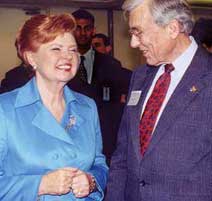
Latvian President Vaira Vīķe-Freiberga shares a laugh with Gunārs Zāgars during a meeting in Washington, D.C. (Photo courtesy of Norma Zāgars)
Andris Straumanis is a special correspondent for and a co-founder of Latvians Online. From 2000–2012 he was editor of the website.