


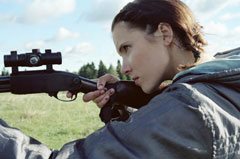
Kristīne Krūze plays Ria in the Viesturs Kairišs film Tumšie brieži, based on a play by Inga Ābele.
If you were to judge the Latvians by their films you would have to arrive at the conclusion that the Latvians are a very, very unhappy people. Viesturs Kairišs’ Tumšie brieži (The Dark Deer), based on a play of the same name by Inga Ābele, follows in that rich tradition of doom and gloom where things start out bad and then they get worse.
Latvian filmmakers seem to be primarily interested in making two types of film, the depressing or the tragic.
The characters’ entire lives are spent in a cycle of manic depression punctuated by brief spells of exhausted catatonia. Few are the films offering escapist fare and simple entertainment. If a Latvian filmmaker were to make It’s a Wonderful Life, George Bailey would jump off that bridge, Clarence would not get his wings and be relegated to the depths of hell, and Mary would become Mr. Potter’s unwilling mistress. And those would be the cheerful parts.
Tumšie brieži follows the lives of Aija (Elita Kļaviņa), Alfs (Kaspars Dimiters) and Augusts (Juris Žagars). The film opens with the three riding in a car. A pregnant Aija sits in the back, Alfs in the passenger seat and Augusts at the wheel. The relationships between the three aren’t clear, but it’s evident that they are intimately close. They’re returning from an evening at the theater when the car runs into a deer and crashes. The next scene picks up 17 years later. Aija is now a semi-catatonic recluse tended to by Alf and his new wife Nadine (Maija Doveika), Aija’s former nurse. They all live on a game farm and hunting lodge managed by Alfs and his father Opis (Pēteris Martinsons). Times are evidently hard, but a group of German hunters, among them Augusts who is now a successful businessman in Germany, has just arrived and the money they’ll spend just might save the day.
There’s just one problem. Ria (Kristīne Krūze), Aija’s and Alfs’ daughter, has grown up with and loves the deer. She will do everything in her power to disrupt the hunt and save them.
Kairišs is a talented filmmaker with a very strong feel for pacing, composition and mood. His 2001 Pa ceļam aizejot (Leaving By the Way) was a lyrical and mystical film despite some uneven performances. In Tumšie brieži we have the opposite. Despite some very strong performances from his cast, the film never really engages us. The characters somehow never really connect. We never seem to care about any of them. The motivation of the actors is never clearly explained.
While Aija is certainly a very attractive woman, we are never really sure why the two men would be so attracted to her or she to them. Why is Aija in the state she’s currently in? An accident can certainly be a traumatic experience, but is that enough to drive Aija to madness? Why does Alfs not just run away from his crazy family and why does Nadine put up with any of it? Why did Augusts leave? And why did he come back? Obviously there’s a lot of missing backstory. The film hints at its presence, but most of it doesn’t find its way to the screen. Ultimately, the answer to all of these questions seems to be that it’s in the script and that’s the way the actors play it.
It’s not that Tumšie brieži is necessarily a bad film. It has a definite feel to it and Kairišs’ strong visual sense and feel for mood and pacing are evident. The acting, with the possible exception of Krūze, is strong. Both Dimiters and Žagars bring a presence to their roles which goes beyond just their lines of dialogue. Kļaviņa does the best with what the limited script offers her. Krūze, unfortunately, brings the least to the table. Her Ria seems to alternate between petulance and cliché teenage rebellion. It’s Ria’s role that has to be the focal point of the film. All the action flows through or from her. How much of that is the fault of Krūze and how much is the fault of the script is debatable, but it never really seems to come together on the screen.
Details
Tumšie brieži
Viesturs Kairišs, director
Kaupo Filma, 2006
Notes: In Latvian. Feature, 85 minutes, in color. Screenplay by Viesturs Kairišs, based on a play by Inga Ābele; cast: Kaspars Dimiters, Maija Doveika, Elita Kļaviņa, Kristīne Krūze, Pēteris Martinsons, and Juris Žagars; producer: Guntis Trekteris; director of photography: Gints Bērziņš; music: Artūrs Maskats. DVD offers original Latvian and Russian dubbing, as well as English subtitles.
