


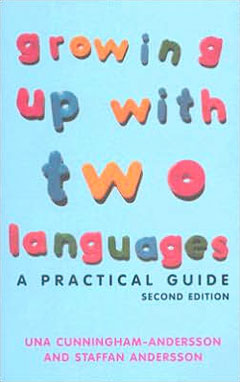
I recently took a look at the second edition, published in 2004, of Growing Up with Two Languages: A Practical Guide by Una Cunningham-Andersson and Staffan Andersson. I read the first edition (1999) almost 10 years ago, but was curious to see the book again.
Growing Up with Two Languages is a manual for families living with two languages, written by a couple who have not only gone through the experience themselves, but also have the professional credentials (senior university lecturer in English language and linguistics) to back up their observations and recommendations with current linguistic research. The book is nevertheless easy to read and focuses much more on practical suggestions than scientific explanations.
The main readers in mind are those parents and families who are generally not part of an established bilingual community and also not native to their country of residence. For this reason the book may seem a bit simplistic and self-evident to those Latvians who have the luxury of being rooted in—often to the point of actually being born into—an established minority community. But it is still an interesting and informative read that will raise parents’ awareness about bilingual family life. It raises many issues to think about, such as bilingualism vs. biculturalism, children’s culture, semilingualism and community.
The first three chapters focus on preparation: reasons for and circumstances of bilingualism, issues in mixed-culture marriages, making plans for the minority language and culture while expecting a child, developing a two-language system, and various types of bilingualism.
Chapter 4 deals with more technical aspects of bilingualism, including general linguistic development in children, interference and mixing of languages, and a look at the “critical period hypothesis” of language acquisition.
After that the book delves into the emotional and psychological aspects of bilingualism in children, parents, and families, such as the advantages and disadvantages of bilingualism, being different at school, and competence in two cultures. It also offers many practical suggestions for parenting in a bilingual home.
Chapter 8 addresses problems that families may encounter, such as poor quality of input (how well do the parents themselves speak?), semilingualism, changed family circumstances, and children with special needs. The last chapter focuses on motivation, identity and older children, including teenagers. One suggestion the authors give is to not call children “half this and half that,” but rather both Irish and Swedish, as is the authors’ case. They also suggest that parents reevaluate their family’s motivation for maintaining two languages, since pleasing the parents is no longer enough of a motivation for older children to speak in the minority language (and may even be a reason not to speak it).
At the very end of the book the authors provide suggestions on how to organize a workshop on raising bilingual children and how to begin a minority language play group or Saturday school. These are phases that most Latvian communities abroad have already gone through, but which the newest wave of immigrants might find useful as they confront issues of retaining the Latvian language. One of the appendices provides information on how to document a young child’s linguistic development, which can be exciting even for those parents who are not linguistics geeks.
The book offers lots of advice and ideas from other parents of bilingual families, some of whom grew up bilingually themselves. Sometimes this advice is contradictory, but it underscores the underlying theme of the book: do what feels comfortable for you and your family. One father goes so far as to remind readers that “…some kids may well not want to be bilingual. It is, after all, a personal decision… I think parents should respect the kid’s decision” (pg. 115). That definitely os not popular with trimda-era Latvians, but nevertheless a legitimate opinion that can stimulate interesting moral discussions.
Growing Up with Two Languages offers practical insight into bilingual life, such as “A child with two languages needs to work and play more with language than a monolingual child who has two parents giving input in a single language” (pg. 77). The authors also encourage teaching children to read in the minority language, because reading is a very efficient way to enlarge vocabulary and open a wide door to further language learning. One suggestion the authors give for encouraging reluctant readers is to find or make taped recordings of books so that the children can listen to and follow the text at the same time. Another suggestion is outright bribery, for example, 15 minutes of reading in the minority language in return for 15 minutes of computer time.
Some of the book’s suggestions for, say, a child’s refusal to speak the minority language, are in my opinion wishy-washy and too weak. But the authors don’t tread on anyone’s feelings and accept that some parents are satisfied with their children having only a passive knowledge of the minority language, meaning that they understand it but are not able to speak it. I presume that this will be too liberal a view for many Latvians, and it is for this reason that I was critical of the book when I read it the first time around. Maybe I’ve since grown more tolerant or am now more relaxed about my own children’s language situation, but I like the book better now. It does not provide all the answers, since real life is messy and there really is no one correct way to live with two languages. But it does give parents much food for thought and get them thinking about language. It offers good practical suggestions and should be required reading for all families dealing with two languages.
Details
Growing Up with Two Languages
Una Cunningham-Andersson and Staffan Andersson
London: Routledge, 2004
ISBN 978-0-415-33332-0
