Remember the band, but forget the album

Nekad nesaki nekad

One practically needs a scorecard to track everyone who has gone through the ranks of the Latvian rock group Līvi. The Liepāja-based group has been through so many lineup changes that one becomes dizzy trying to remember them all. Former members often go on to their own successes. Singer Igo Fomins launched a successful solo career after spending time in the group. Guitarist Tomass Kleins, after spending many years in the group, joined up with Igo’s brother Ivo to form the successful but short-lived duo Fomins un Kleins.

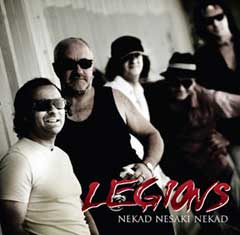
A former Līvi member who seemed to vanish completely off the radar after leaving the group is Aivars Brīze. His last album with the band was 1997’s Bailes par ziņģēm, after which he departed the group seemingly never to be heard from again. However, he has resurfaced, partnered with Kleins and other well-known musicians, to form the “new” band Leģions. The band released its debut compact disc, Nekad nesaki nekad, in the fall of 2008.

One of the reasons the duo Fomins un Kleins broke up was supposedly because Kleins wanted to pursue pop music. Kleins formed the band Cacao with popular young singer Andris Ērglis and recorded the big pop hit “Ripoja akmens.” However, after a very public breakup, Cacao was disbanded and Kleins returned to his hard rock roots.

Joining Brīze and Kleins (who is also the principal music writer) is another Līvi member, drummer Vilnis Krieviņš, as well as bassist Eduards Glotovs and keyboard player Juris Kristons. Throw in lyrics by respected rock lyricist Guntars Račs and you would figure you would have the recipe for a seminal Latvian rock album.

Unfortunately, the record is underwhelming and not quite as good as you would expect considering who was involved in making it. But first, though, I must point out that Brīze sounds great. He returns to the microphone for, I believe, the first time in a decade, and has not missed a beat. His unique chainsaw-through-iron voice that sang Līvi classics like “Dzelzsgriezējs” is as strong as ever. Kleins’ guitar work is also as good as ever. However, for whatever reason, the record remains uninspiring, with many songs barely climbing past the generic rock anthem level.

The album begins promisingly, with riffing that would make Angus Young of AC/DC proud in “Tev vajag daudz.” However, much like recent AC/DC releases (like 2008’s Black Ice, sadly generic and uninspired), the riff is the best part of the song, and the song does not grab you as much as an opener should.

Next up is a song about a dog, appropriately titled “Suns,” and a number of tracks that are rather cliché rock music, not to mention with quasi-philosophical lyrics, such as “Laiks ir laiks” (“Time is Time”) or “Notici sev” (“Believe in Yourself”). The standout track is the final song: the ballad “Kad brālis modīsies” (“When Brother Awakes”). The palpable emotion in Brīze’s voice is heartfelt.

The album also sounds a bit too polished. For a rock group that is meant to be a rough and tumble bunch, Leģions seems to be holding back. I would certainly like to hear Kleins go all out in at least one song. Perhaps he is shaking off the last remnants of his excursion into all-out pop music with Ērglis. Or perhaps the guys need some additional time to get into a groove. Hopefully a second album (if there is one—these groups are notorious for being short lived and unstable) will show the members’ full capabilities, as Nekad nesaki nekad seems to be almost reserved and tentative in certain ways. With the talent brought to the table, these guys should have knocked this one out of the park, but apart from a few brief glimpses of brilliance (and the very welcome return of Brīze), this album is, unfortunately, all too forgettable.
Leģions

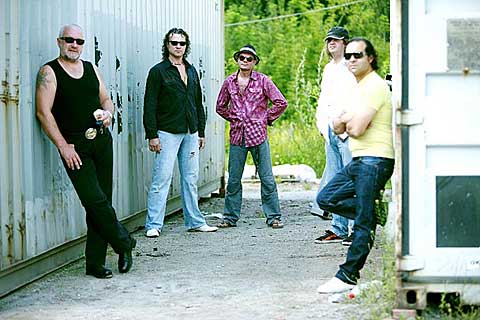
Leģions includes five veteran rock musicians, among them ex-Līvi singer Aivars Brīze and guitarist Tomass Kleins.

Details

Nekad nesaki nekad

Leģions

MICREC,  2008

MRCD 391

Track listing:

Tev vajag daudz

Suns

Liekot roku uz sirds

Šeit un tūlīt

Laiks ir laiks

Sēdies un brauc

Es gribu dzīvot

Pilnmēness

Notici sev

Kad brālis modīsies

Where to buy

Purchase Nekad nesaki nekad from BalticShop.

Note: Latvians Online receives a commission on purchases.

Egils Kaljo is an American-born Latvian from the New York area . Kaljo began listening to Latvian music as soon as he was able to put a record on a record player, and still has old Bellacord 78 rpm records lying around somewhere.

Deadline nears for ALA’s summer tours to Latvia

The March 30 deadline is fast approaching for persons who want to join the American Latvian Association’s (ALA) educational trips this summer to the homeland.

The ALA is organizing a total of four tours through the youth-oriented “Heritage Latvia” and the family-oriented “Hello, Latvia,” said Program Coordinator Anita Juberts.

“Heritage Latvia” is an English-language educational tour that “has been popular with young people of Latvian descent who do not speak Latvian, but are interested in seeing the homeland of their Latvian grandparents,” Juberts said in an e-mail. This year’s tour is set July 6-19 and includes visits to the International Folk Festival Baltica, which will be held in Rīga, Jelgava and other locations in the Zemgale region.

Young persons must be 13-15 years old at the time of the trip. Cost is USD 3,000 and includes air fare from Chicago or Newark to Rīga. Also included in the cost are all meals, transfers, accommodations, tickets to museums, concerts and other attractions.

“The tour includes day-long visits with students at two Latvian schools, as well as the opportunity to spend a day with the students in Rīga,” Juberts said. “For many, this is one of the highlights of the trip to Latvia.”

“Hello Latvia” is a bi-lingual tour for adults and families. It also runs July 6-19 and will include visits to the Baltica festival.

The trip includes a full-time English-speaking guide, transfers and transportation in Latvia, accommodations in high quality and comfortable hotels and guest houses, all breakfasts and most other meals (with the exception of those during free afternoons and evenings) as well as attendance at a number of concerts, Juberts said.

The tour will visit the Rundāle Palace, an operetta performance in Tukums, the seashore of the Gulf of Rīga, the Baltic Sea port cities of Ventspils and Liepāja, Latgale region and Daugavpils, and the scenic banks of the Daugava River.

“We have planned a stay in a new four-star hotel recently opened in the Vecgulbenes manor,” Juberts said. “The trip back to Rīga features cultural and scenic highlights of Vidzeme, including Vecpiebalga, Cēsis, Rujiena, Valmiera and Sigulda.”

The “Hello Latvia” trip costs USD 3,300 per person and includes round-trip airfare from Chicago or Newark to Rīga.

Each tour has a maximum of 20 participants and participation is on a first-come, first-served basis. For further information, contact Juberts at the ALA, +1 (301) 340-8719 or projekti@alausa.org. Information also is available on the ALA’s Web site, www.alausa.org.

The ALA also organizes the Latvian-language “Sveika, Latvija!” summer tour aimed at children finishing the eighth grade in Latvian schools in the United States.

Andris Straumanis is a special correspondent for and a co-founder of Latvians Online. From 2000–2012 he was editor of the website.

Saeima OKs five-party coalition government

Latvia’s parliament has approved a new five-party coalition government to be led by new Prime Minister Valdis Dombrovskis, who has promised to set the country’s economy back on course and restore the public’s trust in state institutions.

The Saeima on March 12 voted 67-21 to approve the Dombrovskis government.

The 37-year-old Dombrovskis replaces Ivars Godmanis as prime minister. The four-party coalition government led by Godmanis collapsed last month and he resigned Feb. 20.

Dombrovskis, a member of New Era (Jaunais laiks, or JL), is a former finance minister. Before being tapped to form the nation’s new government, Dombrovskis was serving as a member of the European Parliament.

Besides New Era, the new center-right government will include ministers supported by the People’s Party (Tautas partija, or TP), the Union of Greens and Farmers (Zaļo un zemnieku savienība, or ZZS), the Civil Union (Pilsoniskā savienība, or PS) and For Fatherland and Freedom / LNNK (Tēvzemei un Brīvībai / LNNK, or TB/LNNK). Shut out from the government is the First Party of Latvia (Latvijas Pirmā partija), whose members include Godmanis and the controversial former minister of transport, Ainārs Šlesers. The socialdemocratic Harmony Centre (Saskaņas centrs), which may have had hopes of being part of a center-left coalition government, also remains in the opposition, as does the pro-Moscow party For Human Rights in United Latvia (Par cilvēka tiesībām vienotā Latvijā).

The new Cabinet of Ministers includes:

  • Agriculture Minister Jānis Dūklavs (nonpartisan, delegated by ZZS), chairman of the board of the Piebalgas alus beer company.
  • Culture Minister Ints Dālderis (nonpartisan, delegated by TP), who is director of the Latvian National Symphony Orchestra.
  • Defense Minister Imants Lieģis (nonpartisan, delegated by PS), the British-born son of World War II exiles who most recently has served as ambassador to Spain. He also has been Latvia’s ambassador to the European Union’s Political and Security Committee and before that was ambassador to the NATO defense alliance.
  • Economics Minister Artis Kampars (JL), vice chairman of his party’s caucus in the Saeima.
  • Education and Science Minister Tatjana Koķe (ZZS), who continues in the post she had in the Godmanis goverment. She is one of two women in the new government.
  • Environment Minister Raimonds Vējonis (ZZS), who has held the job since 2002.
  • Finance Minister Einars Repše (JL), a former prime minister and former president of the Bank of Latvia.
  • Foreign Minister Māris Riekstiņš (TP), who continues in the post he had in the Godmanis government.
  • Health Minister Ivars Eglītis (TP), who continues in the post he had in the Godmanis government.
  • Interior Minister Linda Mūrniece (JL), a member of the Saeima and a former minister of defense. She is one of two women in the new government.
  • Justice Minister Mareks Segliņš (TP), who was interior minister under Godmanis.
  • Regional Development and Local Government Affairs Minister Edgars Zalāns (TP), who continues in the post he had in the Godmanis government. Zalāns was a leading candidate to replace Godmanis as prime minister, but instead Dombrovskis got the nod from President Valdis Zatlers.
  • Transport Minister Kaspars Gerhards (TB/LNNK), who was the economics minister under Godmanis.
  • Welfare Minister Uldis Augulis (ZZS), who most recently was the ministry’s parliamentary secretary.

The new government is smaller by two ministries. Gone are the Ministry of Children, Family and Integration Affairs as well as the Secretariat of the Special Assignments Minister for Electronic Government Affairs.

The Ministry of Children, Family and Integration Affairs, led by Ainars Baštiks (LPP), had just recently absorbed the Secretariat of the Special Assignments Minister for Social Integration Affairs, which was shut down at the end of 2008. The integration ministry, among other responsibilities, oversaw Latvia’s support for diaspora communities. The Dombrovskis government, according to its declaration, will promote the repatriation of ethnic Latvians and the return of Latvian residents living abroad.

Andris Straumanis is a special correspondent for and a co-founder of Latvians Online. From 2000–2012 he was editor of the website.