
The Briefing serves up salad bar of jazz-funk

Funny Thoughts

Jazz is not everyone’s cup of tea. Neither is funk. I know they aren’t mine. And yet, much like the clever combination of grapefruit (hate it) and cranberry juice (not a big fan), elements that might otherwise leave a bitter taste in your mouth can be brought together to make something that, for unknown reasons, cancel each other out and just seem right.

Acid jazz/rock/pop group The Briefing certainly strays from any established line of Latvian bands in what could probably be likened to a little musical awakening. It is a one-of-a-kind ensemble that twists jazz and funk and pop and rock, grooving to a truly different beat. The vocals sound neither unschooled nor overly primped, leaving the stereotypical vibrato voices of music academy graduates in the dust to make way for aggressive and sultry sounds that speak lyrics a bit grittier than those of their Baltic colleagues. This is your official memo: If you’re in the mood for an on-the-fence kind of safe-but-different, The Briefing’s debut album Funny Thoughts is something you should look into.

Taking in the awkward lip-biting monkey scene (by California street artist Nate Van Dyke) depicted on the cover of Funny Thoughts and the lyrical content of the all-English album, I wasn’t expecting or prepared to learn the members of The Briefing met while playing in a Liepāja church band. I’m not implying they can’t be religious, just that I don’t usually associate churches with street art or monkeys. This strange, in-your-face conglomerate consists of Kristīna Dobele (vocals), Raimonds Dobelis (bass), Sandis Volkovs (drums), Andris Kauliņš (keyboards) and Uldis Melka (guitar).

The Briefing has been making musical wonders since 2002. In addition to being named by the newspaper Diena as one of Latvia’s most progressive jazz bands, The Briefing has a hefty history of playing open-air festivals and has performed throughout the Baltic states and in Poland. The band’s witty lyrics and fascinating sounds show these guys have a propensity for groove.

An outright exclamation of “This is my world!” opens the album in a straightforward, to-the-point introduction—no holding back. Right away you hear an almost complete range of Dobele’s vocals, which are immediately established as unique, capable and willing to try things others wouldn’t. “My World” has a little “acid trip circus Bjork” moment that almost makes you want to turn and run, but it slips out of the trance before things get too weird. Like I said, there are many “wrong yet right” bits to come.

Moving further through the album you get witty lyrics and interesting ideas expressed with cynical poeticism, exclaiming such things as “Oh, how I hate their lies; they are so sticky.” Other lyrics are sassy, or even create a somewhat achy feeling, like with the track “Dry Skin,” which starts out very soft before moving into twangy, dreamlike sounds.

The album is a theme park of sounds. At times I feel like I’ve stumbled onto a Japanese pop-rock band cum Mario Brothers video game set (“Hurry Up!”), while other tracks put me in a fancy dinner club filled with tuxedos and the rustle of evening gowns (“Lullaby”).

The album truly does take getting used to and after countless hours of listening to it on loop, I am bothered by a good portion of it, but there are a few tracks that are little consolation prizes for sticking with the program. My favorites include “My World,” “Totally” and “Do I Know You,” all three of which carry certain clarity with the clean mess of drum, keyboard and guitar. Everything has its place, though it may not really sound like it. Some other tracks veer a bit more toward the side of “what is this?”, like the marginally dark “Funny Thoughts (Inside My Head),” wherein the narrator entertains thoughts of killing her boyfriend and the possible repercussions. All of these creepy thoughts are set to a background of bubblegum funk and psycho whistling. Then there are the galactic, tippy-toe sounds of “My Boo” and the plea to one’s lover to rethink leaving. The album’s wind-down strikes as a bit lazy compared to the preceding tracks, but the complete change of style is a small redeeming point.

Funny Thoughts deals a lot with inner and outer human turmoil, voicing bursting opinions and ideas not often heard from Latvians. It’s a real salad bar of emotions and ideas, and though it’s a bit difficult to get into and keep up with, I am at least able to appreciate the simple fact that The Briefing is different.
Description of image

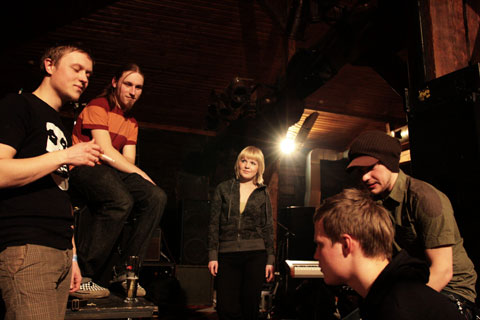
The Briefing, fronted by vocalist Kristīna Dobele, is a jazz-funk band from Liepāja, Latvia. (Publicity photo)

Details

Funny Thoughts

The Briefing

Antena,  2008

Track listing:

My World

Do I Know You

Totally

Hurry Up!

Funny Thoughts (Inside My Head)

In the Mood of Love

In the Mood of Love (Acoustic)

Second Chance

Dry Skin

My Boo

Lullaby

On the Web

The Briefing

The band’s official Web site. EN

Grasis, Sējāne offer twist on chamber music

Modern Chamber Music

Guitarist Kristaps Grasis has teamed up with flutist Liene Sējāne to record an album of contemporary chamber music, appropriately titled Modern Chamber Music. Classically, the term “chamber music” applies to works for smaller ensembles, so that it could be performed in a smaller “chamber.” Usually this refers to works like piano duets, string quartets and chamber choir pieces.

As a “modern” twist to this, Grasis and Sējāne, together with Wendel Biskup on bass and Mike Haarman on percussion, composed their own chamber music works and recorded them on this compact disc, released last year in Germany by ZYX Music.

Sējāne and Grasis have a long history together. Grasis, himself from Sweden and son of Latvian folk singer Austris Grasis, studied at the Royal College of Music and the Royal Swedish Academy of Music, both in Stockholm. On one of his first visits to Latvia in the 1980s, he met up with members of the Latvian rock group Pērkons, including keyboardist and principal composer Juris Kulakovs, and brothers Leons and Juris Sējāns. Grasis has released two albums, his debut Nangilima (1994) and Naktis/Nights (1996). He also collaborates with Latvian poet Juris Kronbergs on the album Vilks vienacis, which also features the One-Eye Wolf Band.

Liene Sējāne, originally from Latvia and the daughter of Pērkons guitarist Leons Sējāns, studied flute at the Latvian Academy of Music. Via Grasis’ collaborations with the members of Pērkons, she began working together with him and they released their first album, Parallels, in 2004. The album was published by Musica Baltica in Latvia and featured works by Béla Bartók, Astor Piazzolla and original material by Grasis.

The CD begins with the Sējāne-composed “Elve’s Song”, an almost Renaissance-like work, particularly with her flute work. In fact, it almost seems that the apostrophe is in the wrong place—and maybe it was meant to be “Elves’ Song”—since the work would fit quite nicely in any of the Lord of the Rings films. Or perhaps the song simply is about someone named Elve.

Following on that is the more modern “Fantasie: The Wolf and the Garden” by Grasis, with a more jazz-like influence and a more modern sound to it. “Night Turns to Day,” also by Grasis, features him on classical guitar in the introduction, joined later by the flute of Sējāne. The track presents the sounds of daybreak, as well as its calmness and periodic tension (perhaps from birds who are just beginning to awake).

The CD also features “The Traveller’s Suite”, a work by Grasis made up of the movements “The City,” “Promenade,” “At the Airport,” “Trainride” and “By the Sea.” “The City” features a minor key melody, performed by Sējāne, slightly reminding the listener of English folk songs. “Trainride” is also far more soothing than an actual train ride usually is, but otherwise the movement is a very tender work.

The packaging of the CD is very minimal, with no biographical information or any additional information about the works. However, one can visit the artists’ Web site for further information. Unfortunately, neither the packaging nor the Web site offer any further information on the works on the CD. It would have been interesting to read about what inspired the works and what the intended meaning is, but the listeners are left to guess about what the artists’ intentions were (which, perhaps, was the idea all along).

To give the CD the simple title of Modern Chamber Music is very ambitious, almost implying that this could be a new standard against which further chamber music works are judged against. The musicians are clearly talented and the CD is pleasant enough to listen to and well produced, but perhaps it still lacks something that would make it stand out among other such releases of modern instrumental works. Though certainly no expert on classical music myself, I probably would not call this “chamber music,” more simply instrumental music. More often than not, it reminds me of the progressive rock of the 1960s or 1970s, with the flute in particular recalling Jethro Tull (and maybe even early King Crimson). The music is all very soothing and probably would fit very well on a “smooth jazz” radio station. Certainly the guitar and flute combination is one that is rarely heard, so that itself is one reason the talented duo of Grasis and Sējāne is worth keeping an eye on.

Details

Modern Chamber Music

Sējāne & Grasis

ZYX Music,  2008

CLA 10058-2

On the Web

Liene Sējāne & Kristaps Grasis

The artists’ page on the Latvian social network draugiem.lv. LV

Modern Chamber Music

The official Web site for the musical project. EN

Where to buy

Purchase Modern Chamber Music from Amazon.com.

Note: Latvians Online receives a commission on purchases.

Egils Kaljo is an American-born Latvian from the New York area . Kaljo began listening to Latvian music as soon as he was able to put a record on a record player, and still has old Bellacord 78 rpm records lying around somewhere.

Veterans defy ban, march to Freedom Monument

An estimated 300 World War II veterans and their supporters have defied officials and marched to the Freedom Monument in downtown Rīga, Latvian media report.

The March 16 action, banned by Rīga city officials, saw the veterans and supporters parade—under heavy police protection—through the Old Town district from the Dome Square to the Freedom Monument. There they placed flowers at the base of the monument and sang patriotic songs.

The annual event commemorates veterans of the two Latvian Legion divisions that fought on the side of Nazi Germany against the Soviet Union. An estimated 100,000 Latvian men, most of them drafted, served in the German army. Opponents of the commemoration, including the Russian Foreign Ministry, say allowing it is glorification of Nazism.

City officials last week banned the gathering at the Freedom Monument, saying they feared unrest. Two counter-demonstrations also were banned. The Daugavas Vanagi veterans group, as well organizers of a counter-demonstration, appealed the city’s ruling, but the Administrative Court in a March 13 closed-door session upheld the ban.

Rīga Mayor Jānis Birks urged the marchers to be smart and not give in to provocation, according to a March 16 press release from his office. He warned that leftist extremism has grown in strength and that the city council and police are hard-pressed to deal with unrest like that seen after a large-scale anti-government demonstration on Jan. 13.

Latvian media reported that a few counter-demonstrators were arrested.

Latvian Legion commemoration

Watched by local media, veterans of the Latvian Legion and their supporters gather before a March 16 parade to the Freedom Monument in Rīga. (Photo by Arnis Gross)

Andris Straumanis is a special correspondent for and a co-founder of Latvians Online. From 2000–2012 he was editor of the website.