For Latvians abroad, this is another one of those odd years when the biggest celebration of the year, Midsummer or Jāņi, falls on a work day. While friends and relatives in Latvia will have time off to mark the June 24 holiday, many festivities abroad are scheduled for the weekend before or after.
But that does not mean any less of a good time. Latvians everywhere are gearing up for Jāņi, some as early as June 18, while others will wait for June 26.
Perhaps the biggest shindig outside Latvia is set for June 19 in the United Kingdom. The Midsummer celebration begins at 19:00 hours at the Latvian rest home Straumēni, Lilbourne Road, Catthorpe, Lutterworth.
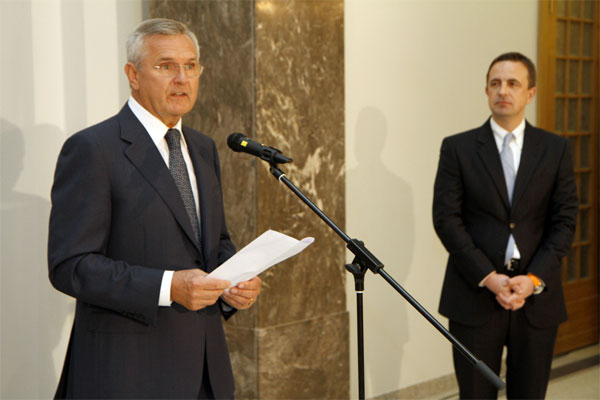
The organizers—the Daugavas Vanagu Fonds and Sabiedrība LTips—are bring over from Latvia some well-known musical talent: singers Ance Krauze and Normunds Rutulis, the band Labvēlīgais tips, and DJ Ufo. The evening will begin with an address by Uldis Reveliņš, head of the Daugavas Vanagu Fonds, followed by folk dance performances Kamoliņš and Londonas dejotāji, as well as singing by the folk ensemble Dūdalnieki. An open-air ball starts at 21:00 hours at the grand stage, while in the Swedish hall local performers Helmuts un Liene (Helmuts Feldmanis and Liene Lozberga from Mansfield) will offer 100 percent Latvian music.
Planning for the Jāņi celebration began last autumn, event organizer Pēteris Pētersons told Latvians Online via e-mail. He forecasts quite a crowd.
“It is difficult to say how many will come, but we are expecting 2,000-plus from all over England,” Pētersons said. “And we know that Jāņubērni also are coming from Ireland and Sweden.”
Based on experience, he expects that at least 85 percent of the participants will be recent immigrants to Great Britain.
Tickets for Straumēni celebration are GBP 8 for adults, GBP 4 for children to age 16 and pensioners. Admission on the day of the event will be GBP 12 for adults, GBP 6 for children to age 16 and pensioners. Participants who wish to camp in tents or caravans may do so for GBP 5. Tickets are available from www.wegottickets.com, as well as at Straumēni, the Daugavas Vanagu house in London or the Daugavas Vanagu house in Bradford. For further information about the event, visit draugiem.lv.
Other events planned around the world include, but are not limited to, the following (listings will be added as information arrives):
Australia and New Zealand
Even though winter is about to start in the Southern Hemipshere, Midsummer will be marked around Australia and in New Zealand in the coming week, according to the newspaper Latvietis.
In the Australian Capital Territory, Latvians will mark Jāņi at 14:00 hours June 26 in the Immanuel Lutheran Church, 37 Burnie St., Lyons.
The celebration in New South Wales is set for 13:00 hours June 19 in the Sydney Latvian House, 32 Parnell St., Strathfield. Performing will be the folk dance troupe Jautrais Pāris, the Sydney Latvian Society Saturday School, Jaunais vējš and Sidnejas Muzikanti.
In Queensland, the Midsummer festival gets going at 14:00 hours June 26 in the Brisbane Latvian House, 24 Church Ave., Buranda. Admission is AUD 10, but children get in free.
South Australia will mark Jāņi with a celebration beginning at 14:00 hours June 19 at Dzintari, Willson Drive, Normanville. The camp is south of Adelaide. For further information, contact Margota Puķīte at +61 (08) 8261 9931.
In Victoria, the Latvian school along with boy scouts and girl guides will celebrate Midsummer at 12:00 hours June 19 at the Tērvete camp, Old Lancefield Road, Kilmore.
Latvians in Western Australia will celebrate Jāņi at 14:00 hours June 20 at the Latvian Centre, 60 Clever Terrace, Belmont. To reserve a place for dinner, contact Rita Džonsone, +61 (8) 9349 2332
And in New Zealand, a Midsummer celebration is scheduled at 18:00 hours June 19 in the Latvian House in Christchurch. Admission is by donation and participants should bring food to share and items for the raffle.
Canada
In Alberta, the Edmonton Latvian Society Imanta has organized a Līgo celebration starting at 2 p.m. June 26 at Lake Isle. Activities are to include wreath-making, a pīrāgi tasting contest and musical entertainment. Dinner is planned for 5 p.m. and, weather permitting, a bonfire also is planned. Participants are asked to bring their old wreaths to throw in the fire. Admission is CAD 10 for adult members of Imanta, CAD 15 for non-members. For children ages 5-12, admission is CAD 5. Children younger than 5 will be admitted free. For further information and to arrange transportation, contact Ena Rudovics at +1 (780) 468-2728 or rudovics@telus.net, or Jim McDonald at +1 (780) 240-8257 or jrmcdonald@gmail.com.
On Līgo evening, June 23, a Midsummer program is planned at the Latvian Canadian Culture Centre, 4 Credit Union Dr., Toronto. The program begins at 6:30 p.m. and will include Jāņu siers, songs, games and dances. Performing will be Ainars Bumbieris and Laima Dimanta from Latvia, the folk dance group Daugaviņa, as well as local kokles players and singers. Admission is CAD 20 for adults, CAD 10 for youths. Dinner costs CAD 12. Reservations may be made by calling +1 (416) 759-4900.
At Camp Sidrabene in Ontario festivities begin at 7 p.m. June 26. Headlining the event is the country band Lauku Muzikanti from Latvia. Also performing will be the folk dance groups Dižais Dancis and Mēnestiņš, as well as the ensemble Dzirksts. Adult admission is CAD 25 and student admission is CAD 10. Children to age 12 will be admitted free. The camp is located at 5100 Appleby Line, Milton West, Ontario. For further information, visit www.sidrabene.org.
Europe
In Austria, a Jāņi celebration is scheduled to begin at 18:00 hours June 23 on Donauinsel in Vienna, according to the Latvian Society in Austria. Participants should bring food (including something for grilling) and beverages. For further information, contact Nils Silkalns at silkalns@gmail.com. In case of rain, participants will meet at the bar Centimeter, Stiftgasse 4, Vienna.
In Denmark, a Līgo celebration is scheduled from 16:00-19:30 hours June 19 in Kulturhuset “Kilden”, Nygårds Plads 31, Brøndby. Latvia’s ambassador to Denmark, Gints Jegermans, will address participants, followed by various presentations and entertainment. Latvian food and beer will be available, according to Ieve Grūbe of the Latvian Embassy. For further information, contact Anda Zarāne at anda.zarane@gmail.com or the Latvian Embassy by telephone at +45 39276000 or by e-mail at embassy.denmark@mfa.gov.lv.
Latvians in Georgia will celebrate Midsummer on June 27 in the Kumisi region southwest of Tbilisi. Participants will leave at 17:00 hours from the headquarters of the Ave Sol Latvian Society of Georgia, Tabukashvili St. 17, Tbilisi. Participation costs GEL 5. To make a reservation or for further information, contact the Ave Sol Latvian Society of Georgia at avesol@caucasus.net.
Several Jāņi celebrations are planned around Germany. At the Latvian Embassy, Reinerzstrasse 40/41, Berlin, festivities are schedled from 17:30-23:30 hours June 18. The Berlin Latvian Choir will perform, but līgotāji also will be able to participate in Latvian karaoke. Visitors are asked to bring food to share. For further information, contact Alda Bahls at Alda.Bahls@mfa.gov.lv.
In Bonn, a Midsummer celebration begins at 20:00 hours June 23 at Haus Annaberg, Annaberger Str. 400. For further information, visit www.annaberg.de.
In Hamburg, a Midsummer celebration is scheduled from 16:00 hours until midnight June 25 near Geesthacht along the Elbe River. Participants are asked to bring food to share. Further infomration is available by visiting www.hamburga-lv.de, the website of the Hamburg Latvian Society.
The Gasthof Riga in Hasbergen, southwest of Osnabrück, is offering a Jāņi celebration beginning at 18:00 hours June 26. The cost is EUR 12.50 per person. The restaurant and guest house is located at Osnabrücker Str. 21, Hasbergen. For further information, visit www.gasthof-riga.de.
In Italy, a small Jāņi celebration for invited guests is planned at the Latvian Embassy, Viale Liegi 42, Rome. No broader celebration is planned because of Latvia’s tight budget, according to Ģirts Jaunzems, first secretary. The embassy will be closed both June 23 and 24 for the holiday.
The Latvian Society of Norway will host a Midsummer celebration near Oslo beginning at 18:00 hours June 23 at Disen Gård, Kolderups vei 23, Kjelsås. Admission for members of the society will be NRK 50, but adults who are non-members will have to pay NRK 80. Participants should bring food to share and their own beer. For further information, contact Ilze Gehe at ilze_gehe@yahoo.no.
In Portugal, a Midsummer gathering is scheduled from 16:00-21:00 hours June 19 in the Latvian Embassy, Rua do Sacramento á Lapa 50, Lisbon. Participants are asked to bring food to share, such as cheese, sausages, sandwiches, cookies, fruits and vegetables, and beer. RSVP by contacting the embassy at +351 21 340 71 73 or embassy.portugal@mfa.gov.lv.
In Sweden, a Jāņi celebration for Latvians in the Goteborg area is scheduled to begin at 3 p.m. June 26. To RSVP and for further information, telephone +46 320 461 61 or +46 730 66 70 72.
In addition to the celebration in Straumēni, Latvians will celebrate in several smaller events around the United Kingdom. For example, Latvians in Nottingham will mark Midsummer with a celebration starting at 19:00 hours June 24. Participants are asked to bring jāņuzāles and food to share. The celebration will take place in the Daugavas Vanagi House, 1a Standhill Road, Carlton Hill, Nottingham.
United States
Latvians in Indiana will mark Midsummer along with Estonians and Lithuanians on June 26 in the Latvian Community Center, 1008 W. 64th St. Indianapolis. Doors are set to open at 4 p.m., according to Andrejs Kancs. Attractions will include a bounce house, games, a campfire and ethnic programs. Admission will be USD 5 per person, but children younger than 12 will be admitted free. Food and drinks will be available for purchase. For further information, visit indylv.com.
Latvians in Minnesota will mark Jāņi with a gathering at 7 p.m. June 23 in the Latvian Ev. Lutheran Church of Minneapolis and St. Paul, 3152 17th Ave. S., Minneapolis. The church choir will perform as part of the event sponsored by the Latvian Organization Association in Minnesota.
Latvian singer Viktors Lapčenoks, who was especially popular in the 1970s, will be the star attraction June 19 in New Jersey at the Latvian center Priedaine, 1017 State Route 33, Freehold. Festivities begin at 4 p.m. with the main concert scheduled at 6:30 p.m. Also performing will be the Philadelphia folk dance troupe Dzirkstele and the Namejs troupe from Washington, D.C., as well as the dance band Pēdējais vilciens. Admission is USD 30 for adults, USD 10 for youths ages 15-18 and free for children to age 15. For further information, visit priedaine.org.
In Ohio the Latvian Welfare Association Daugavas Vanagi has organized a Midsummer celebration starting at 5 p.m. June 26 in the Ottawa Point Reserved Picnic Area in the Brecksville Reservation of Cleveland Metroparks. A map in Adobe Acrobat format may be downloaded from Cleveland Metroparks. Admission is USD 5. Participants are asked to bring their own food.
A celebration in Texas is planned at 3 p.m. June 26 at a private residence by Lake Houston in Crosby, said Sandija Bayot of the Latvian consulate in Houston. Celebrations also are planned in Dallas and Austin, she added. For further information, contact Bayot by e-mail at sandija@swbell.net or by telepone at +1 (281) 932-9566.
In Wisconsin, the annual Jāņi celebration at the Latvian center Dievsēta, 19264 Bittersweet Ave., Warrens, begins the afternoon of June 19. Cost for the weekend, which includes food, is USD 25 per adult. For further information and to reserve accommodations, contact Zinta Pone at zintapone@yahoo.com or +1 (612) 751-1679, or Maija Stumbris at mstumbri@uwsp.edu or +1 (715) 457-6761. Some celebrants at Dievsēta might make their way to the Tupesis property on Locust Avenue east of Wilton, where another Midsummer event is scheduled June 19-20. For further information, visit www.tupesujani.com or contact organizers Aija Kīns at aijamara@me.com or +1 (773) 329-0309, or Ēriks Kīns at erik@millionlittlevoices.com or +1 (773) 619-1320.