


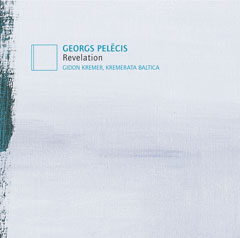
While browsing through the latest releases at the record store one day, I encountered a compact disc entitled Revelation and containing works by Latvian composer Georgs Pelēcis.
Though I had some minimal knowledge about the composer, I was not familiar with any of his works, so I decided to give the CD a try.
And I am glad I did, since the CD was quite a find: an enjoyable collection of modern classical music, as performed by Kremerata Baltica—one of the world’s best ensembles, made up entirely of young musicians from the Baltic states—and its founder and artistic director, distinguished violinist Gidon Kremer.
Pelēcis is a professor at the Latvian Academy of Music and the author of many texts on music. His symphonic music for the Roald Dahl story Jack and the Beanstalk was performed at the Royal Albert Hall in London. His work “Nevertheless” (included on the CD) has been performed in Rīga, Pittsburgh and San Francisco with dance choreography.
Modern classical music has a reputation, often deservedly, as harsh and very difficult to listen to, with jarring intervals and intentional avoidance of melodies and traditional elements. Though Pelēcis is certainly a modern composer, his music is not lacking in melodies and harmonies. As Pelēcis has an interest in ancient music, there are clear melodic elements of earlier eras, making for quite enjoyable listening.
The album begins with the fast paced “Revelation,” featuring not just Kremerata Baltica, but also countertenor Jānis Šipkēvics, Gabor Boldoczki on trumpet and Katia Skanavi playing the piano. As its title would indicate, the text of the work has Biblical elements to it. Šipkēvics’ soaring voice is nicely balanced with Skanavi’s piano playing, while the string ensemble provides a rapidly moving foundation to this celebratory piece. Pelēcis’ interest in ancient and Renaissance music shines through here, with many elements reminding the listener of the Baroque era, but certainly with a modern aspect to it.
Kremer is featured on the composition “Nevertheless,” a single-movement “double concerto” for violin, piano (once again performed by Skanavi) and orchestra. The piano part, very melancholic in its minor key setting and with an almost minimalistic feel to it, balances with Kremer’s violin, which performs a tender melody in a major key. The piano and violin seem to have a conversation with one another throughout the work, with the dialogue switching between the sadness of the piano and the more positive melody of the violin, though, at the end, the piano switches to a major key.
In a slightly different style, there is also the concerto-like work “Buena Riga,” a fantasy weaving together music in the style of Argentine composer Astor Piazzolla as well as Daugavpils-born Oscar Strock, who was of Jewish ancestry and known as the “King of the Tango” in Rīga, where he lived for many years. These disparate elements come together to form one of Pelēcis’ unique compositions, a slow, yet romantic and lyrical tango.
The collection finishes with a brief work (five minutes long) appropriately titled “The Last Song.” It is a slightly ominous work that expresses a sense of loss and regret, expressing the feelings and emotions that arise when someone does something for the last time, or if someone is bidding farewell to some place. Though the work is brief and certainly tinged with sadness, it is a particularly poignant way to finish the collection.
The CD booklet contains biographical information on both Pelēcis and Kremerata Baltica, as well as a brief notes on all of the compositions in English, German and French.
Though perhaps not as well known as others, Pelēcis has clearly established himself as one of the pre-eminent composers in Latvia. Thanks to the always dependable Kremerata Baltica and its visionary leader, this positive and beautiful music is given an excellent treatment and presentation.
Details
Revelation
Georgs Pelēcis / Gidon Kremer, Kremerata Baltica
Megadisc Classics, 2009
MDC 7797
Track listing:
Revelation
Nevertheless
Buena Riga (Astor Piazzolla, Oscar Strock and Me)
The Last Song
