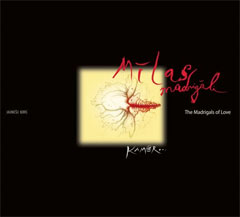
The youth choir Kamēr…, which with visionary conductor Māris Sirmais at the helm is almost consistently considered the best amateur choir in Latvia, celebrated its 20th anniversary in 2010. In addition to a sold-out performance at the Latvian National Opera, the choir released the compact disc Mīlas madrigāli, a collection of choir songs that in some manner are all related to the theme of love.
The album contains a broad range of styles, as well as works by both Latvian and international composers. Songs are also in many different languages: Latvian, French, English, German and Italian. The compositions also traverse the years—from the baroque of Claudio Monteverdi to today’s young Latvian composer Ēriks Ešenvalds.
Though the title of the CD references madrigals, not all of the compositions on the record could be classified in the classic definition of “madrigal.” Perhaps the title simply alludes to the fact that songs of love appear in many different forms.
Mīlas madrigāli features a trio of songs by Latvian composer Zigmārs Liepiņš, each of which is based on a folk song of another nation. They include “Es palikšu pie tevis,” based on a German folk song; “Lai tevi salasītu,” a Greek folk song; and “Padre Frančesko,” which has its origins in an Italian folksong. “Padre Frančesko” isn’t much of a song actually; it has more of a spoken quality about it, particularly the male voices. The song tells the tale of Father Francesco, who, for reasons known only to himself, tells an old woman to leave him alone, but a young maiden is warmly welcomed.
A song that actually is in the style of a madrigal is Marģeris Zariņš’s “Četrbalsīgs madrigāls par vecmodīgu tēmu.” Although it is a modern composition, the song is very much in the lyrical and musical style of an English madrigal from a previous century. Granted, I am by no means a musical scholar, but are traditional madrigals sung at such a rapid pace as this song? Certainly it shows the pure technical ability and talent of the choir members, but the breakneck pace doesn’t really fit what is meant to be a breezy, lilting English-style madrigal.
The two true treasures on this album—perhaps coincidentally, perhaps not—both involve composer Ešenvalds. “Mazā bilžu rāmīti” is a song arranged by Ešenvalds, but with music originally written by Renārs Kaupērs (of the popular Latvian group Prāta Vētra), and lyrics by beloved poet Imants Ziedonis. Kaupers also provides guest vocals on the song. The album closes with Ešenvalds’s “Tāls ceļš,” which for me is the highlight of the album. The romantic lyrics by Paulīna Bārda are provided equally romantic music by Ešenvalds, to make for one of the more engaging songs on the album.
However, one thing that strikes me about these performances is that they are perhaps a bit too perfect. The singers in Kamēr… are, to my knowledge, near professionals (some in Latvia would even be up for debating the choir’s “amateur” status), and certainly the recordings are precise and technically outstanding. Listening to the album, at some points I get the sense that it could use just a bit more emotion, since it seems to me that there is even a bit of restraint from the choir. Technical precision serves the choir well with the World Sun Songs collection and my favourite Kamēr… CD, Veltījumi, which is a collection of the choir’s interpretations of contemporary choir works by Latvian composers. At times it seems like there is something missing. I guess I was more expecting a CD that could be played during a candlelit dinner, or some similar romantic occasion. Mīlas madrigāli is not quite that.
Overall Mīlas madrigāli is enjoyable, particularly the works by Ešenvalds. Not only does conductor Sirmais possess a unique talent in choir conducting, but he has the ability to build a choir that achieves world wide renown. While perhaps this CD is not the most memorable by Kamēr…, it is still a notable collection by a stellar choir.
Details
Mīlas madrigāli
Kamēr…
Kamēr…, 2010
KCD 010
Track listing:
Robert Lucas Pearsall, “Lay a Garland”
Valts Pūce/William Shakespeare, “Sonets Nr. 12”
Pierre Passerau, “Il est bel et bon”
Renārs Kaupers/Imants Ziedonis, arrangement for choir by Ēriks Ešenvalds, “Mazā bilžu rāmītī”
Johann Hermann Schein, “Freue dich des Weibes deiner Jugend”
Kārlis Lācis/Jānis Elsbergs , “Mīlas madrigāls”
Marģeris Zariņš/Eriks Ādamsons, “Četrbalsīgs madrigāls par vecmodīgu tēmu”
Rihards Dubra/Ojārs Vācietis, “Rīt jau jābūt”
Claudio Monteverdi, “S’andasse Amor a caccia”
Juris Vaivods/Dzintars Sodums, “Dzintara Soduma Piektais Alšvangas madrigāls”
Carlo Gesualdo, “Itene o miei sospiri”
Arturs Maskats/Ojārs Vācietis, “Es tevi mīlēšu”
Arturs Maskats/Klāvs Elsbergs, “Madrigāls (klusā daba) ar lāčiem”
John Farmer, “Fair Phillis I Saw”
Zigmārs Liepiņš, “Es palikšu pie tevis”
Zigmārs Liepiņš, “Lai tevi salasītu”
Zigmārs Liepiņš, “Padre Frančesko”
Ēriks Ešenvalds/Paulīna Bārda, “Tāls ceļš”