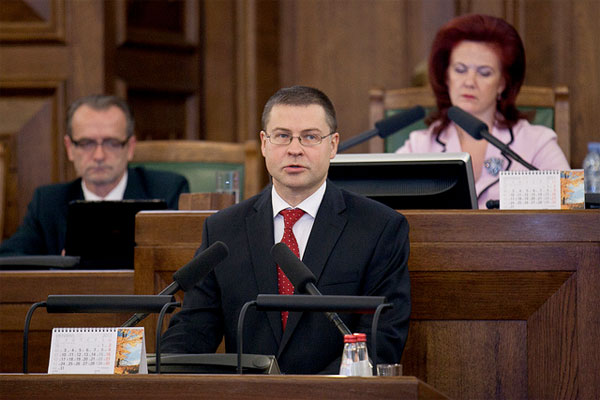
Saeima confirms new government

Valdis Dombrovskis uzrunā Saeimu

Prime Minister Valdis Dombrovskis addresses the Saeima before its vote to confirm Latvia’s new government. The parliament on a 57-38 vote Oct. 25 supported the three-party coalition offered by Dombrovskis. (Photo by Ernests Dinka, courtesy of the Saeima Chancellery)

Latvia’s new three-party coalition government, which will be headed by current Prime Minister Valdis Dombrovskis, has been confirmed by the country’s parliament.

After about two hours of debate Oct. 25, the Latvian parliament confirmed the government on a 57-38 vote. While the new government seemed assured of at least 56 votes, it earned one more when Ingmārs Līdaka, a member of the Union of Greens and Farmers (Zaļo un Zemnieku savienība, or ZZS), appeared to break from his caucus to support Dombrovskis.

However, according to Latvian media reports, Līdaka apparently voted in favor by mistake. ZZS head Augusts Brigmanis told the LETA news agency that Līdaka tried to correct the error after the vote was already recorded.

Also backing the new government were all MPs from Dombrovskis’ centrist party Unity (Vienotība), the Zatlers Reform Party (Zatlera Reformu partija, or ZRP) and the right-wing National Alliance (Nacionālā apvienība “Visu Latvijai!” – “Tēvzemei un Brīvībai/LNNK”). The three parties makes up the new coalition government. An additional six votes came from former ZRP members who broke with the party to create an independent caucus.

The 38 votes against the new government came as expected from MPs representing the centre-left and Russian-oriented Harmony Centre (Saskaņas Centrs) and the conservative ZZS.

Three MPs—Viktors Jakovļevs of Harmony Centre as well as Ilona Jurševska and Kārlis Seržants of the Union of Greens and Farmers—did not vote.

The new government includes:

  • Justice Minister Gaidis Bērziņš (National Alliance), 41, a practicing lawyer and a lecturer in law at the University of Latvia. Bērziņš was the minister of justice from 2006-2009.
  • Health Minister Ingrīda Circene (Unity), 54, who previously served in the post during former Prime Minister Einars Repše’s government from 2002-2004.
  • Culture Minister Žaneta Jaunzeme-Grende (National Alliance), 47, former chairperson of the Latvian Chamber of Commerce and Industry.
  • Interior Minister Rihards Kozlovskis (ZRP), 42, who currently is an attorney for SIA BBF Consulting.
  • Education Minister Robert Ķīlis (ZRP), 43, an associate professor of economics anthropology at the Stockholm School of Economics in Rīga.
  • Defense Minister Artis Pabriks (Unity), 45, who will continue in the position from the previous government.
  • Economics Minister Daniels Pavļuts (ZRP), 35, who currently heads corporate relations for the Latvian branch of the Swedish-owned bank Swedbank.
  • Foreign Minister Edgars Rinkēvičš (ZRP), 38. He previously was chief-of-staff for former President Valdis Zatlers.
  • Transportation Minister Aivis Ronis, 43, a former diplomat who has been deemed nonpartisan. Currently president of the Latvian Association of Private Banks, Ronis has served in various diplomatic posts and was foreign minister in 2010.
  • Edmunds Sprūdžs (ZRP), 31, minister for environmental protection and regional development. Sprūdžs originally was ZRP’s candidate for prime minister.
  • Agriculture Minister Laimdota Straujuma (Unity), 60, who currently is an assistant state secretary in the Ministry for Environmental Protection and Regional Development.
  • Finance Minister Andris Vilks (Unity), 48, who will continue in the job from the previous government.
  • Welfare Minister Ilze Vinķele (Unity), 39, who has served as the Ministry of Finance’s parliamentary secretary and currently is pursuing a doctorate in political science at the University of Latvia.

Confirmation of the new government followed the Sept. 17 special parliamentary election, which was called after Latvian voters overwhelmingly approved a July referendum to dissolve the 10th Saeima. The 11th Saiema began work Oct. 17.

Andris Straumanis is a special correspondent for and a co-founder of Latvians Online. From 2000–2012 he was editor of the website.

President invites Dombrovskis to form Latvia’s next government

Latvian President Andris Bērziņš has nominated current Prime Minister Valdis Dombrovskis to form the country’s next government, but he also suggested that all five political parties elected to the Saeima be included the coalition.

Bērziņš made the invitation on Oct. 19 after meeting with representatives of all parties, according to an announcement from the president’s press office.

The president’s invitation follows weeks of unsuccessful negotiations between the parties. The Zatlers Reform Party (Zatlera Reformu partija, or ZRP), Unity (Vienotība) and the National Alliance (Nacionālā apvienība “Visu Latvijai!” – “Tēvzemei un Brīvībai/LNNK”) announced Oct. 14 that they had come to terms on a three-party coalition that would be backed by 56 of the parliament’s 100 members. But two days later six ZRP MPs broke away from the party, throwing the solidity of the coalition in doubt.

Efforts to include the other two parties have run into objections. When the reformist ZRP at first tried to create a government with just the center-left Harmony Centre (Saskaņas Centrs), many voters protested that Harmony Centre’s pro-Russian stance cast doubt on its loyalty to Latvia. Efforts at broadening the coalition to include the centrist Unity and the right-wing National Alliance ran into trouble, too. The National Alliance has said it would not work with Harmony Centre. Meanwhile, ZRP leader and ex-president Valdis Zatlers has said his party would not work with the conservative Union of Greens and Farmers (Zaļo un Zemnieku savienība), which is seen as controlled by Latvia’s oligarchs.

Even a last-minute effort to strengthen the three-party coalition by inviting Jānis Duklavs of the Greens and Farmers to take the minister of agriculture’s portfolio in the new government—which would have earned the backing of his party’s 13 seats in the Saeima—was dropped after ZRP objected.

While Klāvs Olšteins and the other five MPs who split from Zatlers’ party have said they would back the Oct. 14 coalition model, the president has expressed his doubts.

Nontheless, Bērziņš said in his Oct. 19 announcement, the three-party coalition appears to be the only one that realistically could form the new government.

At the same time, the president’s invitation to Dombrovskis does not prevent the parties from working on an improved—and broader—model, according to the press office announcement.

“The first serious test of the would-be coalition’s ability to take action will be the vote on the state budget for 2012,” the president said, “which cannot become an experiment with the state and threaten the state’s international agreements.”

Once a coalition is assembled, Dombrovskis will have to present it to the Saeima for confirmation.

The new Saeima, elected Sept. 17, began work Oct. 17. Zatlers, who campaigned on ridding the parliament of the influence of oligarchs and on reforming government and politics, suffered his first defeat, losing in his bid to become speaker of the Saeima. Unity’s Solvita Āboltiņa, who served as speaker in the previous Saeima, was elected instead.

Andris Straumanis is a special correspondent for and a co-founder of Latvians Online. From 2000–2012 he was editor of the website.

Proposed coalition begins to fray as 6 ZRP deputies turn independent

Just when it seemed Latvia’s political world had reached some sort of equilibrium with news that agreement has been reached on a new coalition government, six newly elected MPs from the Zatlers Reform Party (ZRP) announced Oct. 16 that they turning independent.

The six—Klāvs Olšteins, Elīna Siliņa, Gunārs Rusiņš, Jānis Upenieks, Viktors Valainis and Jānis Junkurs—told Latvian media they are unhappy with what they see as “undemocratic” maneuvering within ZRP, the party headed by ex-President Valdis Zatlers.

Olšteins is the apparent leader of the breakaway group and for some there had been talk in ZRP of kicking him out for his “destructive work” in the party, ZRP spokeswoman Daiga Holma said in a statement.

While politicians were scrambling to salvage the proposed coalition, the breakway MPs demanded that they get to name two of the ministers in the new government, according to media reports. Specifically, they want to pick the ministers of interior and of transportation.

ZRP announced Oct. 14 that it had reached agreement with Unity (Vienotība) and the National Alliance (Nacionālā apvienība “Visu Latvijai!” – “Tēvzemei un Brīvībai/LNNK”) to create a new government to be headed by current Prime Minister Valdis Dombrovskis.

Under the coalition agreement, the minister of the interior would be named by ZRP while the transportation minister would have been non-partisan. According to Holma, Olšteins has declared that he wants to be the interior minister.

The three parties in the coalition would have controlled 56 out of the 100 seats in the Saeima, but with the six deputies announcing that they are leaving it could mean that the coalition could count on only half of MPs to side with it.

The new parliament, elected Sept. 17, is set to meet for the first time on Oct. 17. Under the Latvian constitution, Latvia’s president invites a prime ministerial candidate to form the new government, which must then be confirmed by the Saeima.