Latvia heads into 2005 hockey championship

Latvia faces heavily favoured Canada on the opening day of this year’s International Ice Hockey Federation World Championships scheduled in Vienna and Innsbruck, Austria. Big hockey, as they call it in Latvia, is back. Thousands of fans will be in attendance with many more tuned in back home.

Latvia is in Group B and will play its games in Innsbruck. In addition to facing Canada in the preliminary round, Latvia will play the United States on May 3 and Slovenia on May 5. The top three teams from each of four groups advance to the qualification round to battle for quarter-final spots. The last place teams in each group play in the relegation round with the bottom two demoted from the top division next year.

This year the pressure is off Latvia. Win or lose, as host nation to the 2006 World Hockey Championships, Latvia is automatically seeded in next year‘s round. All it has to do is finish building the new Multihalle in Rīga that will house 12,500 fans and reconfigure the existing Skonto Olympic Hall in Rīga for 6,500 hockey fans.

While Latvia has on occasion won against hockey’s superpowers, the game against Slovenia will probably be key. Slovenia is competing in the top tier for the first time and Latvia should not take the game lightly. In February, Slovenia gave Latvia a run for its money at the 2006 Olympic Qualifications in Rīga. Latvia was only able to post a 2-1 victory. If the Slovenes lose against Canada and the United States, then a Latvian victory against Slovenia will send Latvia to the qualification round and a guaranteed ninth to 12th place finish even if it loses against the two North American teams.

Latvia’s national team is anchored by National Hockey League players Arturs Irbe and Kārlis Skrastiņš. It also continues to rely on a core of aging veterans who play in various European leagues even though a generation of younger players like Jānis Sprukts, Armands Bērziņš, Agris Saviels, Edgars Masaļskis, Miķelis Rēdlihs, Mārtiņš Cipulis, Juris Ozols, Vents Feldmanis and Juris Štāls are making their mark. A number of newcomers are also fighting for spots in the lineup. They include 20-year-old goaltender Mārtiņš Raitums from Latvian league champions Rīga 2000, who had an excellent showing against the NHL Stars during their December swing through Rīga; Māris Ziediņš, a former college star now playing pro in South Carolina with the East Coast Hockey League’s Greenville Grrrowl, and teenager Guntis Galviņš, who also is from Rīga 2000. Edijs Brahmanis from the Latvian Army team ASK/Ogre did not make it and others will also be cut this week.

Leonīds Berešnevs is back as head coach in his first World Championship since 1999 taking over from Swede Kurt Lindstrom. He is assisted by Harijs Vitoliņš, a former national team captain who still plays with Thurgau in the Swiss B league and is the third generation from the Vītoliņš family dynasty to play hockey.

Goaltending is solid with Irbe and Masaļskis who now plays with Dukla in the Czech Republic. Either Raitums or Dimitrijs Žabotinskis from Liepājas Metalurgs will tag along as their understudy.

While its defense is experienced, the problem for the Latvian team is with the lack of scoring punch. Latvians tend to play a European style game working the puck around the outside looking for the picture perfect pass to set up a goal. The power play has been anemic.

So far results from exhibition games prior to Austria have been predictable. Latvia lost 2-4 and 0-3 in to the powerful Slovak team but picked up a 4-2 victory and 2-2 tie against Germany, which is seeded eighth in international rankings against Latvia’s 10th. Latvia on April 25 lost to Canada 1-3 in Rīga after Jānis Sprukts scored the opening goal. Latvia will play a final exhibition game in Finland on April 27.

In the cards for this year’s World Championship is a new look for the Latvian national team. The jerseys the team has worn for the last 10 years are being retired and the team will be suited in new home and away uniforms featuring Latvia’s coat of arms.
Porter brew has long history in Latvia

The dark-coloured beer known as a porter, although not a common drink among Latvians, nonetheless has a long history. The careful reader of Augusts Deglavs’ novel Rīga, which describes the social and cultural milieu of the first Latvian Awakening in the second part of the 19th century, will come across a passage where Pēteris Krauklītis is working the bar at his Germanicized uncle Georgs Rabemanis’ party. Krauklītis has to unload boxes of beer and properly sort the bottles: porters, Muncheners, Kulmbachers, bock beers and others.

Today, the Aldaris Brewery of Rīga makes a such a beer—Aldaris Porteris. Renowned British beer expert and author Michael Jackson describes Aldaris Porteris as a “liquorice-tinged interpretation” of a “strong Baltic Porter.” He rates it between two and three stars out of four, a rating surpassed only by a couple of beers from the Baltic States.

Cēsu Alus, Latvia’s oldest brewery, also has resumed brewing a porter, according to the company’s Web site.

Aldaris has been brewing its Porteris continually since pre-war independence days, said brewmaster Valdis Ilguns. Aldaris was established in 1937 when the former Waldschlosschen brewery founded in 1865 but dormant since the outbreak of World War I was revived. It too was brewing a porter at the turn of the 20th century.

Aldaris is Latvia’s biggest brewer and is owned by Baltic Beverages Holdings, which in turn is a joint venture of Scottish & Newcastle the United Kingdom and Carlsberg of Denmark.

Aldaris Porteris can trace its roots back to England. In the early 18th century at the start of the Industrial Revolution, porters were introduced and brewed in London, quickly becoming the most popular beer of the time. Porters were one of the first beers brewed by emerging mechanized breweries. According to legend, writes Jackson in The Beer Companion, “the new type of beer became popular with porters in nearby produce markets, and this is one theory as to how it acquired its… name.”

Porters were exported to Ireland. Locally brewed versions were dryer and darker and evolved into Irish stouts with today’s Guinness Stout popular around the world. From the 1780s porters were also exported to ports around the Baltic Sea, but they were brewed stronger to survive the longer sea voyage. One of the first shippers from London was founded by a Belgian named Le Coq.

Strong porter became popular in the court of Empress Catherine II, who ruled from 1762-1796, and it acquired the name Imperial Russian Stout. The Courage brewery in England, now part of the Scottish & Newcastle brewing group, has brewed an Imperial Russian Stout for more than 200 years and still does so periodically, albeit rarely, as a vintage dated brew. Imperial Russian Stouts are also popular with some of today’s microbrewers in North America and England (for example, Old Rasputin Russian Imperial Stout from California’s North Coast Brewery and Samuel Smith’s interpretation from England).

Local variations popped up around the Baltic with the style retaining the name porter. A Scottish settler Carnegie founded a brewery in Gothenburg, Sweden, in the early 19th century. Now under the name of Pripps, it still brews Carnegie Porter. Russian Nikolai Sinebrychoff founded a brewery in Finland in 1819. It too brews Koff Porter today. Denmark’s Carlsberg produces Carls Porter. The label also carries the designation Imperial Stout, cementing the connection.

Closer to home we have Utenas Porteris from Lithuania and Saku Porter from Estonia. Other Baltic porters can be found in Poland and St. Petersburg. But Aldaris and Cēsu Alus brew the only Latvian porters today.

In the early 20th century the British shipper Le Coq acquired the Tivoli brewery in Tartu, Estonia. It was adapted to brew porter in order to circumvent Czarist import duties and started shipping Imperial Extra Double Stout in 1912. The brewery survived the Soviet era, but had stopped brewing porter in 1969. Today it has reverted to the name A. Le Coq and the porter tradition has been revived. Coincidentally A. Le Coq owns Cēsu Alus, which traces its roots back to the estate brewery at Cēsis castle, first mentioned in 1590. A. Le Coq in turn is owned by the Finnish brewing group OLVI Oy. Today’s Harvey & Son brewery in Sussex, England, plays homage to the Estonian connection and brews a vintage dated Imperial Russian Stout embossed with a facsimile label of the original brew. “Brewed in Dorpat” (Dorpat is the German name for Tartu) is clearly visible on the label.

The dark colour of Aldaris Porteris is produced by 10-15 percent dark malt and 5 percent roasted malt, Ilguns explained. It weighs in at approximately 7 percent alcohol by volume, a bit lighter than Imperial Stouts which can hit 10 percent, and the sweetness is due to unfermented sugars. The recipe has changed little over time although hop pellets are now used rather than hop cones and the maturation process has been shortened. Like other Baltic porters, Aldaris Porteris is brewed with bottom-fermenting rather than the top-fermenting yeasts typically used in porters and stouts from the British Isles and elsewhere. With their high alcohol content, Imperial stouts can be laid down and some can be consumed even after 10 years. Similarly an Aldaris Porteris kept in a cool cellar can be poured a year or two later.

Aldaris Porteris is a big brew, a winter warmer that is somewhat out of place on a hot summer’s day. Drink it in a brandy snifter and let it warm up a touch so that its complex flavours open up to the palate.

You can find Aldaris Porteris in many markets in the United States. In Canada, it’s usually in stock at the Latvian Canadian Cultural Centre in Toronto. While it’s a niche product and represents only 2-3 percent of Aldaris production, Ilguns said Porteris is a unique style that has its fans.

Aldaris brewery

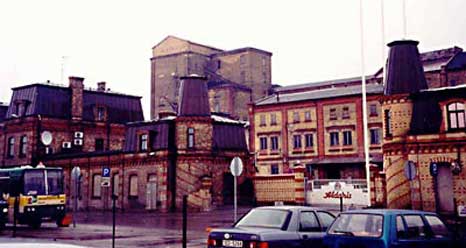
The Aldaris Brewery in Rīga sports a brewing tower of traditional design in the background. Raw materials aided by gravity work their way through various stages of brewing from the top ending up with the finished product at the bottom. (Photo by Viesturs Zariņš)

Aldaris Porteris

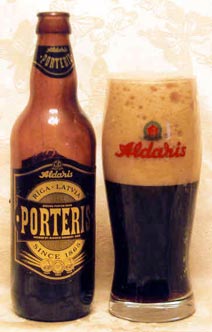
The porter made by the Aldaris brewery in Rīga is described by one expert as a “liquorice-tinged interpretation” of a strong Baltic porter. (Photo by Viesturs Zariņš)

Latvia’s lone paddler in the Olympics

Dagnis Vinogradovs is the lone paddler on the Latvian Olympic team heading for Athens. Vinogradovs, or “Vīnoga” as he is nicknamed, made the cut in May with a sixth-place finish in the European sprint canoe and kayak qualifications in Poznan, Poland. In Athens, he will race solo canoe (C-1) in the 500- and 1,000-metre competitions.

The 23-year-old athlete from Limbaži, a student at the Academy of Sports Education in Latvia, has been paddling for almost 10 years. He competed in several European and World junior championships before breaking into the adult circuit in 2002. During the 33rd International Canoe Federation’s Flatwater World Championships held in September in Gainesville, Ga., in the United States, Vinogradovs finished fourth in the B Final for the C-1 1,000-metre race. And on July 24 he placed first in the C-1 1,000-metre race in the European Under 23 (U-23) Championships in Poland.

“It is difficult to predict how well Dagnis will do at Athens,” said Viktors Zujevs, an assistant coach at the Latvian national paddling centre in Limbaži. “Dagnis is still young and inconsistent. He needs to mature in a sport where paddlers often compete well into their thirties.

“He has a lot of promise,” Zujevs continued. “A couple of years ago he beat world champion German paddler Andreas Ditmer in a race. On other occasions he has missed the finals. Dagnis could bring home a medal from Athens or just as easily end up empty-handed.”

Vinogradovs said he is mentally ready for the Olympics.

“Even though these will be my first Olympic games,” he said in an e-mail. “I don’t feel that they will be any different from the last World Championships or European Championships because there, too, it was a battle for life and death.”

To relax after the long and grueling hours spent training, Vinogradovs is trying his hand at fishing and just finished reading a crime novel.

In European countries like Germany, Hungary and Poland, sprint canoeing and kayaking is a huge spectator sport. Crowds of up to 50,000 attend international competitions in Hungary and ranked paddlers are national celebrities. While Canadian paddlers, and particularly women, have brought home medals, the sport is relatively unknown in Canada and even more so in the United States. It is often confused with whitewater paddling, which is a separate sport and Olympic discipline.

Olympic sprint canoe and kayak events include the 500- and 1,000-metre races, with the 200-metre added in national and world championships. Canoers and kayakers, or C-boaters and K-boaters as they are often called, race in solo (C-1 and K-1), two-person (C-2 and K-2) or four-person (C-4 and K-4) boats. The four-person canoe is not raced in the Olympics.

Sprint canoes and kayaks are built for speed. They are sleek and light. The K-1 or solo kayak weighs only 12 kilograms, while the C-1 or solo canoe in which inogradovs races weighs 16 kilograms. Even the K-4 is relatively light at 30 kilograms. Expect to see top Olympic times for 1,000-metre races of around 3’50” for the C-1 and 3’30” for the K-1.

Canoeing differs from kayaking. A canoer is on one knee and paddles to one side. A kayaker sits and paddles on both sides with a double bladed paddle. The canoe has no steering mechanism and is controlled through paddling technique, but a kayak has a rudder with foot controls.

Both have open cockpits. If a paddler tips, they get thrown out into the water and the race is over for them. Forget the Eskimo roll in sprint kayaking or canoeing.

Both men and women kayak, but only men canoe at the Olympics and most international competitions. While women canoers are common in Canada and only recently have been accepted in the United States, they are prevented from competing internationally by entrenched chauvinistic attitudes, particularly in the national federations of the big European paddling powers.

Sprint canoe and kayak traditions in Latvia date back to the Soviet occupation. Paddlers from Latvia who competed internationally under the Soviet banner include Aleksandrs Afdejevs, Juris Runcis and Sergejs Zaļupe. A former Soviet era world champion kayaker is Vilnis Baltiņš, the current president of the Latvian Olympic Committee. The most successful Olympic canoer from Latvia is Ivans Klementjevs, who won a gold for the Soviet Union in Seoul in 1998 and then followed with medals for Latvia—a silver in Barcelona in 1992 and a bronze in Atlanta in 1996.

About 500 canoers and kayakers are active in Latvia today, and of those 20-30 are competitive internationally. Clubs are found in Rīga, Ventspils, Jelgava, Saldus (Brocēni), Limbaži and Jūrmala. The national team is based and trains in Limbaži, 80 kilometres northeast of Rīga in Vidzeme province. Genadijs Zujevs is head coach and he will accompany Vinogradovs to Athens.

Vinogradovs is scheduled to compete Aug. 23-28 at the Schinias Olympic Rowing and Canoeing Centre east of Athens near Marathon.

K-4 kayak crew hopefuls Ronalds Stālmanis, Mārtiņš Upītis, Kristaps Zaļupe un Arnis Lazdinieks did not qualify for this summer’s games despite posting good results in international competitions the last two years.

Getting canoe weighed

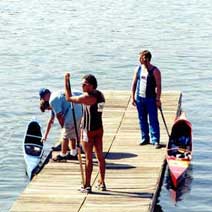
Dagnis Vinogradovs (center) waits while his canoe is weighed in after the B final of the 2003 World Championships in Gainesville, Ga. (Photo by Viesturs Zariņš)