Latvia’s hockey history spans a century

The hockey world is coming to Latvia this May for the International Ice Hockey Federation’s (IIHF) 2006 World Championships. The event is sure to be a highlight of Latvia’s nearly 100-year history with the game of hockey.

The first recorded game in Latvia occurred Feb.15, 1909, between the Union and Strēlnieka Dārzs teams, according to histories of Latvian hockey. However, “Canadian hockey,” as it was called, did not take root until the 1930s when it nudged out bandy, a sport similar to field hockey but played on ice with a ball. Bandy is still played today in Scandinavia and a few places like Minnesota in the United States.

In 1929, Rīgas Strādnieku Sports un Sargs, or Rīga SSS, a sports club affiliated with Latvian Social Democratic Labor Party, switched from playing bandy to hockey. The first official ice hockey game was played on Feb. 15, 1930, between the Rīga Centre and Konigsberg chapters. The Rīga squad included Bruno Kalniņš, a member of Latvia’s parliament and in later years a venerable Latvian political exile in Sweden.

The Latvian Winter Sports Federation threw its support behind hockey in 1930 and Latvia was admitted to the IIHF in 1931. Local hockey teams included Universitas Sports, Wanderer, Union, Armijas Sporta Klubs from Riga and Olimpiade from Liepåja. The Social Democrats played separately until they were shut down by the regime of Kārlis Ulmanis. Rather than set league play, teams competed in shorter tournaments.

Latvia participated in the European Championships for the first time in 1932 and a year later made its debut at the World Championships in Prague. At the 1935 championships in Davos, Switzerland, Latvia met Canada, losing 0-14. The teams met again at the 1936 Winter Olympics in Garmisch-Partenkirchen with Latvia losing 0-11. Latvia played the United States in 1938 and lost by a respectable 0-1. Exhibition games were played in various countries often on stopovers to and from the World Championships. All players were amateurs. Professionals were unable to compete until 1976.

Hockey in Latvia was played on flooded outdoor surfaces and occasionally on lakes. Both were dependent on the weather, which could quickly swing from a deep freeze to a thaw. More than a few games were played in slushy conditions or had to be canceled. In those days there were no sideboards, which were introduced only after players got tired of searching for the puck in snow banks. Artificial lighting, which allowed night games, was added by the Army club at its rink in 1934. The first permanent outdoor ice rink was constructed in Latvia at the Daugava stadium in Rīga in 1950. The facility had stands for 4,500 spectators. Artificial ice was installed in 1960. Even though indoor rinks were already being built in Canada in the latter part of the 19th century, Latvia’s first indoor rink, the Rīga Sports Palace, only opened its doors in 1970.

In 1939, Latvia hired Canadian hockey player and physical education graduate Larry Marsh to coach its players for a month. Marsh at that time played in Budapest, Hungary.

The outbreak of World War II did not shut down hockey. The Soviets disbanded existing teams but formed new one,s including Rīga Dinamo. The old teams were re-established with the arrival of the Germans but new teams with distinctive Latvian names also sprung up: Ledus Lāči, Daugavieši, Skrejošais Holandietis and Ledus Simfonija. They continued as best as they could in war-time conditions.

No hockey was played from 1944-45. A year later, a Soviet Latvian all-star team visited Lithuania flying down to Kaunas in a rickety Douglas bomber. The return trip by land was no less eventful as the team was jailed for three hours in a small Lithuanian town.

Next season Rīga Dinamo started in the Soviet league and, on the strength of its pre-war Latvian players, continued to play in the top tier until the 1958-59 season. In 1948 Harijs Mellups was the best goaltender in the Soviet Union and was on the national team. RVR (Rīgas Vagonu Rūpniecība), Spartaks, VEF and Latvijas Berzs were some of the other junior and senior teams that played either locally or regionally during the Soviet era.

Prior to the war, bandy rather than ice hockey was played in the Soviet Union. After the war, Soviet authorities decided to switch to hockey, which unlike bandy was a recognized Olympic sport. A fact-finding trip to Rīga was organized for an official. He returned with Canadian ice hockey rules translated for him into Russian and written out by hand. There is some truth to claims that Latvia introduced hockey to Russia.

Other pre-war players ended up in Germany. Between 1946 and 1949 up to eight played on the Augsburg team nick-named “Letten Mannschaft” (Latvian Crew). They led the team winning the Southern German championships in 1948 before the players dispersed. Rūdolfs Veide went on to have a long and successful career as a player and coach in West Germany, even playing on the national team in 1953-54. His son, Ēriks, repeated 20 years later.

Hockey in Latvia languished in the late 1950s and 1960s. The top team, Riga Dinamo, renamed Daugava between 1949 and 1967, was unable to escape the second-tier Soviet league. Along the way there were exhibition games in Eastern Europe and visits from the Finnish workers all-star team, Duklu and Kladno from Czechoslovakia, the Eastern Hockey League all-stars from the United States in 1964 and a later visit to Canada in 1978-79 to play top junior teams. Of note are 1967 outdoor games in Novosibirsk and Ustjkamenogorsk played in termperatures of -37 degrees and -40 degrees Celsius, respectively.

Things changed with the arrival in 1968-69 of Soviet coach Viktor Tikhonov, then at the start of his legendary coaching career. A disciplinarian to some and tyrant to others, he was an innovator and strong on physical conditioning. By 1973-74 Rīga Dinamo was back in the top tier.

RVR opened a hockey school in 1967 and one of its students, Helmuts Balderis, emerged as a superstar. He was nick-named the Electric Train and played for Dinamo. He was moved to Moscow’s Central Red Army team along with Tikhonov in 1977. Balderis starred for the Soviets, playing in the 1976 Canada Cup, five World Championships and winning an Olympic silver medal at Lake Placid. He won the Soviet scoring championship twice.

Balderis rebelled against Tikhonov’s authoritarian regime and constant abuse. In 1975 he stormed off the bench after telling Tikhonov to get stuffed. There were later incidents. Tikhonov retaliated by making sure Balderis did not get named to the 1976 and 1984 Soviet Olympic squad,s depriving Balderis of gold medals at Innsbruck and Sarajevo. Balderis was allowed to coach in Japan between 1986 and 1989. At the age of 37 he was drafted by the National Hockey League’s Minnesota North Stars, but it was too late in his career. He played only 26 games with the team during the 1989-90 season. Balderis played on Latvia’s national team in 1994 and is currently the vice president of the Latvian Hockey Federation.

Rīga Dinamo remained in the top tier until the collapse of the Soviet Union. In the 1970s and 1980s, the ethnic composition of the team changed and local Russians and imports came to outnumber Latvians. Artūrs Irbe made his debut as a promising young goaltender in 1986-87. The following season, Dinamo won silver in the Soviet Championships, its highest ever standing. During the 1988-89 season, Irbe made the Soviet national team and led Dinamo on a seven-game swing through North America against National Hockey League teams.

By the winter of 1990-9,1 the Soviet Union was unraveling and Latvia was driving hard for independence. Already a hero, Irbe further endeared himself to Latvians by manning the barricades in Rīga against possible Soviet attack. Afterwards he refused to play on the Soviet national team and in the fall of 1991 was in North America. He was the first Latvian to establish himself in the NHL and played there for 13 years. 

Hockey in Latvia collapsed and players scattered. Sandis Ozoliņš was spotted playing on the Soviet junior team in the fall of 1991 and soon joined Irbe in North America. In the spring of 1992 the Edmonton Oilers and Boston Bruins held a scouting camp in Rīga. Sergejs Žoltoks and Grigorijs Panteļejevs got their chance. Throughout the 1990s a string of players from Latvia headed overseas. Crashing in the homes of others who had preceded them, they took anything they could get. Most languished in the minors, jumping from one team to another, enduring road trips on long bus rides and often playing for a pittance in the hope that they would make the big time. Some even played roller hockey during summers. Most eventually headed back to Europe. A few made it to the NHL, some only for a handful of games. NHLers included Harijs Vītoliņš, Viktors Ignatjevs, Kaspars Astašenko, Kārlis Skrastiņš, Raitis Ivanāns, Herberts Vasiljevs and Panteļejevs. Only Irbe, Ozoliņš, Žoltoks and Skrastiņš established solid NHL careers.

Several Latvians from North America also played professional hockey. Harolds Šnepsts, born in Edmonton in 1954, holds the record for Latvian NHLers. He played 1,033 games in over 17 seasons, easily eclipsing runner-up Sandis Ozoliņš, who has just topped 800. Juris Kudrašovs from Toronto played in the International Hockey League in the 1970s. Āris Brīmanis and Jarrod Skalde both have more than 100 games in the NHL but spent much of the last decade playing one level lower. They now play in Europe. Mike Knuble was born in Toronto but moved to Grand Rapids. Mich., as an infant. His mother was Latvian. Knuble is a solid NHLer currently with the Philadelphia Flyers. Ironically, he has played on the U.S. national team against Latvia.

Back home in Latvia, funding evaporated and hockey struggled to survive during the first years of independence. Players bolted from their teams at a moment’s notice for any opportunity abroad. Teams were here one day and gone the next. Teams were often named after their sponsors, such Essamika and Laterna. Rīga Dinamo was renamed Hockey Club Riga, then became the Riga-Stars after its sponsor A/S Stars and finally Pārdaugava, another sponsor. The team first played in the Russian Interstate League and then in the Eastern European Hockey League before going bankrupt in 1995 and being replaced by the Riga Juniors. And throughout most of the 1990s, Latvia was down to just one rink, the venerable Riga Sports Palace.

Faced with a host of new nations following the break-up of the Soviet Union, the IIHF held qualification tournaments for the World Championships. Latvia won its games in 1992 against Estonia and Lithuania. A year later in Slovenia, Latvia took the C pool title, narrowly beating Ukraine but posted huge lopsided victories against Belgium 26-3, Israel 32-0 and South Korea 27-0.  After three years Latvia won the B pool in 1996 in Eindhoven, Holland, and made its debut at the elite level in 1997. The national team surprised the competition, finishing seventh. Latvia has been in the top tier ever since and has posted a number of upsets, including huge emotional wins in 2000 against Russia in St. Petersburg and then in 2003 in Finland on May 4, the anniversary of the restoration of Latvia’s independence.

With the success of the national team, hockey rebounded in Latvia. By 2006 there were 15 hockey rinks and arenas. For some players, competing at home with Rīga 2000 and Liepājas Metalurgs, which field teams in both the Latvian and Belarus Leagues, has become a viable option. Youth programs have popped up throughout the country. The national team has successfully weathered a partial changing of the guard with younger post-Soviet players breaking through. The ethnic composition has changed and Latvians are again in the majority on both the senior and junior national teams. Latvia played in both the 2002 and 2006 Winter Olympic games and the juniors made it, if only for a year, to the elite level at the World Junior Championships in British Columbia in 2006. On top of that, Latvia in April fought its way to the top of its group in IIHF U18 Division I play, meaning the team has been promoted to the 2007 IIHF World U18 Championship.

Meanwhile, hordes of Latvian hockey fans accompanying their teams are a legend throughout Europe and have even received media attention in North America.

Sponsorship and depth are continuing challenges, but on the eve of the World Hockey Championships in Rīga, a proud tradition spanning a century continues in Latvia.
Small-town Canada man plays hockey in Latvia

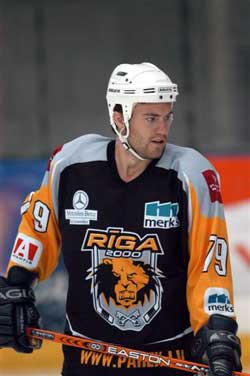
Many young émigré Latvians in the West have made their way back to the home of their parents or grandparents. But 23-year-old Vilis Ābele from Perth, Ontario, went back as a professional athlete. He plays hockey on the Rīga 2000 team.

Ābele played junior hockey in his hometown, located about 80 kilometers (about 50 miles) southwest of the Canadian capital of Ottawa, then moved to New York to study and play college hockey. The 190-centimeter (about 6 feet, 2 inches) and 97-kilogram (about 213 pounds) player joined Rīga 2000 last year. He shoots left.

Rīga 2000 is acknowledged as one of the best—if not the best—hockey teams in Latvia. Six of its players are on the national Latvian team scheduled to play in the Winter Olympics in Turin, Italy.

How does a kid from small-town Ontario end up playing hockey in Latvia?

It’s a wonder I ended up here but it really was a goal for me. I wanted to play hockey in Europe and playing in Latvia and being able to speak the nation’s language is a huge bonus and experience. This has been the first year in my life I have been able to experience Latvia, which was something I always wanted to do while growing up learning about Latvian culture.

How did you make the move from Canadian junior hockey to college hockey in the United States?

I played junior hockey for three years in my hometown, Perth, while going to high school. During my first year I suffered my first shoulder dislocation, which was disappointing because it prevented me from stepping up to higher levels. After finishing high school I decided I needed a change and also finish my academics. The United States was a great option being able to play and finish university at the same time. I first went to a junior college in Canton, N.Y. I had a very good year and won the All-American award. With this successful season I had NCAA (National Collegiate Athletic Association) teams interested in me and I decided to go to State University of New York at Potsdam. I played two years at Potsdam and graduated with a bachelor of science in business administration. It wasn’t the easiest being in three different schools in four years and still being able to get my degree.

Did your parents have any problems hauling you out of bed on those cold Saturday mornings before the crack of dawn to suit up for practices or games?

Being a young player it’s never a problem getting up to play hockey. I’m sure it was more a problem for my parents. I always had a skating rink in my backyard and usually had to be dragged off it at night for bed or before I froze my feet off. I remember being really happy when my father wired lights around the pond to be able to take advantage of the early winter nightfall. My father did most of the driving, but if my mother was able to come she was more than happy to. I also remember summers playing AAA hockey before junior. Every weekend there were tournaments and it was fun as a family to travel and stay in hotels and have a little vacation.

Tell us about your family.

I have a very supporting family. I am the youngest of the three kids. My parents are Baiba and Andris. I have two older sisters, Alīze and Indra. Indra is 25 and is newlywed and living in Mississauga, Ontario, and working as a nurse. Alīze is 27 and living in Brooklyn, N.Y., and working as a grade six teacher. My mother and father are still working hard but hopefully will relax more with their children all out of school and in the work world. All those times while playing, my family would make a great effort to come and watch, even if it required driving more than six hours just to be there. Without my parents and their support I probably wouldn’t be here right know still playing hockey.

How did you maintain your Latvian identity living in a small Ontario town?

There were no Latvians in Perth. We were one of a kind, with others not having any clue where Latvia even was. Growing up we always spoke Latvian at home, but as the years went on it was tougher. Every Saturday I was dragged to Latvian school in Ottawa with my mother. She was a teacher and I didn’t enjoy it very much. I didn’t like getting up early on Saturdays and driving just over an hour to go to school again. All this has seemed to work, living here in Latvia now and being able to speak and understand others around me. I also attended Tērvete, a Latvian summer camp in Québec, which was fun. Here we learned a lot about Latvian culture and folklore.

How difficult was it to crack the Rīga 2000 line-up?

After I arrived I had a week until my first game with Rīga 2000, which was an exhibition game against the Latvian national team. I was playing pretty well and riding on a high. They seemed very interested and wanted me to stay and play. Like all European teams they have an impression that any Canadian player must be good. I played around three games and then dislocated my right shoulder for the first time. Ironically I had dislocated my other shoulder over 20 times and had two surgeries on it. After my arm just about fell out during physiotherapy, I needed surgery on my right shoulder. I’m now playing again and need to prove to Rīga 2000 once again that I can crack the line-up of the first team.

Rīga 2000 has two teams. What is the difference?

One team plays in the Belarus league and one plays in the Latvian league. The first team, which is in the Belarus league, is very good. It has around nine players who play on the Latvian national team. Players that have come from the American pro leagues say that this league is better than the East Coast Hockey League, but below the American Hockey League. The second team competes with teams throughout Latvia. We call it the farm team. If you are playing well on the second team you could have the opportunity to play on the first team. Any player from the second team can be called up to the first team and vice versa.

What position do you play? How is the game in Latvia different from the one played in North America?

I play defense. I like to think that I’m an offensive defenseman like (Sandis) Ozoliņš and enjoy jumping into the rush. However, with my size, I’m more useful focusing on playing defensively. The game is totally different here than in North America. At home it was a much more physical game. Here you will be lucky to see five hits in a game. In the NCAA the two-man forecheck was used almost always, while here the forecheck trap is much more common. Over here it is a more “fancy-dancy” game, which unfortunately is not one of my strengths. I am more of a physical player. There is a lot of talent here in Latvia. A lot of young players have great potential to play professionally in North America.

Who was your hockey idol when you were growing up?

My idols were Artūrs Irbe and Sandis Ozoliņš, who then played on the San Jose Sharks. I still remember seeing Artūrs after an Ottawa Senators NHL game and getting an autograph. It was amazing to meet and train off ice with Artūrs this season when he was playing for Rīga 2000. It was a couple of weeks after my surgery when he arrived but before I was healthy he went off to play in Austria. It was great to work out with him while he was suffering from a groin injury. He was very nice and interesting. It was disappointing when he left because it would have been great to be able to play a game as a defenseman in front of him.

The Rīga 2000 teams have ethnic Latvians and Russians from Latvia as well as Estonian, Slovak, American, Canadian-Latvian and Canadian players. How do you communicate on the team?

Rīga’s coaching staff run their practices in Russian, everyone from Latvia seems to understand and were raised being coached in Russian. I don’t understand Russian and just ask the guy next to me what was just said or what is supposed to be done in the drill. I just look at the drawing board and figure it out most of the time. The head coach is Slovakian and doesn’t speak Latvian but speaks enough English for me to understand.

How often do you play and practice in Rīga? What do you do away from the rink?

We usually train, practice and play six days a week and have one free day to relax. It is a pretty busy schedule. Things are strict so I don’t have a lot of time to go crazy. I usually visit and relax with friends when I have the opportunity. I live in Jūrmala in a nice hotel right by the Baltic Sea and enjoy walking along the beach.

What are your future plans?

I’m not sure of my future plans. Hockey will probably not provide me with a long career. I’m fortunate to have a degree to fall back on. I would like to go home for the summer and spend time with my family and work back there. I’m fortunate for my present opportunities and only time and hard work will tell what is in store for me.

Vilis Ābele

Vilis Ābele, whose hockey career started in a small town in Canada, last year began playing for Rīga 2000. (Photo courtesy of Rīga 2000)

Latvian joins Canadiens hockey team

The Montréal Canadiens professional hockey team has a new enforcer. Raitis Ivanāns measures 6 feet 4 inches (1.93 meters) and weighs 263 pounds (119 kilograms). He’s the biggest Canadien in the team’s storied history. But unlike most hockey pugilists, he’s from Latvia.

Ivanāns has attracted a lot of attention since making the Canadiens roster.

Now 27, Ivanāns came to Canada as a 17-year-old to play Tier 2 junior hockey near Toronto. Since then he has played in just about every minor hockey league in North America. His tour has included the Flint Generals, New Haven Knights and the Rockford IceHogs of the United Hockey League, the Macon Whoopee and the Tulsa Oilers of the Central Hockey League, the Pensacola Ice Pilots, Toledo Storm and Baton Rouge Kingfish of the East Coast Hockey League and the Hershey Bears of the American Hockey League.

By the 2003-2004 season he was established in the AHL as a member of the Milwaukee Admirals, one step away from the National Hockey League. He was on the Admirals roster that won the league’s championship and the Calder Cup. The following summer he was signed as a free agent by the NHL’s Montréal Canadiens and played during last year’s lockout with their Hamilton Bulldogs AHL farm team.

Ivanāns started out as a defenseman. Along the way he shifted to forward and learned how to use his size and fight. The penalty minutes racked up, 270 in New Haven, 208 with Rockford and 259 last year in Hamilton.

The Canadiens were looking to add muscle to their young and fast lineup and Ivanāns fit the bill. He beat out veteran minor league enforcer Peter Vandermeer for the tough-guy spot after taking on Toronto’s Nathan Perrott and Ottawa’s Brian McGrattan in exhibition games. A healthy scratch for Montréal’s first two regular season games, he suited up Oct. 8 for Montreal’s 5-4 victory against the Toronto Maple Leafs and logged just under three minutes. He had no penalties and went down in the books as the latest Latvian to play in the world’s best hockey league.

While Ivanāns’ role is to protect his teammates when the going gets rough, he shouldn’t be discounted as a hockey player.

“He certainly earned himself a spot,” Canadiens Coach Claude Julien told the Toronto Sun. “He’s a good person who came from a long way to adapt to the North American lifestyle, made sacrifices to leave his country and groom himself to be a hockey player. Sure he has a role on this team. Anyone who watches him sees he’s not a bad skater for his size. He creates some space for himself. He does have skills and he earned his spot with us. He deserves a lot of credit.”

Ivanāns also has taken young Russian-speaking players under his wing helping them with English and adjusting to life in Canada. Last year in Hamilton, his protege was Belarus rookie sensation Andrei Kostitsyn. Canada’s Rogers Sportsnet broadcast a 10-minute segment showing the two on and off the ice—in the dressing room, going out for fast food and bowling. This year he’s interpreting for talented Russian Alexei Perezhogin on the Canadiens roster.

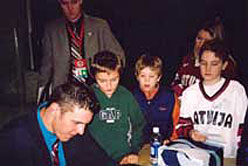
Last winter parents and students of Toronto’s Latvian School Valodiņa went out to watch Ivanāns play in Hamilton. Afterwards he took time to meet with them, spoke to them in perfect Latvian and patiently signed autographs. However, he was stumped when asked to name every Latvian’s most favorite food in order to receive a present from the school. His answer was “kaposti” (sauer kraut). Not quite, but he still walked away with a box a 40 pīrāgi.

On the Latvian Web sites Hockey.lv and Delfi.lv, some readers have downplayed Ivanāns’ skills as a player due to his role as a “policeman.” However, most have cheered his success and are urging that he be given a place on Latvia’s national team. By all accounts the team could use someone who’s not afraid to go into the corners to dig the puck out or to park his massive frame and screen an opposing goalie. But then come springtime, it’s very likely that Ivanāns will be in the thick of Stanley Cup playoff action with the Canadiens. The World Championships may have to wait. —Viesturs Zariņš

Raivis Ivanāns

New Montréal Canadien hockey player Raivis Ivanāns signs autographs for pupils from the Toronto Latvian School Valodiņa. (Photo by Viesturs Zariņš)