Latvia’s hockey juniors make their mark in Canada

Last summer a record number of six hockey players from Latvia were drafted by Canadian Hockey League major junior teams in the European Entry draft. Approaching the end of the season, five of the six are still playing in Canada and continue to draw the support of Latvian-Canadian fans.

Forward Kaspars Daugaviņš, who had celebrated his 18th birthday in his debut with Latvia’s senior men’s team at the World Championships in Rīga and had earlier been drafted by the Ottawa Senators in the third round of the National Hockey League’s entry draft, was picked up by the Ontario Hockey League’s Toronto St. Michael’s Majors. He was joined on the Majors by then 17-year-old defenseman Krišs Grundmanis.

Seventh-round Atlanta Thrashers draft pick defenseman Arturs Kulda joined the OHL’s Peterborough Petes. Forward Kaspars Saulietis went to the Kelowna Rockets of the Western Hockey League. Incumbent defenseman Oskars Bārtulis, a Philadelphia Flyers draft pick, was traded from the Quebec Major Junior Hockey League’s Moncton Wildcats to the Cape Breton Screaming Eagles, who play out of Sydney, Nova Scotia.

Arturs Ozoliņš was picked up by the OHL’s Guelph Storm, but was released in October. Although he is a good skater and has “light” hands, he struggled to adapt to the North American game and failed to register a single point during exhibition and regular season play. He returned to Latvia and now plays with Rīga 20, his old team in the Latvian Samsung league.

Daugaviņš has impressed observers, playing with both flair and grittiness. A skilled play-maker, he is one of the Majors’ top forwards. His determined play along the boards is second to none. Early in the season Daugaviņš was among the Top 20 point getters in the OHL but he has now dropped further down the pack. Part of the issue has been a weak supporting cast. The Majors are last in their division and will not make the playoffs.

Six-foot-four (1.93 metres) Grundmanis has steadily improved his game and is now playing with confidence on a regular shift as well as going out on the power play and penalty kill. His rock solid hits have brought Majors fans to their feet on more than one occasion. No one expected Grundmanis to be drafted by the CHL and he could be a sleeper and go far.

In Peterborough, Kulda is evolving into a solid defenseman. He fought Daugaviņš in a game on Feb. 11. After the game the two embraced and jokingly compared the damage each had done.

Out west Saulietis had a slow start with the Rockets and his position was shaky until he picked up his game and started scoring to become one of the team’s top scorers. He was traded Dec. 8 as part of a blockbuster deal with the WHL’s Regina Pats. Meanwhile, Bārtulis is one of the Quebec league’s top defensemen and was voted October player of the month. Bārtulis will likely graduate to the pros next year while Saulietis, Daugaviņš and Kulda will have at least another year in the juniors. Grundmanis, the youngest of the group, will be back for two.

A fan club is born

The arrival of Daugaviņš and Grundmanis in Toronto triggered the founding of the Latvian Hockey Fan Club in Canada by Viesturs Zariņš (author of this article) and Vilnis Blūms. A hard core group of up to a dozen fans nicknamed the “Latvian Embassy” has been going to most Majors games. Others, often in Latvian hockey jerseys, have joined them. With their chants, horns and waves, they have kept games lively even on nights when the Majors have been outplayed. The Latvian presence has not gone unnoticed by the Majors, who have been stocking Aldaris Zelta beer in their lounge since the start of the season.

On Oct. 17 the fan club organized an event at the Latvian Canadian Cultural Centre in Toronto featuring Colorado Avalanche defenseman Kārlis Skrastiņš, as well as juniors Daugaviņš, Grundmanis and Ozoliņš. The evening was attended by about 100 Latvian fans of all ages and featured door prizes, a hockey trivia quiz and Latvian food. The players answered questions from the public and were kept busy all night signing autographs and posing for photographs. A few months later on Feb. 8, Skrastiņš broke the all-time record for NHL defensemen with 487 consecutive games, eclipsing Canada’s iconic Tim Horton in a run set 40 years earlier.

The next outing was on Dec. 3 when more than 75 Latvian fans descended on a Majors game against the rival Barrie Colts in a fundraiser for Latvian youth with the Majors selling tickets at a discount for resale by the Latvian National Youth Association of Canada (LNJAK) and the Toronto Latvian School Valodiņa. Following the game the fans assembled in the rink’s lounge to give Daugaviņš and Grundmanis a rousing send-off to the World Junior Under-20 (U-20) Division I championships held in Odense, Denmark, from Dec. 11-17. The two players were presented with a huge best wishes card with player caricatures that was signed by those in attendance.

(Latvia’s U-20 juniors were attempting to get promoted back to the elite level after being relegated in their debut last winter in British Columbia. They beat Estonia 6-0, Poland 7-2 and Slovenia 7:2, only to stumble and lose to Ukraine 4-5 in an undisciplined game. It came down to a final game on Dec. 17 against Denmark. Even though Latvia beat Denmark 5-4 with late game goals by Saulietis and Ozoliņš, it was not enough. Denmark, Latvia and Ukraine were tied with 12 points and Denmark went ahead on goals differential. Latvia missed getting promoted by one goal. Daugaviņš was the leading point getter at the tournament followed by teammates Gatis Gricirskis and Andris Dzēriņš. Bārtulis was the top defenseman. The U-20 juniors will have another shot next winter. Meanwhile Latvia’s U-18 team will be making its elite level debut in Sweden in April. Grundmanis is the only junior playing in Canada young enough to qualify. Daugaviņš will likely be heading back to the senior men’s team at this year’s World Championship in Moscow.)

In recognition of the support provided by Latvians fans this season, the Majors hosted Latvia Day on Jan. 28. The event was attended by more than boisterous 100 Latvians in a sellout crowd of 1,400. Young Latvian women served pīrāgi and apple bread while the newly formed LNJAK men’s choir sang the Canadian and American national anthems for the game against the Plymouth Whalers from Michigan. The game sheet included facts on Latvia and Latvian hockey. Raffle tickets to a Maple Leafs Game were provided by Latvia’s honorary consul in Toronto. After the game Daugaviņš and Grundmanis signed autographs.

More Latvians could head to NHL

Despite inroads made by colleges in the United States and European imports, the three leagues that comprise the CHL still produce about half of the NHL’s players. It is probable that within a few years, at least one or two of the Latvian juniors now playing in Canada will make it to the “Big Show.” Daugaviņš and Bārtulis are the favourites but one or two of the others could surprise observers.
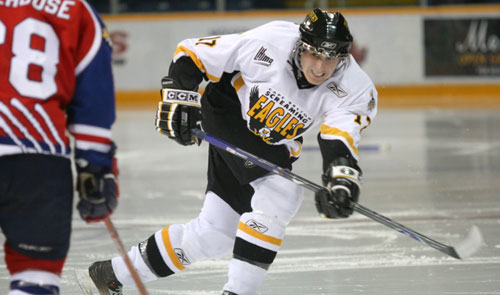
Oskars Bārtulis

Defenseman Oskars Bārtulis of the Cape Breton Screaming Eagles looks for an opening during a Nov. 15 game against the Moncton Wildcats. (Photo courtesy of Mike Sullivan, Quality Cameras & Computers)
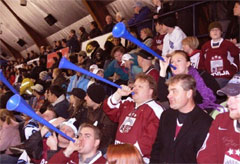
Hockey fans at Toronto Majors game

Latvian fans make some noise during a Toronto St. Michael’s Majors hockey game. (Photo by Raimonds Sultmanis)
Latvia makes its lacrosse debut

Latvia recently made its world debut in yet another athletic competition, this time in a sport not all that familiar to folks back home – lacrosse or, as it is called in Latvian, lakross.

Originally part of Native American religious and community life in what is now Southern Canada and the Northeastern United States, lacrosse was picked up by non-natives and in 1859 was named Canada’s national game. Over the next century the sport spread to the United States and countries of the British Commonwealth.

In the early part of the 20th century, lacrosse in Canada was eclipsed by hockey. Lacrosse was married with hockey and the indoor version, or box lacrosse, became the dominant form of lacrosse in Canada. Today, it is played by thousands across Canada – youths, juniors and seniors. The National Lacrosse League is a professional circuit that has grown in popularity on both sides of the border. In recent years, crowds of more than 10,000 have not been uncommon. Meanwhile, field lacrosse took root in American high schools and colleges particularly on the East Coast. 

The International Lacrosse Federation (ILF) holds World Championships in field lacrosse every four years. The United States has been the dominant power for a quarter of a century. Canada and Australia have been runner-ups. The 2006 championships were held July 13-22 in London, Ontario, about halfway between Toronto and Detroit, Mich.

Twenty-one teams were divided into four divisions for round robin play. Latvia played in the yellow division consisting of the lowest-seeded teams. Latvia lost its opening game to eventual division winner Finland (3-9) and then followed with victories against division rivals Spain (11-9), Denmark (7-3 and 5-3) and Bermuda (9-3), before losing to higher-ranked Netherlands (4-10) and Wales (2-18). Latvia finished 14th. The gold medal went to Canada, which finally beat its rival, the United States.

In e-mail interviews, Andris Dikmanis, a Team Latvia player and director of the Latvian American Lacrosse Organization, and Stephen Jacobson, coach of Team Latvia, talk about lacrosse and Latvia.

Latvia and lacrosse. It seems like an unlikely combination. How did lacrosse get started in Latvia?

Dikmanis: The game of lacrosse was first introduced to the Baltic region in 1992 in the form of Intercrosse. The first real lacrosse practices and developmental programs were started in the summer of 2002, followed by regular team practices in several Latvian cities the following year. Currently Latvia is home to two lacrosse clubs and more than 30 players. The larger of the two is the Mitavas Lacrosse Club with players from several cities including Rīga, Jelgava and Ogre. The Latvian National Lacrosse Team in 2003 participated in their first European Newcomers Lacrosse Championship in Salzburg, Austria, as well as in the 2004 European Lacrosse Championship in Prague.  The team then set its sights on the World Championships. Last summer the LALO organized a week-long exhibition and camp in Latvia to showcase the players from each of their cities.

Tell us about yourself and how you got involved with Latvian lacrosse.

Dikmanis: I am a former Division 1 player from the United States who played with Hofstra University. I enjoy the game and when I became aware of an attempt to form a competitive Latvian national team, I volunteered to play for the team and help organize and recruit some experienced players of Latvian descent. It became evident that the team needed financial help and publicity concerning their efforts. As a result, I utilized my computer experience to construct the LALO Web site and started a campaign to raise funds. With the help of the lacrosse network throughout the United States, we gained partial sponsorship from Warrior Lacrosse. This enabled us to purchase our uniforms and equipment at reduced cost. By producing Latvian lacrosse paraphernalia, we were able to raise additional funds for the team.

Latvia made its debut at the World Championships this year. How did that happen?

Dikmanis: Aigars Grinbergs in Latvia wanted to send a team to participate in the international arena. I volunteered to help train the Latvian team last summer where they held a camp in Gramzde. It became evident that there was a great amount of work to be done. Consequently an infusion of experienced players of Latvian decent was necessary to make the team competitive. Aside from the competitive aspects, we are proud of their effort to break into the international scene of lacrosse and we wanted the team to succeed.

The players from Latvia were joined by five from the United States. How and why?

Dikmanis: Judging from the results and the actual play in the tournament, the players from the United States helped the inexperienced players from Latvia rise to a new level. At the end of the World Championships, the Latvian players left with a great deal of pride and recognition of how much they had improved over the two-week period by playing with and against other experienced players.

Could you share your favourite memory from the World Championships?

Dikmanis: First there was the thrill of representing Latvia in the opening ceremonies. Then came our first win against Spain, a team that had an excellent offense and it was up to us to shut them down. It was a legitimate victory that instilled confidence in our team and it convinced them that they were for real. Next was our first win against Denmark. When my father suggested that we could beat Denmark the night before, certain people thought he was crazy. When we won, I can remember the big grin on his face and the words, “I told you so.” He truly believed in us and the determination of this rag-tag team that only came together to practice three days before the beginning of the tournament and made it happen. The second time we beat Denmark was validation of our first victory. We are for real and we will only get better.

What’s next for Latvian lacrosse?

Dikmanis: We have had Latvians crawling out of the woodwork expressing interest in our efforts. We hope to run summer camps in the United States or Canada, and Latvia, where new players can develop their skills. We want to popularize this sport in Latvia with the thought in mind that, if you like hockey, lacrosse is similar to hockey—just without the ice. We hope that our remarkable results in the World Championships will kindle interest among Latvians everywhere.

You met your team for the first time just prior to the World Championships. Tell us about the challenges you and the team faced.

Jacobson: When we first met, eight of the 12 native Latvian players had never played an organized game prior to this. They had to be taught offensive plays and positioning on the field. Considerable time was spent improving the team’s stick skills. We had to find several face-off players and players capable of playing the wing positions on the face-off team. We worked on teaching the players how to play a zone defense and how to slide when help was needed. I felt we could have used several weeks of practice before this tournament. However our first game was against the strongest team in our division, and we were not quite ready. I felt we had a chance to win perhaps one game—against Bermuda. A win against Spain was only possible if our two best defensemen could shut down the two main scorers of the Spanish team. When we limited their best players to two goals, we were able to achieve victory. From that point on, the team played with greater confidence and demonstrated the perseverance to win.

How satisfied are you with the guys and the performance of the team?

Jacobson: The results achieved are beyond my wildest expectation. To achieve a winning record by an affiliate nation in its first appearance in the World Games is significant. There were teams that have been playing together in tournament play for many years that did not fare as well as we did.

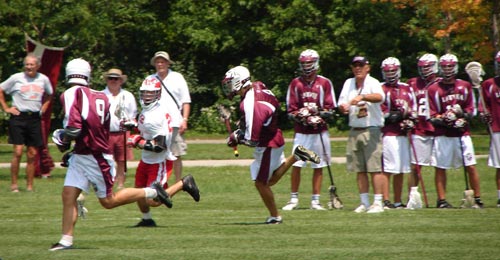
Latvian defenders converge against Dane

Latvian defenders converge on a Danish attacker during the 2006 World Championships, while teammates, coaches and spectators watch from the sidelines. (Photo by Viesturs Zariņš)

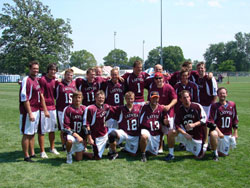
Team Latvia poses for photo

Team Latvia poses for a photograph after its 7-3 victory against Denmark in the World Championships. (Photo by Viesturs Zariņš)

Canadian hockey teams draft five Latvians

A record five Latvian juniors have been selected In the 2006 Canadian Hockey League draft, according to media reports and team Web sites.

The June 28 CHL draft placed players in Canada’s three top junior leagues: the Ontario Hockey League, the Western Hockey League and the Quebec Major Junior Hockey League.

Kaspars Daugaviņš, 18, a recent third round draft pick of the National Hockey League’s Ottawa Senators, was picked up by the Toronto St. Michael’s Majors. The Majors alos chose Kris Grundmanis, 17. Daugaviņš made his debut in Rīga during the World Hockey Championship and, together with Grundmanis, was on Latvia’s U-20 team that played last winter at the World Championship in British Columbia.

The Peterborough Petes took seventh round Atlanda Thrashers draft pick Arturs Kulda, 17, while the Guelph Storm selected Artūrs Ozoliņš, 18. Kulda and Ozoliņš were on Latvia’s U-18 squad that won the Internatonal Ice Hockey Federation’s Division 1 and was promoted earlier this year to the elite level.

Nineteen-year-old Kaspars Saulītis was drafted by the Kelowna Rockets of the WHL. Saulītis also was on the U-20 squad.

Given that each of the 54 teams in the CHL can draft only two imports from Europe, having five Latvian juniors drafted is a huge accomplishment for Latvian hockey. That means Latvians will fill 5.5 percent of the CHL’s available import slots going into the 2006-2007 season.

Meanwhile, 19-year-old Oscars Bartulis, who played two seasons with this year’s QMJHL champions, the Moncton Wildcats, has been traded to the Cape Breton Screaming Eagles, who play out of Sydney, Nova Scotia. He has been drafted by the Philadelphia Flyers of the NHL. Teamate Oscars Bartulis, a Boston Bruins draft pick, will be at the Bruins’ rookie camp and will either play in the Boston system or be returned to Moncton for one last season as an over-age junior.

Nashville Predators draft pick Laurins Dārziņš is getting a lookover at the Predators rookie camp. He graduated from the junior ranks having played several seasons with the Kelowna Rockets of the WHL. Dārziņš was on Latvia’s starting lineup in Rīga championship. The jump from the juniors to the NHL is a big leap even for those drafted and many don’t make the cut.

The success of Latvia’s junior teams and the attention its top players are getting bodes well for Latvian hockey as a new generation of players steps forward. Latvia has about 3,000 registered hockey players.