Latvians again dot North American hockey

With the turn of the New Year, North American hockey is at mid-season. This year 10 players from Latvia are playing professional hockey and another four are playing with top tier junior teams in either Canada or the United States.

Even though hockey is Latvia’s No. 1 sport, the Latvian émigré community in North America has been slow to embrace the game. A few Latvians in Canada and the United States do attend games and cheer their players. Being far from home, players appreciate the attention and are happy to sign autographs and engage in post-game talk.

Perhaps the biggest story this season the so-far successful comeback of former National Hockey League (NHL) all-star defenseman and Stanley Cup winner, 35-year-old Sandis Ozoliņš. He signed a one-year deal with his first NHL team, the San Jose Sharks. Ozoliņš struggled with leg injuries and alcoholism following the 2003-2004 season. He entered the NHL’s substance abuse and behavioural health program for the second time in 2006. Over the past year Ozoliņš has turned himself around, stayed sober and put himself into shape by training for triathlons. He credits his wife Sandra and their two sons, ages 11 and 13, for much of the comeback.

Defenseman Kārlis Skrastiņš returned for his eighth NHL season, his fourth with the Colorado Avalanche. Last season Skrastiņš become the NHL’s all-time ironman defenseman, playing 487 consecutive games since February 2000 without injury. He shattered the record previously held by Canada’s iconic defenseman Tim Horton, founder of the successful Canadian coffee and doughnut restaurant chain. Shortly afterwards Skrastiņš was sidelined by a knee injury.

Raitis Ivanāns, a hulking 6-foot 4-inch, 250-pound forward from Rīga, is in his second season in the NHL with the Los Angeles Kings. Ivanāns came to play junior hockey in Canada back in 1996. On his way to the NHL, he played in every North American minor pro league with teams ranging from Baton Rouge, La., and Pensacola, Fla., in the south to Rockford, N.Y., and Hamilton in Ontario in the north. Ivanāns made his mark as an enforcer who regularly scraps with the opposing team’s tough guys. He had his NHL debut in 2005-2006 when he played four games with the Montreal Canadiens. In today’s NHL it’s not enough to be an enforcer and Ivanāns has shown he’s a solid fourth-line player, has a long reach and good checking skills, and is a surprisingly strong skater for a big player.

Poised one level below the NHL in the American Hockey League (AHL) is talented forward Mārtiņš Karsums, who is playing his second season for the Boston Bruins farm team in Providence, R.I. The Hockey News recently characterized Karsums as a “speedy, hounding forechecker who is a scoring threat and can play every role from the power play to the penalty kill” and someone who should expect to be called up to the NHL.

Karsums is joined in the AHL by Oskars Bārtulis. A skilled defenseman, Bārtulis has been drafted by the Philadelphia Flyers and is in his first year with the Philadelphia Phantoms farm team after graduating from Canada’s junior leagues, where he played together with Karsums on the Moncton Wildcats.

Latvian hockey fans had hoped that this season forward Jānis Sprukts would stick in the NHL. Last year he played with the Rochester Americans of the AHL and had the second highest number of points. Sprukts was called up to the Florida Panthers in the NHL for 13 games. This year he turned down a two-way contract from the Panthers to start in the AHL and instead returned to Finland to play with Rukko Rauma. Under two-way contracts players are paid much less when they play in the AHL rather than the NHL. The money was much better in Finland, a major consideration for a player with a young family.

Things looked promising for Jēkabs Rēdlihs, a defenseman in his second pro season after graduating from Boston University. Rēdlihs was drafted by the NHL’s Columbus Blue Jackets and last season was one of the better defencemen on their AHL farm team in Syracuse, N.Y. This year, rather than getting a shot at the big team, Redlihs was sent down to the Elmira (N.Y.) Jackals of the East Coast Hockey League (ECHL) after 13 games with the Syracuse Crunch. At this point he is likely considering options to play in Europe, joining his brothers Miķelis, who plays in Belarus, and Krišjānis, who now plays in Germany after four years in the AHL.

Further down in the minors, 30-year-old Kārlis Zirnis, a University of Alabama in Huntsville graduate from Rīga, returned for his fourth year with the Central Hockey League on the roster of the Bossier-Shreveport Mudbugs in Louisiana.

Two defensemen from Latvia play in Indiana with the Fort Wayne Komets of the International Hockey League (IHL). Formerly the United Hockey League (UHL), the IHL is centered around the Great Lakes and is down from 12 to six teams and has ongoing financial difficulties. Maksim Sirokov is in North America for the first time while Sergei Durdin is a four-year veteran of the IHL.

Ervīns Muštukovs has had a disappointing season. The goaltender who played junior hockey in Quebec back in 2003-2004, decided to give North America a try in 2006-2007. He landed in the Southern Professional Hockey League (SPHL), a seven-team loop based in the southeastern United States. The league is the lowest minor pro hockey league in North America, one level below the East Coast, International and Central Hockey Leagues. Muštukovs impressive play saw him called up to the ECHL where he finished last season. There was even interest in him from at least one AHL team. This year Muštukovs started the season in the ECHL but he was bounced from two teams. As a free agent, Muštukovs became expendable as AHL and NHL teams moved their goaltenders up and down in the minors. He is now back in the SPHL with the Knoxville Ice Bears in Tennessee, where he is a fan favourite and nicknamed “Moose.”

Latvian juniors in Canada

Latvia’s top junior players continue to make their presence felt in Canada, too. Four players started the season with the Canadian Hockey League (CHL), which in turn consists of the Western Hockey League (WHL), Ontario Hockey League (OHL) and Quebec Major Junior Hockey League (QMJHL). Each team can carry only two Europeans. Some teams in all three leagues are based in U.S. cities.

Kaspars Saulietis returned to the Regina Pats of the WHL, but a serious injury on his first shift in the first game saw him dropped and he returned home.

Kaspars Daugaviņš, a third-round Ottawa Senators draft pick, is back with the OHL’s Mississauga St. Michael’s Majors. The talented forward was called up to the Binghampton Senators of the AHL at the end of last season and participated in the Ottawa Senators training camp at the start of this season before being sent back to the juniors. Daugaviņš is the Majors’ top scorer and will turn pro at the end of the season and likely play in the AHL. Back in 2006, Daugaviņš, who at the time was only 17, was the youngest player ever to crack Latvia’s senior men’s national team.

Artūrs Kulda, a seventh-round Atlanta Thrashers draft pick, is back for his second season with the OHL’s Peterborough Petes. A tough and strong defenseman, Kulda is getting a lot of ice time with the Petes. He participated in the Thrashers’ rookie camp in Traverse City, Mich., prior to the season and has said he hopes his play will lead to a contract with the Thrashers and their farm system.

Andris Džeriņš had played junior in Sweden and Finland before being picked up by the Kingston Frontenacs of the OHL. Džeriņš is a smooth skater and passer. In his first year overseas, he is adapting to North American hockey and has recently been scoring goals. As a 19-year-old player, this is his final year of junior eligibility unless he comes back as overage junior. Each CHL team can carry three overage juniors who are 20 at the start of the season.

Eighteen-year-old Krišs Grundmanis, a tall, lanky defenseman who played with the Majors last season, is now in Wisconsin with the Green Bay Gamblers of the U.S. Hockey League, the top junior league in the United States. He got a try-out with the Johnstown Chiefs of the ECHL before heading to Green Bay.

Hockey Canada, the country’s national governing body of ice hockey, limits European players to the three Major Junior leagues. Europeans cannot play at lower levels (for example, Junior A or Junior B). USA Hockey also restricts junior teams to two Europeans, but unlike Canada, they can play junior hockey at any level. A number of Latvian players are toiling in various lower-level junior leagues in the United States hoping that they will be noticed and called up or land a National Collegiate Athletic Association scholarship.

The juniors in Latvia

The biggest event in Latvian hockey this season was the Division 1 Group B Under-20 World Junior Championships held in December in Rīga. Latvia was pooled with Belarus, Slovenia, Hungary, France and the United Kingdom. The winner of the group would be promoted to the top tier and play against hockey’s superpowers like Canada and Russia. Latvia had been there once before playing in British Columbia two years ago before being demoted after finishing ninth in the group of 10. At this year’s championship, Latvia handily beat Hungary, France and the United Kingdom. A loss against Slovenia set up a Dec. 18 showdown with Belarus in a packed Arēna Rīga. Latvia won 3-1 and the North American juniors were a big part of the gold medal victory.

Unfortunately, Latvia’s U-20 squad will be weaker next year when it plays in Ottawa. A number of talented juniors including the three currently playing in the OHL will no longer be eligible.

The next Division 1 Group B Under-18 World Junior Championships are also being held this April in Rīga. Latvia will compete with Austria, Norway, Italy and Japan for the right to move up to the top tier.

Big hockey, as it is called in Latvia, is set to return in May. Latvia’s senior men’s team, currently ranked 10th in the world, will compete at this year’s International Ice Hockey Federation (IIHF) Championships in Quebec City and Halifax, Canada. Sixteen countries will participate and Latvia is in a tough pool drawing Canada, the United States and Slovenia. Latvia’s games will be played in Halifax. Qualification round dates are set for May 2, 4 and 6. The core of the national team plays in Europe where post-season play ends before the World Championships. Typically Latvia relies on North America-based players to bolster the national team. At mid-season it looks like a number of the North American teams are poised for playoff runs and so the availability of players like Skrastiņš, Ozoliņš (who has said he has retired from the national side), Karsums, Bārtulis and Daugaviņš will not be known until April.
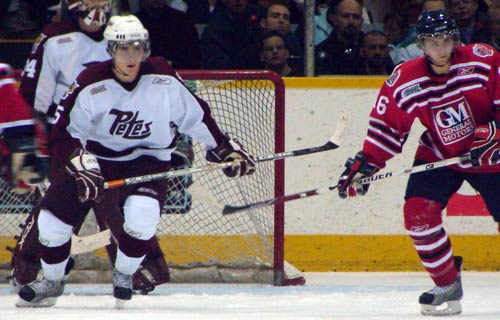
 

Artūrs Kulda follows a play

Artūrs Kulda, in his second season with the Peterborough Petes, follows the action during a game. (Photo by Viesturs Zariņš)
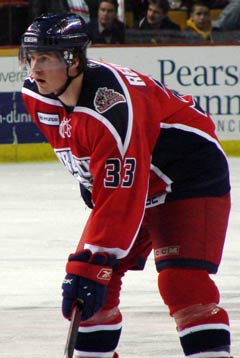
Rēdlihs lines up for face-off

Jēkabs Rēdlihs, while still with the Syracuse Crunch, lines up for a face-off. He has since been sent down to the Elmira (N.Y.) Jackals. (Photo by Viesturs Zariņš)
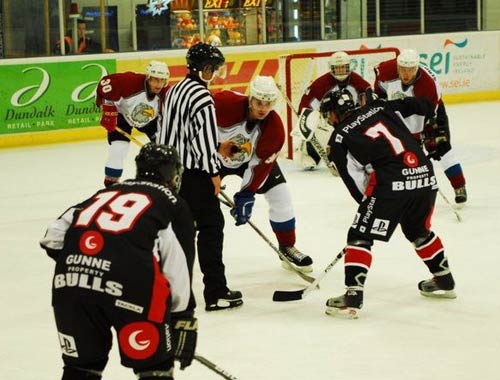
Latvian hockey, and Latvian hockey fans, come to Ireland

With the arrival of at least 20,000 Latvians in Ireland over the past several years, it is hardly surprising that their passion for hockey wasn’t far behind. The Latvian Hawks, an amateur team consisting of only Latvian players living and working in Ireland, have joined the Irish Ice Hockey League in its inaugural 2007-2008 season. The Latvian Hawks intend to be contenders for the league championship.

In a land where Gaelic football, rugby, soccer, cricket, field hockey and the ancient game of hurling rule the sports pages, ice hockey is a tough sell.

Belfast in Northern Ireland has had several ice rinks for some time and the professional Belfast Giants, albeit heavily stocked with former North American minor leaguers, have played in the British Elite Ice Hockey League since 2000. But in Ireland itself ice hockey is nascent. The country has only one regulation-size ice rink. The first officially recorded game was played in 1983 when a visiting Liverpool team beat one from Dublin. The Irish Ice Hockey Association (IIHA) only joined the International Ice Hockey Federation (IIHF) in 1997. The senior men’s side is ranked 43rd out of 46 countries and competes in the lowest IIHF division along with the likes of Mongolia, Armenia, Luxembourg, South Africa and New Zealand. Latvia competes in the top division and is currently ranked 10th.

Latvians Online caught up with Latvian Hawks representative Ieva Baradouska, who discussed the team in an e-mail interview.

How were the Latvian Hawks founded?

It started simply enough with a group of Latvian guys in Ireland who wanted to play hockey on weekends. The ice hall in Dundalk had just opened and given that it is relatively close to Dublin, getting there didn’t require a lot of time or money so the timing was good. News about the newly formed Latvian hockey club spread quickly. When a couple of former professional players joined, we started thinking about establishing a team that would compete in Ireland.

Why did you choose the name Hawks?

The intent was to choose a name that would accentuate the team’s Latvian ties. At first we couldn’t decide between the names Hawks and Oaks. But Hawks won. The hawk is a strong and fast bird with endurance and these are the characteristics we felt were necessary for the team to compete successfully.

Was it easy to put together a team?

It wasn’t difficult to get players for our team. In fact interested players sought us out. Currently we have 45 members who are players and new ones are joining every month. In fact we’re in the process of putting together a second team that will play at the B level. The Hawks look good when compared with other teams. We’re not professionals, however we are motivated and have a winning attitude. In addition, we’re the only team that has such a large number of fans. That helps.

There’s a lot of movement between Latvia and Ireland. Do you have problems keeping players on your roster?

Yes, this is a serious issue for the team but one that we have taken into account. We realize that not everyone wants to stay and live in Ireland for long periods. However, there are new, young players who continually arrive and are interested in joining. They bring new enthusiasm and skills replacing any players who leave. (The Hawks’ starting goaltender was injured prior to the opening game on Sept. 15 against the Dundalk Bulls, so they flew in a top amateur goaltender from Latvia —VZ.) Right now we have a starting lineup for our A team and everyone is committed to Irish League play until next spring. No one is planning on leaving.

Tell us more about the B team and your plans for youth hockey.

There’s a wide range of skills among the 45 Latvian Hawks. At one end we have those who have played professional hockey in Latvia and internationally while at the other, those who have chased a puck on a frozen pond. Our A team consists of the most experienced players. The B team is for those who are less experienced but still able to go out and play a solid contact game. Right now our B team might be one of the best in the league. While our focus has been on the A and B teams, we do not want to ignore youth hockey. We’re looking into coaching and ice time for them although there are few opponents in Ireland for them to play.

Where is your home rink?

The Irish League has five teams: the Latvian Hawks, Dundalk Bulls, Dublin Flyers, Dublin Rams and the Belfast Bruins. Given that the rink in Dundalk is the only one decent rink in Ireland, games for all teams are played there.

How often does the team train and play? Is it easy for players to work hockey into their day-to-day schedule?

The Hawks are coached by our most experienced players. Practices are held for two hours on Fridays. We’re planning more because they are essential for the team’s development. There have also been exhibition games. Irish League games are held on weekends and the Hawks will play every one or two weeks. Most of our players live in Dublin but given that Dundalk is only an hour away, getting there is not a problem.

Hockey is an expensive sport. How do you fund the team? Do you have any sponsors?

Funding is a painful question. Right now the guys are paying for equipment and ice time out of their own pockets but we’re looking for sponsors. We realize that we need to prove ourselves in order to get sponsors. As a result, we worked hard to be ready for this hockey season. We have also become very popular among Latvians in Ireland. They come not just to watch hockey but also to get together because there aren’t too many opportunities to do that on a day-to-day basis. We’re hoping that our large fan base will interest local sponsors. And if there are any readers who would like to sponsor the Latvian Hawks then they should contact the team’s manager Janeks Oberts (info@latvianhawks.com) or the media and marketing coordinator Ieva Baradouska (ieva.baradouska@latvianshawks.com). We’re an amateur team, but if things work out we’re hoping on turning professional.

How many fans come out to games?

So far we’ve had 300-500 turn out for our exhibition games and of those 90 percent are Latvians living in Ireland. We’re hoping for a lot more at our league games. Ice hockey isn’t popular in Ireland but we’ve heard that after seeing our boisterous fans, locals have started to realize that ice hockey is an interesting and exciting sport. We’re planning various contests for fans in between periods during our games. For example, we’ll pick out the most colourful fan of the game. Hawks souvenirs will be given out as prizes and we’ll post photographs of the winners on our Web site. Fans will also be able to buy hats and jerseys before too long. We’re also working on getting cheap air fares for any fans from Latvia who want to fly out to our games.

Can anyone become a Latvian Hawk?

Up to now we’ve only accepted members who are players. However, we have an initiative called “Latvian Hawks are looking for fans.” This will allow the public to register as official Latvian Hawks fans and be eligible for various contests and special events throughout the season. Official Hawks fans will receive the latest information about the team including game date reminders by e-mail.

How do the Irish react to a Latvian team playing in their hockey league?

The other Irish teams are envious of the Hawks because we’re the first team with so many fans. That of course gives the games a different flavour. One of the goals of the Latvian Hawks is to enhance the image of Latvians in Ireland. That will depend on how we play but a lot will also depend on our fans. We want them not just to support our team but we also want them to bring along their Irish friends to hockey games.

Did you get pressure from the IIHA to drop the tag “Latvian” from the team’s name? Did other teams try to pick up your players?

The IIHA has been extremely supportive of our initiative to found the Latvian Hawks. They see this as an opportunity to bring in a lot more fans to hockey games. So far, other teams haven’t raided our roster but we are conscious of the threat and are doing everything possible to build a team that players would have no interest in leaving.

How did the season opener go on Sept. 15?

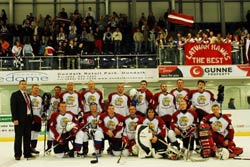
The game was emotional. We lost 13-6 to the league-leading Dundalk Bulls. It was a rough game. Two of our players suffered injuries and both were taken to the hospital. One broke his wrist and lost consciousness after being checked heavily in the boards. He will be out for three to four months. The other suffered a shoulder injury but is expected back soon. Our captain, Jānis Kipurs, was ejected from the game after questioning the referee’s decision and then getting embroiled in a fight with two Canadian players from the Bulls. Despite the loss, the large contingent of Latvian fans was loud and behind the Hawks even when we trailed 11-2. The fans drew favourable comments from their opponents who were badly outnumbered in the stands but did manage to field a group of cheerleaders. And when the Hawks scored, the blare of horns was deafening. Supporters also unfurled a huge banner reading “Latvian Hawks—The Best.” After the game the team received a 15-minute standing ovation from their fans.

Any plans for the Hawks to travel and compete elsewhere?

At this point our primary objective is to compete in the Irish League, but in the long term we’re certainly interested in competing in tournaments in Latvia and elsewhere. We’re also great Latvian hockey fans ourselves and our players are looking into heading to the IIHF World Hockey Championships being held in May 2008 in Halifax to support the Latvian senior team.

Latvian Hawks face off Sept. 15 against Dundalk Bulls

The Latvian Hawks ice hockey team faces off against the Dundalk Bulls during the season opener Sept. 15. (Photo by Guntars Bleiks, courtesy of the Latvian Hawks)

Latvian Hawks

The Latvian Hawks, and some of their fans, pose for a photo. (Photo by Guntars Bleiks, courtesy of the Latvian Hawks)

Indulis Ābelis and family

Indulis Ābelis, Latvia’s ambassador to Ireland, and his family were among fans attending the Latvian Hawks’ season opener in Dundalk. (Photo by Guntars Bleiks, courtesy of the Latvian Hawks)

Toronto: Capital of the Latvian exile community

In Latvian terms, Toronto and the surrounding area is big. Even almost 15 years after the restoration of Latvia’s independence and the downsizing evident in so many communities in the Latvian diaspora, the size and activity of the Toronto community is impressive.

Check out the events calendar in Toronto Ziņas (www.torontozinas.com) and there will hardly be a weekend when a special event isn’t happening. Then there’s the stuff you don’t see.

Centrs is the centre

Life in the Toronto Latvian community revolves around “Centrs,” or the Latvian Canadian Cultural Centre as it is officially called. Centrs is a sprawling complex purchased in 1979 for more than CAD 6 million and is the largest such Latvian facility in the West. It houses one of the largest Latvian libraries outside of Latvia, a children’s library, a playground, a book store, the Toronto Latvian Credit Union (with assets of more than CAD 39 million), classrooms, rooms for use by scouts and guides, a restaurant and bar called Umurkumurs (serving beer from Latvia), a number of Latvian fraternity and sorority rooms, offices of the Latvian National Federation in Canada, and—since the older and much smaller Daugavas Vanagu house was sold—offices of the weekly newspaper Latvija Amerikā and the veterans and relief organization Daugavas Vanagi. Chef Ingo Karkliņš heads acclaimed catering crew. They prepare food for the many Latvian and non-Latvian individuals and groups who rent facilities at the centre. Sunday morning brunches are popular throughout the fall and winter season. Attendance rarely dips below 100.

The large hall at Centrs can hold more than 300 people and has hosted many a Latvian politician since the Third Awakening in Latvia, as well as banquets for presidents Guntis Ulmanis and Vaira Vīķe-Freiberga, who lived and studied in Toronto before moving to Montreal.

The fate of the older Latviešu Nams (Latvian House) in downtown Toronto is still up in the air and could be sold. It is home to one of two Latvian pensioner groups and the Toronto Latvian High School.

Four Latvian congregations can be found in Toronto, five if you count the Dievturi, followers of pre-Christian Latvian mythology. The two largest congregations are the Lutheran St. John’s and St. Andrew’s parishes, each with approximately 1,000 members. The much smaller Austrumu parish has less than 200 members. The Catholic congregation is even smaller. St. John’s is served by Dean Fritz Kristbergs. He is helped by the Rev. Anita Gaide, who also serves the Austrumu congregation. The Rev. Ilze Kuplena-Ewart is resident at St. Andrew’s.

Both St. John’s and St. Andrew’s congregations have their own churches. St. John’s church is modernist and located in a prestigious residential area of mid-Toronto. St. Andrew’s shares a historic church in downtown Toronto with an Estonian congregation.

All four congregations have country properties. The two largest are Sidrabene (St. Andrew’s), near Milton 45 minutes west of Toronto, and Saulaine (St. John’s), near Barrie an hour north of Toronto. Both host summer camps for children and are home to dozens of cottagers. Some live in Saulaine year round. The Austrumu congregation has a smaller property, Tālava, near Saulaine, while the Catholics head up to Mežciems farther north near Bracebridge. Come Jāņi, the midsummer festival, many Toronto-area Latvians head to these properties to celebrate.

Three Latvian heritage language schools operate in Toronto. Two of them are elementary schools. The Toronto Latvian School Valodiņa holds classes on Friday nights while the Toronto Latvian Society Saturday School (known just as Sestdienas skola) convenes, of course, on Saturday mornings. Although the numbers are down and Latvian language skills are weaker than in earlier years, between the two they have more than 100 students. Both use facilities at the Latvian Canadian Cultural Centre. The Toronto Latvian Folk High School with 30 students meets on Friday nights at Latviešu Nams.

The cultural scene

On the cultural scene, the Toronto Latvian community includes the Toronto Latviešu Biedrība, the artists’ collective LATVIS, the artisans “Daiļamatnieku savienība,” and the folk dance groups Diždancis, led for many years by Zigurds Miezītis, and Daugaviņa, as well as the offshoots Dižais Dancis for older dancers and Mēnestiņš. Choirs include Dzirksts, directed by Vizma Maksiņa; Zīle, directed by Arvīds Purvs directing; ensembles from St. John’s and St. Andrew’s churches, and Daugavas Vanagi men’s choir. The Toronto Latvian Concert Association has for many years offered classical concerts which in recent years have featured artists from Latvia. Notable Toronto area writers, all women, include Indra Gubiņa, Ingrīda Vīksne, Velta Toma and Aina Zemdega. Linda Maruta Kronbergs and Maia Ķuze are visible in the local contemporary music scene.

Toronto has been home to all 12 Canadian Latvian Song Festivals. The first one was held in 1953 while the most recent one was held in 2004 and included the debut of “Eslingena,” a popular musical set in a post-war Displaced Persons camp. A large portion of the cast was from the Toronto area. The next song festival in 2008 however, will be held in Hamilton, 70 kilometers southwest of Toronto. In earlier years, the Latvian community participated in Caravan, hosting a pavilion in the heyday of this popular multicultural festival.

In a rural setting near Woodbridge is Kristus Dārzs, an old age home and long-term care facility with 100 beds. Most residents are Latvian but the facility has had difficulty filling staff positions with Latvians. Canadian immigration and labour laws have prevented Kristus Dārzs from bringing qualified staff from Latvia.

Toronto area Latvians who have gained wider prominence in Canada include composer Tālivaldis Keniņš; pianist Arturs Ozoliņš; Olgerts Kupcis, former president of Ontario Hydro, one of the largest public utility companies in the world; E. N. Legdziņš, chief operating officer of First Canadian Funds; Brunis Rubess, former president of Volkswagen Canada; Georgs Benjamins, founder of the now defunct Benjamin Film Labs; Rhodes scholars Baņuta Rubesa and Zinta Zommere; hockey author Andrew Podnieks; landscape photographer Jānis Kraulis; Ivars Tauriņš, founder and director of Tafelmusik Chamber Choir; music critic John Tērauds; freelance writers Kaspars Dzegūze and Māra Gulēns (also editor of Toronto Ziņas), and radio news commentator Dzintars Cers. The numerous Latvian professors in Toronto-area universities include Rhodes scholar and historian Modris Ekšteins. He is the author of the critically acclaimed books Rites of Spring: The Great War and the Birth of the Modern Age and Walking Since Daybreak: A Story of Eastern Europe, World War II and the Birth of the Modern Age.

In 1997, lawyer Sarmīte Bulte was the first Latvian elected to Canada’s House of Commons as a Liberal member of Parliament for the Toronto riding of Parkdale–High Park. She was re-elected in 2000 and 2004 but was defeated in the January 2006 federal elections as the Liberal Party lost power to the Conservatives. A high profile woman in the Liberal Caucus, Sam, as she is known by her colleagues, was parliamentary secretary to both the Minister of Industry (for Women Entrepreneurs) and the Minister of Canadian Heritage as well as the chair of the Ontario Liberal Caucus.

On the culinary scene, entrepreneur Ojārs Kness-Knezinskis is owner of Ein-Stein, a popular downtown pub catering to University of Toronto students. It is a popular hangout for younger Latvians. Andris Grīnbergs is the current owner of Kristapsons. His smoked salmon is rated highly by local food critics. Toronto resident Mārtiņš Vagners runs what is arguably Canada’s smallest winery, Dom Vagners, as a hobby. It is located in one of Ontario’s wine-producing regions near the town of Niagara-on-the-Lake.

Arrival in Canada

The bulk of Latvians in Canada and the Toronto area arrived from Displaced Person camps in Germany after World War II. The 1941 census lists 975 Canadians of Latvian descent. Toronto was home of Honourary Consul R.N. Bryson, who hosted Latvian Independence Day ceremonies attended by a handful of so-called “Old Latvian” families who had emigrated from Latvia prior to the war. They helped the first post-war “DPs” settle in.

By 2001, according to Statistics Canada, the number of Latvians in Canada was 22,615 (including 13,730 who listed multiple ethnic backgrounds) although only 4,750 listed Latvian as the language spoken most commonly at home. Of those, 14,575 lived in Ontario and 7,870 were concentrated in the Greater Toronto Area or Metropolitan Toronto with another 570 in nearby Oshawa. An additional 1,230 lived in Hamilton, the second largest Latvian community in Canada, whose members often attend Toronto events less than an hour’s drive away. The next largest Latvian community in Ontario is in Canada’s capital city, Ottawa, with 835 Latvians living 450 kilometers northeast of Toronto. Congregations in both communities own churches and the Hamilton Latvian Society has a Latvian House. Smaller Latvian communities in southern Ontario include Kitchener-Waterloo, London and St. Catherines, but their numbers are shrinking.

Most post-war Latvian refugees arrived in Canada by ship in Halifax at Pier 21, Canada’s Ellis Island. Most then traveled by train to Ontario where they were contracted as farm labourers, household servants, lumberjacks and hospital workers. Others went to northern Ontario and Québec mining communities in Rouyn-Noranda, Timmins, Kapuskasing and mill towns Thunder Bay, Sault Ste. Marie and Sudbury. After completing their contracts, many moved to Toronto where a number found construction jobs in its booming economy. Toronto continued to attract Latvian immigrants from Europe well into the late 1950s. Some migrated from Montréal in the 1960s as separatist sentiment and violence in Québec left many uneasy.

The foundations of the Latvian community in Toronto were laid in the 1950s as congregations and various organizations were established. The community boomed, the immigrants bought houses, gained a measure of affluence and their children, a new generation of post-war émigré baby boomers grew up swelling the ranks of Latvian schools, summer camps and confirmation classes.

Culture wars

In the mid- to late-1970s the peace and quiet of the Toronto community was shattered by the so-called “kultūras sakaru” question. A younger group of professionals challenged the “better dead than red” mentality of the establishment led by the Daugavas Vanagi and the Latvian National Federation in Canada (Latviešu nacionālā apvienība Kanādā, or LNAK), which was headed by its long-term president Tālivaldis Kronbergs. They started traveling to Soviet-occupied Latvia and maneuvered around the KGB to open up links with Latvia’s cultural intelligentsia. Five Toronto area activists led by Guntis Liepiņš formed Dardedze. They hosted artists and musicians from Latvia and showed films produced in Latvia.

The ensuing battles were fierce and included vitriolic attacks in the Latvian media, anonymous middle-of-the-night telephone calls and heated debates in public forums and fraternal organizations. The schism sparked the creation of the Latvian Arts Trust Society (LATS), which sponsored alternative cultural programs, and the Toronto Latvian School Valodiņa, which provided an alternative to Sestdienas skola, whose teaching and curriculum at that time were rooted in pre-war Latvia. Unlike other Latvian colonies, Toronto’s was big enough to support what almost amounted to two communities.

The wars carried on with the establishment of the Latvian Canadian Cultural Centre. The need to find an alternative to the cramped quarters of the Latvian House was identified by LNAK as early as 1974. The new initiative was headed by Valdis Liepiņš and others who were either active kultūras sakarnieki or sympathetic to them. As a result, the move by the community to spacious quarters for many took on ideological undertones.

Toronto joins independence struggle

Latvia’s Third Awakening in the late 1980s interrupted Toronto’s tribal feuds as attention shifted to the homeland and supporting the restoration of Latvia’s independence. Ironically, both sides played a key role and ended up working together.

The LNAK under its political leaders Tālivaldis Kronbergs, Linards Lukss, Pēteris Vasariņš and Elma Mināte had cultivated political contacts in Ottawa, ensuring that the government of Canada continued to refuse to recognize the illegal occupation of Latvia by the Soviet Union. In the mid-1980s, their campaign shifted to human rights and the observation of the Helsinki Accords. By the late 1980s a new generation of post-war activists and successful, media-savvy and politically connected professionals took over. They included Guntis Siliņš, Alberts Upeslācis, Viesturs Zariņš (author of this article), Jānis Eichmanis, Pēteris Brauns in Ottawa and Roberts Dambergs in Halifax. They worked the media and ensured that doors in Ottawa and provincial capitals were kept open. Most worked closely with Valdis Liepiņš, Voldemārs Gulēns and other kultūras sakarnieķi who founded the Toronto support group for the Latvian Popular Front (Latvijas Tautas fronte, or LTF) and had built up close contacts with Latvia’s cultural figures and intelligentsia who had moved into leadership positions in the drive for independence.

In April 1989 the Toronto support group sponsored and organized a three-day summit on the shores of the frozen St. Lawrence River in Gananoque, three hours east of Toronto. It was attended by 23 leaders of the LTF from Latvia and 100 activists from North America, including several from LNAK. The summit hammered out further Popular Front strategies and solidified support from groups in North America. It paved the path for a series of high-level visits from the provisional leadership in Latvia to Canada and meetings with the Canadian government and media.

On January 22, 2001, a day after Soviet OMON troops attacked the Ministry of the Interior in Rīga and killed five, Latvian Vice President Dainis Ivāns, who happened to be in Washington, D.C., was flown into Ottawa and, accompanied by LNAK President Siliņš and political advisor Eichmanis, attended high-level meetings with Canadian government officials. That night Canada’s parliament called an emergency session on the Baltic question and after three hours of all-party debate unanimously adopted sanctions against the Soviet Union. No other parliament in the world took such a decisive step.

In late August 2001 after the putsch in Moscow collapsed, Canada was one of the first countries to recognize the newly restored independence of the Baltic states. LNAK President Zariņš and Dambergs joined an official Canadian delegation headed by senior Cabinet Minister Michael Wilson on a whirlwind tour that took them to Vilnius, Rīga and Tallinn to witness signing of the renewal of diplomatic relations with Canada.

In the 1990s the Toronto community shifted its support for Latvia from the political realm to include broad-based humanitarian aid efforts, shipping a large number of containers with medical equipment, supplies, clothes and even food to Latvian hospitals, old-age homes, schools and orphanages. These efforts were lead by Alberts Upeslācis, Jānis Lūsis, Arvēds Celms, Bruno Logins, Inga Zariņš, Kaspars Tūters, Silvija Janušons and others.

Following Latvia’s renewal of independence, former LNAK President Siliņš moved to Ottawa and was appointed honourary consul general before Latvia established a full-time diplomatic mission. Eduards Upenieks served as honorary consul in Toronto during the 1970s and 1980s. Mārcis Ešmits filled that role between 2001-2003. He was followed by Imants Purvs.

Former LNAK activist Eichmanis became chief of staff to Latvian President Guntis Ulmanis after which he moved on to Latvia’s diplomatic service, first as counselor in Washington during Latvia’s drive to join the NATO defense alliance and then as ambassador in Athens. He was then appointed Latvia’s ambassador to NATO in Brussels.

A new phenomenon for the Toronto Latvian community is the influx of recent immigrants from Latvia. Said to number more than 200, they are predominantly young and include students and nannies as well as families. Among recent arrivals are women but only a few men who have married local Latvians or even Canadians. Some are visible and active in the Latvian community. Most tend to stay on the periphery. Their situation is not helped by many older Latvians who view the newcomers with distrust and question their motives coming to Canada. Immigrants from Latvia also include non-Latvians who become part of the Russian community in the Toronto area.

Today, like other Latvian communities in the West, Toronto is struggling to redefine itself to ensure that it can survive and continue to meet the needs of its members. Unlike other Latvian communities, its size and assets ensure that Toronto will be a viable community longer than others.

Eslingena

The cast of the musical “Eslingena” reprises the theme song at the end of a performance during the 2004 Latvian Song and Dance Festival in Canada. (Photo by Andris Straumanis)