In shadow of Toronto, Latvians in Hamilton hold their own

Hamilton skyline

About 1,500 Canadians of Latvian descent live in Hamilton, viewed here from across Burlington Bay. (Photo by Viesturs Zariņš)

Although barely 65 kilometers of suburban sprawl separates Toronto from Hamilton, Ontario, the two cities have a rivalry that goes back to the 19th century. Torontonians look down at Hamilton, the gritty blue collar steel mill capital of Canada. Many Hamiltonians consider Torontonians big-city snobs and everyone loves to see the Toronto Argonauts lose when they face off against the Hamilton Tiger Cats of the Canadian Football League.

Likewise, Hamilton’s Latvian community has been overshadowed by Toronto’s. According to the 2006 Canadian census, Hamilton is home to 1,515 Canadians of Latvian descent. While Hamilton’s number pales against the 8,540 Latvians who call the Greater Toronto Area home, it ranks third behind Vancouver and is arguably the second most active Latvian community in Canada.

The origins of Hamilton’s Latvian community are similar to those of so many others. Post World War II refugees arriving in Canada had to sign on as farm labourers, household servants, lumberjacks and hospital workers. Once their contracts were up, they migrated to big cities in search of jobs. Hamilton was experiencing a post-war boom and Latvian labourers easily found jobs in the city’s steel mills, electric factories and other industries.

Soon afterwards the foundation of today’s Latvian community was laid. The Hamilton Latvian Society was formed in 1948 by 24 founding members led by Fricis Gulbis and Pēteris Ķikauka. A choir of 32 was up and running shortly and performed for the first time at that year’s Latvian Independence Day ceremonies. Its conductors have included componists Imants Sakss, Jānis Cīrulis and Viktors Rundāns as well as Janis Dindzāns, who established a kokle ensemble after moving to Hamilton in the early 1980s.

The Hamilton Latvian School was also established in 1948 by Elza Gulbe. Attendance peaked in the late 1960s and early 1970s with more than 136 students. High school classes were offered for a time. Today the school is down to 22 students and is led by Baiba Bredovskis.

The Hamilton branch of Daugavas Vanagi was founded in 1950. Over the years it has been the second largest and one of the most active chapters in Canada. The folk dance troupe Vainadziņš and the sport club Sparta have operated under the chapter’s umbrella since Day One. A key focus today is the support of former legionnaires, partisans, families with a large number of children, pensioners and orphans, the Lestene war memorial and Occupation Museum in Latvia. The current chairman is Edmunds Pulciņš.

The first Latvian church services were held in Hamilton in 1949 by the Rev. Dean Alfrēds Skrodelis. Today’s Christ Latvian Ev. Lutheran Church traces its roots back to the early 1950s when pastoral care was provided by the Rev. Arturs Voitkus and the Rev. Pavasars. The Rev. Dean Ivars Gaide is the current pastor. He has been in that position for 20 years. The congregation owns a church in downtown Hamilton on Victoria Street. The facilities are also used by the Hamilton Latvian School and for other community functions.

Other organizations include the Fisherman’s and Hunter’s Club, the Latvian Pensioners Society, the Venta 10th Guides and Aiviekste 39th Scout chapters, and the Hamilton Branch of the Toronto Latvian Credit Union. The youth organization Rota was active in the 1950s and 1960s.

The Hamilton community has been blessed with a number of prominent Latvian figures. They include linguist and professor Pēteris Ķikauka, artist Tālivadis Ķikauka, componists Imants Sakss and Jānis Cīrulis, stained glass artist Gundars Robežgruntnieks, writers Jānis Klaviņš and Juris Zommers as well as medical practitioners Drs. Pēteris Vasariņš, Pāvuls Cakuls and Ieva Neimanis. The Hamilton area was also home to the literary journal Jaunā Gaita, edited for many years by Laimons Zandbergs. During the 1970s and 1980s Alfrēds Grīnbergs led Runči Trimda, a popular dance and rock ensemble that was in demand at Latvian social functions throughout Ontario and neighbouring states. One of its performers, Dzintars Cers, moved on to become a radio newscaster for the Canadian Broadcasting Corporation. Hamilton is also home to LaTV, headed up by Jānis Valdmanis and Niks Ozoliņš. Almost singlehandedly they have documented Latvian functions in the Hamilton and Toronto areas for more than 20 years. A vast collection of videos is available.

Hamilton’s Latvian community joined in the drive for renewing Latvia’s independence. The community organized demonstrations on the anniversary of the Milotov-Ribbentrop Pact starting on Aug. 23, 1986, and running for five years until Latvia had rid itself of Soviet rule. Demonstrations and meetings with local politicians often were held with others from Hamilton’s strong Central and Eastern European communities.

The size of the Hamilton community has ebbed with the demographics of the post-war immigrants and their baby boomer children. The community has shrunk and many offspring have moved away. At one point in the 1950s the Christ Latvian Ev.-Lutheran Church had more than 860 members. Now it is down to 322.

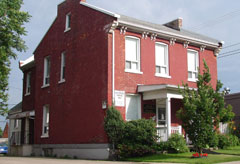
In recent years the Hamilton Latvian Society has seen a revival under the leadership of its energetic chairman Arnolds Smiltnieks. The society boasts about 130 members and has been fueled by funds from volunteers working charity bingo games. The society has renovated its house on Queen Street, donated by Vilis Rudzītis in 1958, with new exterior siding and interior finish. Monthly Latvian video nights run by the society have proved popular. The society hosted the Latvian National Cycling team during the 2003 Road World Cycling Championships in Hamilton. It has also sponsored Liepājas Metalurgs youth hockey teams at tournaments in the Hamilton area. Uncommonly for Latvian organizations, the society has donated money to local charities including the free lunch program at the nearby Christ Church Cathedral and local food drives as well as charities in Latvia that include the Sveķu special needs school, the library and school in Nīca south of Liepāja and the Occupation Museum in Rīga.

Hamilton Latvians have always been frequent visitors to Sidrabene, a summer camp and cottage colony in nearby Burlington that hosts annual Midsummer festivities and runs children’s summer camps. It is owned by the St. Andrew’s Ev. Lutheran Latvian Congregation in Toronto but is actually closer to Hamilton than Toronto.

Latvian Song Festival

The synergy between the Hamilton and Toronto Latvian communities is evident in the 13th Latvian Song Festival in Canada to be held in Hamilton from July 1-5.

The Canadian festivals have been held in Toronto since inception in 1953. Spiralling costs in Toronto—and increasingly louder rumbling from centres like Hamilton, Ottawa and Montreal—finally resulted in a decision to move the festival out of Toronto. Nearby Hamilton was a good choice.

What’s interesting is that the organizing committee includes members not just from Hamilton but also a number who live in Toronto or suburban cities to the west such as Mississauga, Oakville and Burlington, usually considered part of the Greater Toronto Area. Andrejs Buņķis of Toronto is the chair of the committee. Baiba Bredovskis, who headed the charge to get the festival to Hamilton, is vice president and responsible for events while Juris Ķeninš is vice president and responsible for music. Teacher and conductor Vizma Maksiņa is also handling music while Uldis Roze is looking after folk dancing. Juris Simsons, Astrīde Sīlis, Rita Sīlis and Aija Zichmane round out the organizing committee.

The motto for the festival is “Dziedāsim, dancosim, Saules rakstus veidosim” (Let’s sing, let’s dance, let’s create sun signs). The festival is scheduled to kick off July 1 at Camp Sidrabene with a Sun Festival and celebration of July 1, Canada’s national holiday. Festival events will include the traditional choral concert and folk dancing extravaganza, an ecumenical service, a theatre performance, a choreographed folk dance competition, a concert featuring sacred music, Latvian folk music performances, festival balls, a meet-and-greet evening at the waterfront, art and crafts displays as well as a repertoire of Latvian films.

The festival will be held in various downtown Hamilton venues such as Hamilton Place, the Convention Centre, Copps Coliseum and the Art Gallery of Hamilton. All are within yards of each other and connected by sheltered passageways. The DOFASCO Centre for the Performing Arts and the Christ Church Cathedral are also close, only several blocks away from the Sheraton Hamilton Hotel, which will function as the hub of the festival. Only the Royal Hamilton Yacht Club and Sidrabene are farther afield. Mindful of the challenges getting to venues at other festivals, one of the marketing pitches has been “Zem viena jumta / Under one roof.”

Visitors are also reminded of nearby tourist sites: the Royal Botanical Gardens, Toronto and Niagara Falls (only 30 minutes away), as well as almost 20 world-class wineries in the Niagara-on-the-Lake area.

Long under the shadow of nearby Toronto, the Song Festival will allow Hamilton Latvians to step out and be front and centre as they welcome visitors from near and far.
Hamilton Latvian Centre

The Hamilton Latvian Society’s house on Queen Street has been recently renovated. (Photo by Viesturs Zariņš)
Team president talks about rebirth of Dinamo Riga

The Kontinental Hockey League (KHL) replaced the Russian Super League and launched its inaugural season in 2008 with 24 teams mostly from Russia, but Latvia, Kazakhstan and Belarus also have squads. Latvia is represented by Dinamo Riga (Rīgas Dinamo).

Latvian hockey fans may remember the original Dinamo Riga from Soviet days. It was founded in 1945 and survived until the collapse of the Soviet Union in 1991. Between 1949 and 1967 Dinamo was called Rīga Daugava. In 1987-1988, the team won second place in the top Soviet division and was led by Arturs Irbe, then a young and budding Latvian superstar.

Dinamo President Viesturs Koziols is a real estate development entrepreneur and adventurer. He is co-holder of the Latvian hot air balloon height and distance records and has been to the North Pole. Koziols is president of Avantis, a non-government youth organization that sponsored the film Atrasts Amerikā (Found in America). Koziols is part owner (12.18 percent) of Dinamo Riga.

Koziols responded to questions in a telephone interview while the team was visiting Helsinki, Finland.

Question: How did the Kontinental Hockey League arrive in Rīga?

Viesturs Koziols: The first time this question came up was about three years ago. I was part of idle chit-chat about how good it would be to have Dinamo Riga play again with top notch team from Russia, Sweden and other countries. Last year I tried to get Rīga 2000 into the Russia Premier League (one level below the Super League), but that didn’t work because the demands were too high. This year serious talks about establishing the Kontinental Hockey League and including a team from Latvia started around February or March. Former Prime Minister Aigars Kalvītis was in Moscow several times to meet with the league’s founders. He was instrumental in getting us in.

Q: Do you see the KHL as a challenge to the National Hockey League (NHL)?

VK: I think it’s too early to talk about that. This is the KHL’s first season, but last year the NHL celebrated its 90th anniversary. We can’t hope to compete with the NHL for a few years. But I look at things a bit differently. The KHL is the future of European hockey. The KHL can raise the level of hockey in Europe. And to the extent that I’ve talked with Swedes, Finns, Czechs and Germans, everyone is thrilled with the new league even though many have reservations about the ease of working with Russians. However, I can say that if the current atmosphere within the KHL prevails, then everything from a sports or hockey perspective will be fine. Things are a lot better than I had imagined. For example, the former executive director of the National Hockey League Players Association (NHLPA), Bob Goodenow, was hired by KHL head Alex Medvedev as a consultant. When I travelled to Moscow to discuss the possibility of joining the KHL, Goodenow was at the table. To me that said a lot. It’s clear that the KHL will have a Czech team next season. A memorandum of understanding has already been signed. There will also be teams from Sweden and Finland as well as Germany before too long.

Q: How do you respond to comments made by the former Latvian Minister of Foreign Affairs Artis Pabriks that the expansion of the KHL into Latvia and other former Soviet republics is politically motivated and an attempt to expand Russian influence?

VK: I would suggest to Mr. Pabriks that he not mix something delicious like cottage cheese with something that doesn’t taste well in the same bowl—to not mix politics with sports. Our goals are all about sports and it is difficult to imagine how the Russians could influence the Swedish, Finnish, German or Austrian governments through the KHL. That’s crazy. As far as I’m concerned, the more teams we’ll have from European countries, the better it will be for Latvia’s interests.

Q: What does Dinamo Riga do for Latvia’s image?

VK: Let me give you a few examples. When we played in Moscow, I wandered around the arena and local fans, strangers, congratulated Dinamo Riga on their play. They commented that hockey is more interesting with Dinamo Riga in the league. At another arena in Russia, I noticed that our souvenirs were on sale. On one hand I was angry that this was being done without our permission but on the other hand, I was happy that our souvenirs were selling. After Moscow Dinamo visited us, one of Russia’s leading sports newspapers devoted a whole page to Rīga. They lauded our great fans, our team, our city, our country. That’s something our politicians have not been able to do. However we do have to realize that in Russia there will be negative political attitudes towards Latvia. That’s politics. Let’s look at the two games we played in Helsinki. We didn’t do that just to spend money because it wasn’t cheap. We came to Helsinki to popularize Latvia, Rīga, Latvian hockey and Dinamo Riga. Finns came up to us, shook our hands and said they marveled at what we’ve been able to do. And that’s because we’re Latvian patriots, Rīga patriots. But there’s something else. The economic situation in Latvia is difficult. With hockey we’re able to give people in Latvia something to feel good about. Regardless of where I go in Latvia, people come up to me and the first question is always about hockey. They say Viestur, johaidi, what about Masalskis, or why didn’t Hossa score in the last game? Everyone is talking about hockey. I see the positive atmosphere and emotions that Dinamo Riga has created. That’s something that money can’t buy.

Q: What type of hockey does Dinamo Riga play?

VK: Our skills aren’t as good as many Russian teams and we need to be patient, be careful and play defensively. We’ve already shown that we can play in our zone and prevent the opponent from realizing their game plan. And if we’re able to do that and hang in for the first five or 10 minutes, then even though we only have three or four high-calibre forwards, they can take advantage of the situation and go on the counter-attack and score.

Q: How do you avoid complacency among Latvian players who may think they automatically have a place on your team?

VK: It doesn’t matter who the player is. Results are what are important. And if their play isn’t up to what is expected by Dinamo Riga then we’ll send them down to our Riga 2000 farm team.

Q: Did you go after any of the top Latvian pros who play in North America?

VK: Not really, but time will tell if any of them join us in the future.

Q: Tell us about your imports and what type of players you were looking for.

VK: General Manager Normunds Sējējs and I evaluated 200 imports and we chose six. We knew that we needed two strong defensemen. They were Duvie Westcott (201 NHL games) from Canada and Filip Novak (17 NHL games) from the Czech Republic. We knew we needed someone who could score and that was Marcel Hossa (237 NHL games) from Slovakia. We knew we needed someone who could put away rebounds and that was Mark Hartigan (102 NHL games) from Canada. And then there’s Matt Ellison (43 NHL games) from Canada. He’s someone who’ll be out there battling even if he’s exhausted. We needed Ronald Petrovicky (342 NHL games) from Slovakia. He’s someone who doesn’t make way for anyone on the ice. If he needs to fight, he’ll fight; if he needs to go after the puck, he’ll do that. Our imports are role models for local Latvian players who pick up tips from them. But at the same time our imports are also picking up things from the locals. It’s only natural that everyone is learning from each other. But, yes, at this point it is the local boys who are learning most from our imports. That’s the way it should be. The imports are imports. They have more experience and that’s why they’re paid more.

Q: What does the re-birth of Dinamo Riga mean for Latvian hockey?

VK: Dinamo Riga means one thing. Latvian hockey players are starting to gain confidence in their play. By winning against teams like Avangard Omsk, CSKA Moscow, Atlant or Moscow Dinamo the players are able to prove that they can play against and beat Russian teams that are among the best in the world. That hasn’t been the case with the national team which has gone to World Championships to beat Denmark, Norway or Italy and that’s it. But now the players are starting to believe that they can win against strong opponents. That’s the biggest gain for Latvian hockey. In addition, Dinamo Riga will help improve the level of play in Latvia. Young players will see that they don’t need to go to Canada, for example, to play hockey, because there’s top notch hockey in Latvia. There will be new stars and increased fan interest. Our games are broadcast on television and we haven’t had an audience less than 180,000. The best that basketball does is 80,000. Our biggest television audiences were 330,000 when we played CSKA and SKA St. Petersburg. That says a lot.

Q: Three teams in the KHL have the name Dinamo: Minsk, Moscow and Rīga. Why the name Dinamo for your team?

VK: We spent a lot of time discussing what name to choose for the team. Dinamo Riga won out because Dinamo’s successes represented the best era in Latvian hockey. It would be silly to forget or ignore that.

Q: What statement are you trying to make with the design of the Dinamo Riga jersey?

VK: The home jersey is maroon while the away jersey has maroon trim. We wanted to show that we’re patriots of our country, that with our play we respect and defend Latvia’s honour. The three stars on the top, they’re Latvia’s stars. The skyline around the bottom of the jersey is Riga’s and says that we’re from there. The shield represents strength. The two lions from Riga’s coat of arms show that we’re fierce and opponents need to be afraid of us. (The “D” on the jersey is from the Dinamo Riga of old—ed.)

Q: The Toronto Maple Leafs of the NHL pull in USD 1.5 million at the gate for each home game. European teams have to rely less on the gate and more on sponsorship. What can you tell us about the finances of Dinamo Riga?

VK: It’s not realistic to think that business will go very well during our first year. We can’t hope for the kind of crowds that NHL teams pull in or the prices they can charge for tickets. But at the same time Dinamo Riga attendance is very good and averaging 7,500 at Arena Riga home games. In three to four years we’re planning on building our own arena when I expect the economic situation to be better. But it’s clear that our first and second years will be difficult and we will need to leverage every advertising and sponsorship opportunity we can get. (SIA Itera Latvia owns 39.02 percent of Dinamo Riga and is its main sponsor. It is the Latvian subsidiary of a Russian company and is involved in natural and liquefied gas exports and imports, shipping and sales. Other owners include former Kalvītis and former Latvian President Guntis Ulmanis, each with a 9.76 percent share—ed.)

Q: How can you compete against teams like Avangard Omsk, which can spend millions on a player like Jaromir Jagr?

VK: Even though our budget is the third smallest in the league, we’ve proven that it’s not just about money. There are other factors such as teamwork, coaching, discipline, fans and patriotism. Putting them together, you can build a good team.

Q: What about the needs of your players?

VK: Players live on their own, but they get together when we have outings. And of course there are team meals both before and after games. We’ve taken a lot of care to ensure that the team has everything they need: equipment, facilities, computer technology, helping the imports get settled. The team also uses charter aircraft on road trips.

Q: How do you attract fans to fill the seats at your home games?

VK: We have various advertising campaigns and promotions. One of things we do is that we let young hockey players into Dinamo games for one lat if they’re wearing their team jerseys. When I’m at a game, I’m pleased that we have 300, 400 or even 500 young players in the stands from teams in Rīga and other parts of Latvia. We have special promotions for season ticket holders, we work with sponsors and we’re working hard to get our average attendance from 7,500 to 9,000.

Q: Dinamo Riga plays in a division with three teams from Siberia. Would it have not made more sense to align KHL teams geographically?

VK: It certainly would and we’ve been promised, in fact all teams have been told, that next year the divisions will be aligned geographically. That’s why it’s important for us to have new teams from Sweden, Finland, Germany and the Czech Republic because it’s much easier to fly an hour to Prague or Helsinki than it is to get to Habarovsk which is a 12 hour flight with stop-overs.

Q: What is the relationship of the Rīga 2000 team that plays in the Belarus and Latvian leagues to the Dinamo organization?

VK: RIga 2000 is our farm team. We only have one import player on Rīga 2000. The rest are local players because the main objective of Rīga 2000 is to develop young players for Dinamo Riga.

Q: How closely are you involved in player selection and the day-to-day operations of the team?

VK: So far I’m definitely a hands-on owner. In the last six months there hasn’t been a day when I haven’t spent at least a few hours on hockey. The day-to-day work has been intensive but I’m knowledgeable in the game and I need to be there.

Q: Few owners have laced up a pair of skates and played hockey. You have. What does hockey mean personally to Viesturs Koziols?

VK: I usually work 14-, 15- or even 16-hour days. If I didn’t play hockey then it would be much more difficult to handle the workload and stress. From an emotional point of view, like many Latvian hockey fans, hockey for me means great experiences, positive emotions and pride in a job well done. Positive emotions are important for anyone and that’s what hockey gives me.

Q: Do you have any words for Dinamo Riga fans abroad?

VK: We’ve certainly been thinking of our fans, even those far away. If anyone has any ideas or comments then send us a note at info@dinamoriga.eu or info@dinamoriga.lv. At some point fans will also be able to sign-up for e=mail newsletters. That way they’ll be able to get the inside story.

Q: Dinamo Riga played two games in Helsinki. The NHL has played exhibition games in Europe. Any chance of seeing Dinamo Riga in Canada or the United States?

VK: I would be happy if the opportunity arose for us to play a few games in North America. The problem, however, is one of timing. Our training camp gets under way in July while NHL teams start in September when our season is already underway. But it would be easy for us to fly to Chicago, New York or Toronto when compared with our road trips to Siberia and the Russian Far East.

Q: The inaugural KHL season will be a success for Dinamo Riga if…

VK: …Dinamo Riga make the play-offs. But as I said earlier, this season has already been a success. The most important success has been the happy faces and positive emotions that I’ve seen at the arena. But yes, I’d be very happy if we made the play-offs, caught another team off-guard and had a good post-season run.

Dinamo Riga

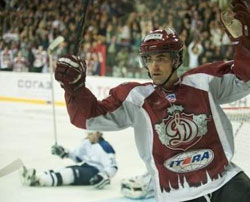
Canadian import Mark Hartigan celebrates a goal against Moscow Dinamo in front of a home crowd. The imports with NHL experience have accounted for more than half of Dinamo Riga’s scoring. (Photo courtesy of Dinamo Riga)

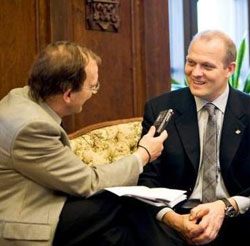
Viesturs Koziols

Team President Viesturs Koziols talks with a journalist during an interview in the Latvian Embassy in Helsinki. Riga Dinamo moved two home games to Helsinki because Arena Riga was not available on those dates. (Photo courtesy of Dinamo Riga)

Latvian hockey players, fans converge on Halifax

The International Ice Hockey Federation celebrates its 100th anniversary this year and as a gesture to the birthplace of hockey, this year’s World Championship is being held in Canada from May 2-18. Eight countries are competing in Québec City, Québec, and another eight are in Halifax, Nova Scotia. The semi-finals and finals will be held in Québec City. Latvia played in Halifax in a tough preliminary round group with Canada, the United States and Slovenia.

Approximately 1,000 Latvian fans arrived in Halifax to support the team. Most were from Latvia but others came from Toronto, Montréal and Halifax itself. A few arrived from the United States.

Four years ago, Latvia’s national team was one of the oldest. This year the team is noticeably younger and less experienced. The average age is 27. Even though more than a half of the team has played at some point in North America either as juniors or pros, most now play in Europe. Two players were based in Latvia last season and only three played in North American. Defenseman Kārlis Skrastiņš, the most prominent Latvian NHLer, did not participate due to a hand injury. Several American Hockey League (AHL) players were tied up with the playoffs and did not make it either, apart from talented Boston Bruins AHL minor-leaguer Mārtiņš Karsums, who arrived on May 10.

It is worth noting that with the changing of the guard on the national team, approximately two-thirds of the players are now ethnic Latvians.

Given the lack of experience playing the physical North American game, Latvia had a tough time against the United States and Canada, losing 4-0 and 7-0, respectively. The shots on goal differential against the U.S. was a lopsided 24-49, but against Canada a decent 30-37.

These results pointed to Latvia’s relatively weak offence when compared to the top teams. At a post-game conference Canadian coach Ken Hitchcock commented that Latvia missed a lot of chances but if they forced the net like teams in North America, the result could have been different.

Latvia’s game against Slovenia was critical for both teams. Slovenia had also lost both its games to the same opponents. The winner on May 6 would move to the qualification round while the loser would go to the relegation round and try to stave off demotion to the next tier. The Slovenes had NHL star Anze Kopitar and in Robert Kristan a hot goalie. They were not to be taken likely. However, this time Latvia won, 3-0. Aleksandrs Ņiživijs scored on a penalty shot midway through the second period while Aleksejs Širokovs added another goal. He pocketed a final empty net goal in the last minute. The Latvian team and fans finally got to see their flag raised and were able to sing their national anthem, “Dievs, svētī Latviju!”

In the first game of the qualification round, Latvia played Finland on May 9 losing 2-1 even though the team was outshot 64-27. The hero of the game was goaltender Edgars Masaļskis, who kept Latvia in the game. Two days later, Latvia beat Norway 4-1. The game against Germany on May 12 and results from other games will be deciding factors where Latvia places and whether it will make the quarterfinals.

Among the players, goaltender Masaļskis put in an excellent performance and is arguably Latvia’s most valuable player in this year’s championship. Also worth mentioning are the three Rēdlihs brothers: Miķelis, Krišjānis and Jēkabs, who played together on the team. Captain Rodrigo Laviņš put in a solid performance and Arvīds Reķis was a tower of strength on defense. Centres Jānis Sprukts and Herberts Vasiļjevs added experience down the middle. Forwards Lauris Dārziņš and Armands Bērziņš created a lot of opportunities but often failed to finish. Even though Karsums joined the lineup without being able to practice with the team, he put in a solid two-way performance against the Norwegians.

Los Angeles Kings forward and enforcer Raitis Ivanāns was the only NHLer on Latvia’s roster. At 6 feet, 4 inches (1.92 meters) and 220 pounds (100 kilograms), he brought a strong physical presence to the ice. Even though he took several needless penalties, he was quick to wade into the fray when the Americans and Canadian started charging Latvia’s goaltenders and to help out Latvia’s smaller forwards. His thundering check against a Slovenian player arguably helped Latvia break out of the 0-0 tie. This was Ivanāns debut at the World Championship and he showed those who thought he could only fight the value of a physical game.

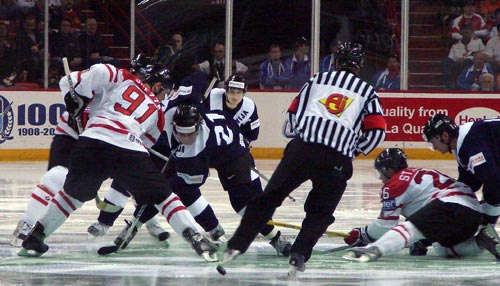
During the championship, each team played one game in historical uniforms. In the game against Canada, instead of the usual maroon-white-maroon or white-maroon-white jerseys, Latvia wore dark blue replica uniforms from the 1936 Olympics.

Fans enjoy Halifax

Even though Latvia will likely not make it to the medal round, Latvia’s fans have once again been among the best. They were a common sight on the streets and in the bars of Halifax with their team’s jerseys. Their drums, horns, songs and chants were deafening at the Halifax Metro Centre venue easily surpassing what Canadian fans could muster when prompted by the electronic scoreboard.

Latvia’s fans got a lot of media attention and they were popular among the locals, even more so when Latvians supported Canada in games that Latvia did not play. Canadian fans would often take pictures of Latvians and were eager to share a beer or two. On the way to the Latvia–Slovenia game, two Canadians were overheard discussing who they should support. One said that he had never seen the likes of Latvian fans and, as a result, he was supporting Latvia.

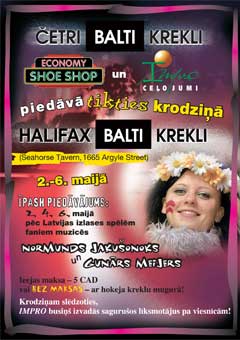
Long-time Latvian Haligonian Roberts Dambergs had lined up The Economy Shoe Shop bar and restaurant complex as a home for Latvians. After Latvia’s games, hundreds of fans would show up. With support from the Rīga club Četri balti krekli, the complex’s Seahorse Tavern was rechristened Halifax balti krekli (Halifax White Jerseys) for the championship. Aldaris Zelta beer was served along with local brews and musicians Gunārs Meijers and Normunds Jakušonoks performed. Dambergs also created a Web site, Hokejs Halifaksā, with useful information for arriving fans. The information was also published in a ceļvedis or tourist guide that was distributed to departing fans in Latvia.

On days when Latvia did not play, Latvian fans spread out to check out Halifax, the famous Citadel from British colonial days, the renovated waterfront, the world famous Peggys Cove fishing hamlet and even farther to the Bay of Fundy to see the world’s highest tides. The World Championship was also an opportunity for Latvian enterpreneurs to visit local businesses and look for trade opportunities, as was reported in the Halifax Chronicle Herald.

On May 3 Latvia’s ambassador to Canada, Marģers Krams, hosted a reception at the Halifax World Trade Centre. Among the guests were Kirovs Lipmans, president of the Latvian Ice Hockey Federation; board member and former Latvian President Guntis Ulmanis; the team’s General Manager Māris Baldonieks; the team, including players, staff and coach Oļegs Znaroks; the Latvian federation’s Canadian representative Viesturs Zariņš; a number of younger Latvian fans from Toronto including Latvian Hockey Fan Club in Canada co-president Vilnis Blūms, and local Latvians led by Dambergs.

Before the championship, Latvia played an exhibition game against Belarus on April 26 in Montréal where both teams held their training camps. The score was tied 0-0 after regulation and an overtime period. It was finally settled in a shoot-out. Belarus won in the eight round. About 200 noisy Latvian fans from Montréal and Ottawa, plus a few from Toronto, were there to support Latvia. Following the game, the team came out to greet the fans and sign autographs.

For those Latvians in attendance, this year’s World Championship in Halifax has been a momentous occasion. Hockey is not only the most popular sport in Latvia but it plays a positive role in consolidating Latvian society. Hockey also creates a positive image for Latvia in the world worth its weight in gold.

Classic uniforms

Latvian player Armands Bērziņš, sporting a dark blue jersey similar to those worn by the 1936 Latvian Olympic team, takes the faceoff against Canada. (Photo by Viesturs Zariņš)

Hockey flyer

A flyer advertises the availability of a Halifax tavern for Latvian fans—complete with musicians from Latvia.