Many Latvians think of Siberia as a wintry hell that swallowed up thousands of their compatriots during Stalin’s rule. However, in a much less known story, this vast territory is also home to the village of Lejas Bulāna, a place that can probably claim to be the longest surviving Latvian diaspora settlement in the world.
While most Latvians in the West arrived in the same migration flow in the early 1950s, those heading to the East have been a much more varied bunch. During World War I, much of the population of Latvia fled to Russia to escape the invading Germans. Some of them couldn’t return to their homeland after 1918, while many committed communists willingly stayed on. The post-revolutionary Latvians in Russia published newspapers, ran schools and theatres, and provided numerous high-ranking officials in the Bolshevik regime, who were massacred in the purge of the 1930s.
Quite a few who survived the 1940s deportations from Latvia chose not to return home after Soviet leader Joseph Stalin’s death and are still living in Russia to this day. They were joined by thousands of others in the 1960s and 1970s who moved east to take up jobs or join spouses.
The residents of Lejas Bulāna trace their roots back well before these migrations. Their ancestors must have passed on some tough genes, because after almost a century and a half, its 140-odd people still speak the language of their ancestors and have preserved traditions that have died out even in Latvia itself.
Gathering the faithful
The foundation of Bulāna is a tale of sinners and saviours. Long before the creation of the Soviet Union, many people from the Western provinces of the Russian Empire were being deported to Siberia for real or imaginary crimes. By the mid 19th century, the spiritual authorities were becoming concerned about the souls of this scattered flock.
About 1845 the Moscow Lutheran consistory sent a minister by the name of Sederholm to make a survey of their co-religionists in exile. After a journey of some 15,000 kilometres he concluded that it was impossible to minister to such a widely scattered group, and so in 1851 the Russian government ordered that in future all Lutheran deportees should be settled in the Minusinsk district around the southern reaches of the Yenesei River. In 1858 several Latvian and German families settled on the banks of a Yenesei tributary, the Kebezh River, which the people of Bulāna to this day refer to by the very Latvian name Lielupe. Separate Finnish and Estonian villages were also founded in the area.
The people living in Bulāna today are mostly the descendants of these 19th century colonists. Time has erased most memories of these beginnings, but most think that their ancestors came from Kurzeme, the western province of Latvia. One old woman remembers her grandmother recounting how it took her a year to walk to Bulāna.
More can be learned from the memoirs of Jānis Driķis, a teacher in Bulāna at the turn of the century. Driķis wrote that the driving force behind the establishment of Bulāna was a German minister named Kosman, who for three summers travelled from Irkutsk to oversee the colony. He was an energetic man who taught the villagers to build houses, brought in school teachers and tried to correct the wayward path of some villagers who drank away the horses and seeds they had been given for farming.
Kosman said he wished to settle in Bulāna full time and asked the villagers to build him a house and tend some fields to support him. But they objected to what they saw as a reintroduction of German and baronial authority—and sent him packing. Occasional clashes were reported between the German and Latvian residents of the village, but after a few generations it seems that the Latvians assimilated their neighbours.
Other ministers followed Kosman, none of whom had an easy time. One problem was a shortage of women. Because few deportees were allowed to bring their spouses with them and exiles were considered as being divorced from commitments back in their homelands. The villagers refused to have Russian brides and so when groups of deported Latvian women were brought in, both genders were lined up facing each other and instant weddings conducted.
Early in the life of the colony gold was discovered in the nearby Sayan Mountains. Many young men departed to seek their fortunes. Driśis describes the short, turbulent lives of the miners, most of whom returned to Bulāna from the diggings in autumn, caroused away their money, and were indentured by leaders of mine gangs who paid off the drinkers’ debts in return for work.
However, the land proved to be a more durable resource. The rich black soil and short, hot summers of this area allow the growing of many crops, including sunflowers and watermelons. In addition to these natural advantages, Driśis wrote that the sturdier pioneers, often those deported for trivial offences, thrived away from the dominating German landowners in Latvia. Free to chop timber and use meadows where they pleased, the settlers began writing home that they had found a land “where milk and honey flows.” Free settlers began moving in. According to the 1897 Russian census, the village had 910 inhabitants, of whom 786 were Latvians. In that year in Western Siberia as a whole there were 6,768 Latvians, 4,082 Estonians and 2,038 Lithuanians.
This census also reveals the relatively high education level of the Latvian colonists, with 69 percent of men and 60 percent of women aged 20 to 29 being able to read. Fifty-five percent of the Latvians were farmers, with 16 percent engaged in mining or metallurgy.
Credit for the high educational standards may go to the village school established in 1860 and to the church opened in 1886. Both these institutions survived the horrors of the 20th century and are crucial to community life today.
Hell on Earth
After the ravages of World War I and the Russian Civil War, Bulāna never regained its previous population level. In the early 1930s the Communist collectivisation drives forced the farmers out of their freestanding homesteads and into the village proper. The wealthier ones, or those who had simply earned the ire of the authorities for one reason or another, were deported to the far north of Siberia. The old people in the village remember the early years of collectivisation as times of slavery and hunger, as they were forced to work for no pay and could be punished for hiding food from the commissars.
The village church was converted into a social club after its steeple was torn down. Religious books were destroyed. And the saying that he who burns books will soon burn people came to fruition, as Stalin’s mass purges decimated the Latvian population in Russia. Bulāna also fell victim with dozens of men taken away on trumped-up charges and shot.
At least 147 people were executed or deported from Bulāna in the 1930s. Simultaneously, teaching in Latvian at the school was banned, as were all Latvian-language books.
World War II also cut a swath through the village. In the early stages of the German invasion of the Soviet Union, Latvians were not conscripted into the Red Army because they were considered a suspect group by the regime, but this policy changed toward the end of 1941 as the military situation worsened. Starting with the battles near Moscow in late 1941, most of the young men from the village were killed fighting on various fronts. Two surviving veterans still living in Bulāna, Aleksandrs Melbārdis and Roberts Atklībers, both spent a few months in Latvia towards the end of the war when their units were stationed there.
The old villagers remember the years after Stalin’s death in 1953 as a time of relative peace and prosperity. Bans on peasants leaving their villages were lifted and people were paid for their work on the kolkhoz.
And despite the horrors, the village managed to keep its Latvian identity. This was partly due to Bulāna’s isolation: the nearest town of any size is about 25 kilometres away. Until about 20 years ago no roads led to Bulāna, just pitted tracks that became unusable in bad weather.
But most of the credit must go to the women of the village. They maintained songs and folklore and spoke Latvian to their children at home. In the absence of ministers, old women conducted Lutheran services at funerals and christenings. Despite living in an officially atheist state, every single child was baptised, a tradition that continues today even in families where one parent is Russian.
In fact, the people of Bulāna identify themselves as strongly with their religious faith as with their nationality. Lonija Tomane, the village librarian, said that until about the 1950s there was strong family pressure on children to marry other Lutherans, so that ethnic Germans and Estonians were acceptable spouses, but Orthodox Russians were not. Bibles printed in Latvia in the 18th and 19th centuries and hidden during the Stalinist book burnings can still be found in the village.
Hard lives
Lejas Bulāna is not only still in existence after 143 years, but its culture has preserved some traditions that have disappeared in Latvia itself.
Naturally, some Russian words and phrases have become a part of the villagers’ vocabulary, but the dominant language is still that of their ancestors. The Bulāna dialect is clearly understandable to speakers of standard Latvian, but shares some features of the tongue spoken in Ventspils district in northern Kurzeme. Endings of words are chopped off in speech, and there are no genderized pronouns (both males and females are spoken of as viņš, or “he”). Another oddity is that some German words are substituted for Latvian ones, for example, gapele instead of dakša (fork) or ķisenis instead of spilvens (pillow). These words may have been picked up from the Germans who lived in Bulāna in its early years, or it may be that the language in Bulāna has retained elements of speech common in Latvia in the 19th century, when German cultural influence was strong.
Although they complain that their memories are fading, the old women still know many songs. Lots of them are folk tunes that would be familiar to Latvians elsewhere, although the melodies and inflections in the voices have local variations. Another idiosyncrasy is the celebration of Jāņi, Midsummer’s Eve, which still involves Latvian traditions such as bonfires and cheese-making, but takes place two weeks later than in Latvia, in line with the Julian calender that was used in the Czarist Empire before 1917.
However, while Bulāna has done exceptionally well to preserve its past, its future may be bleak. This is largely because the economic decline of Russia since the late 1980s seems to have hit this village especially hard.
Back in Soviet days, the local collective farm employed most of the people, but it has been a failure in the transition to capitalism. Low prices for crops have meant that it makes just enough money to buy seed and fuel from season to season, and just 10 people work for it, often without getting paid. Lack of transport and distances to markets have prevented individuals from selling their crops.
Virtually the only other cash in the village is from pensions and from the salaries paid to the school teachers, which are meagre and frequently in arrears. The people grow all their own food. Life moves to a cycle of planting, weeding, harvesting and milking. The village is electrified, but most houses have hand-operated wells and outside toilets. Alcoholism is a serious problem.
This has led to rapid depopulation. With the school only running to the ninth grade, the pupils complete their education at boarding schools in the surrounding towns. The lack of jobs means that most of them never come back. Only a few children have been born in Bulāna in recent years, while the lack of available spouses means that those few young people who do stay usually intermarry with Russians or Estonians. In most cases, the language spoken in these mixed families is Russian.
Many people in the surrounding districts trace their origins to Bulāna, but they are rapidly being assimilated into the mainstream of Russian society. For example, in the town of Yermakovsk, about 50 kilometers from Bulāna, about two thirds of the population of 5,000 are of Latvian or Estonian descent. But the lingua franca between these people is overwhelmingly Russian.
Also, ironically, fewer people from Bulāna are moving to Latvia now than in Soviet times. Earlier, transport was cheap and people were guaranteed jobs and housing wherever they went in the Soviet Union. Today, the Latvian government does provide no-cost visas to Russian citizens of ethnic Latvian origin, and some money for relocation expenses, but afterwards the migrants have to fend for themselves in a struggling economy. Latvia does not have the means to support them, in contrast to the German government which has spent large sums on repatriating its ethnic minority in Russia.
However, Bulāna is being helped by a factor which at first glance might seem to be its biggest threat: the surrounding Russian population. In recent years, four families belonging to a religious cult that worships a guru named Vissarion have moved in after buying abandoned houses from the kolkhoz (see sidebar). The Latvians in Bulāna are mistrustful of these folk who are both Russians and non-Lutherans, but in everyday life the two groups get along well enough. Three of the cult members teach some subjects at the school, and their children willingly attend Latvian-language lessons with the other youngsters.
The attitude of the Russian authorities towards Bulāna is also quite positive. Local newspapers and television programs have run stories praising its interesting history and culture. The 140th anniversary of the school in July 2000 was attended by numerous dignitaries from as far away as Krasnoyarsk. There is official support for teachers from Latvia who teach extra Latvian language lessons alongside the standard curriculum, which is taught in Russian.
The local Lutheran church is also a force for the good. Lutherans in Russia are a tiny minority, but they have a seminary in St. Petersburg that has trained ministers who now run an active parish in Krasnoyarsk. These Russian-speaking clergymen regularly visit Bulāna to hold services and organise Christian camps for the village children.
Reunion
The last decade has also seen increased contacts with Latvia. Although the links were never entirely severed, they were strengthened in 1975, when two young adventurers literally rode into town. Ingvars Leitis, an historian and journalist, and photographer Uldis Briedis set out in that year to cycle from Rīga to Vladivostok. They told the authorities this was their way of paying tribute to the great Socialist Motherland, but their real agenda was to visit the sites of former Gulag camps and older places where Latvians had settled. Leitis says he was stunned to enter Bulāna and find not an archaeological site, but a living community.
He made several documentary films about Bulāna that were only screened in the late 1980s. Two other film makers, Vaira Strautniece and Andris Slapiņš from the Juris Podnieks Studio in Rīga, also documented the life of the village in the mid 1970s.
The contacts increased during the independence drive. A theatre group from Saldus in western Latvia paid a visit in 1989 and in that same year two young teachers from Latvia arrived to spend a year working in the local school. These educational missions have continued up to the present. Strautniece organised a trip to Bulāna in 1991 by folklorists, philologists, ethnographers and other academics, whose studies were published in a comprehensive book about the village.
The Lutheran church in Latvia has also taken an active interest in Bulāna. A semi-clandestine visitor in the early 1980s was Juris Rubenis, who is now a prominent social commentator and the pastor of the Torņkalna Church in Rīga. Jānis Vanags, the Lutheran archbishop of Latvia, held a service in Bulāna in the summer of 2000 and has promised that pastors from Latvia will make annual visits. This year is the third in succession when the teachers going to Bulāna have come from the Svētā Gregora Christian Academy in Saldus; a young missionary from this school is also preparing to set out to work with the village alcoholics.
Despite its problems, Bulāna has lived through much worse times, and may very well survive into the foreseeable future. Its people’s courage, resilience and pride in their heritage can be an inspiration to Latvians elsewhere in the world.
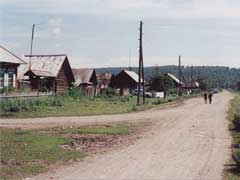
Roads are few in the small Latvian community of Lejas Bulāna in southern Siberia. (Photo by Philip Birzulis)
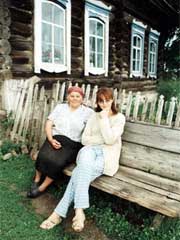
Lejas Bulāna resident Emilija Blūmberga and former school director Vera Gutmane, now living in Latvia, pose for a photographer in the village. (Photo by Philip Birzulis)