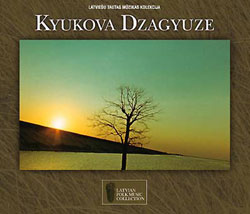
Laiksne sings of weddings and cuckoos

Kyukova dzagyuze

Laiksne specializes in the music of eastern Latvia, and all of the songs on Kyukova dzagyuze (The Cuckoo Called) are sung in the Latgallian dialect. None of the singers is a native speaker of the dialect, but they do a good job. They have employed linguistic consultants, as well as specialists in traditional singing and music, and the result is a very professional recording.

Laiksne’s style of singing is not "rough." It is not the almost-shouting style of singing that some people associate with songs in dialect. The five young women (Lauma Garkalne, Dina Kalniņa, Dace Prūse, Baiba Suško and Vineta Romāne) are all very strong singers with rich, beautiful voices. If you happen to have heard Bolta eimu, the third album in UPE’s Latvian Folk Music Collection featuring the music of Biruta Ozoliņa, then you will understand when I say that Kyukova dzagyuze sounds much like Biruta Ozoliņa times five—and turned up a notch or two in volume and in the variety of instruments.

The recording begins with "Zynu, zynu brūļu sātu," a dreamy song that does not mention the namesake of the album, the cuckoo, but speaks nonetheless about the heartache a grown daughter has for her childhood home.

The album is built around the theme of the cuckoo, a bird that is associated with sorrow, heartache and ill fortune in Latvian—and especially Latgallian—folklore. The cuckoo motif shows up in funeral songs, but also in many wedding songs, because marriage was thought of as a type of death (the woman left a relatively carefree life with her family and was "reborn" into a harsher life as a young wife in her husband’s home). Kyukova dzagyuze focuses on these wedding songs referring to the cuckoo. They are a very appropriate theme for a group of young women, and Laiksne has selected the songs and arranged them very well.

The calmer, slower songs—such as "Kyukova dzagyuze," "Kū es beju sarībuse," "Tymsā dzymu, tymsā augu," and "Kyukoj ōra dzagyuzeite"—all tend to have that dreamy feel to them. Considering the usually heavy emotion in these songs, some sound surprisingly light. "Vanadzenis tupēja" is least like the rest, reminding me of the Lithaunian "sutartine" singing style. Every time I listen to the compact disc I seem to pick out a new favorite song: "Mani mōte radeja," "Palākais vanadzeni," "Tōli mani tēvs atdeve"…

Laiksne is usually considered a "post folklore" group, but they’re not rocky, plugged in or too far out there. In fact, despite the careful arrangements, I would consider their music quite traditional. The accompaniments are heavy on the kokle, the ancient Baltic stringed instrument, but Laiksne also play violin, whistles, bass, drum and bagpipe. A cool switch from major to minor key in "Tev mōseņ zeile vēsti nese" caught my ear as something unusual, but otherwise the harmonies and arrangements do not travel far from the Latvian singing tradition.

For the most part the Kyukova dzagyuze songs are not well-known, but they definitely grow on you and provide for good and beautiful listening.

Details

Kyukova dzagyuze

Laiksne

UPE Recording Co.,  2001

UPE CD 025

Tumsa: Not great yet, but getting better

Nesaprasto cilvēku zemē

After enjoying Tumsa’s 2000 release, Katram savu Atlantīdu, I picked up their 1997 debut, Putni. I also liked that album, which was far more "hard rock" than Atlantīdu. In terms of musicianship and songwriting, Tumsa had considerably evolved between the two albums. With Nesaprasto cilvēku zemē, it has became apparent that Tumsa is slowly perfecting their craft, making this the best and most consistent release of their career.

The core of the group has always been Mārtiņš Freimanis, who not only provides vocals and plays the acoustic guitar, but is the principal songwriter as well. Rounding out the band are Haralds Drekslers on rhythm and solo guitar, Jānis Daugalis on bass guitar, Kaspars Boroduško on drums and Einārs Kokins on sound. Joining them on this album is Aigars Šmits on keyboards.

Tumsa are first and foremost a rock band, and one of the better examples of that is the opening track "Tā nav lijis," with its catchy and sing-a-long chorus. This song also takes advantage of the presence of the new keyboardist, with the piano providing the hummable main melody.

In a more curious example of their evolution is the song "Tu neesi tāda." The drum beat reminds me of quite a few disco songs, though the song itself is very effective, but perhaps a bit out of place on the album.

Another song that deviates from the regular Tumsa sound is "Lai būtu tā," which sounds like it is from the early days of rock (although with a modernized sound). It reminds me a bit of the song "The Lion Sleeps Tonight," what with its constantly repeating backing vocals. Though it is a deviation from their regular style, this song is also very likable, since it has such a light touch, compared to some of the more serious and heavy songs on the album.

The lyrics on the album are also expansive in their subject matter. One of the more “disturbing” songs on the album is "Šupuldziesma slepkavam," which, as its title suggest, is a rather dark song—a lullaby for a murderer. Freimanis’ lyrics include the line "Guli mans asiņainais draugs" (Sleep my bloody friend).

However, many of the lyrics on the album do go over my head. Sometimes I’m not really quite sure what Freimanis is trying to say in a song, but that did not take away from my enjoyment of the album

My favorite song on the album is probably "Arī man ir sirds." With its great beat and driving rhythm, I think this is destined to be one of the all-time Tumsa classics. I would imagine it would be a hit in concert as well, with its oft-repeated phrase "Ša la la."

One criticism of the album would be that even though Tumsa have nearly perfected their songwriting craft, many of the songs wind up sounding very similar. One might ask, "Why mess with a winning formula?" However, Tumsa seem to be aware of this, judging by some of the afortementioned songs that try to break out of their regular mold.

The most apparent weakness of the Katram savu Atlantīdu was that it had a few too many songs in English (four in total). Perhaps wisely they decided to record every song on this album in Latvian.

Nesaprasto cilvēku zemē is a very solid and highly enjoyable rock record. But I am of the belief that Tumsa have not yet made a truly great album. These guys have incredible talent and I think they have a truly great album in them. In the meantime, Nesaprasto cilvēku zemē should delight all rock fans and help Tumsa reach an even broader audience, something these guys have worked hard to do and of which they are fully deserving.

Details

Nesaprasto cilvēku zemē

Tumsa

MICREC,  2001

Egils Kaljo is an American-born Latvian from the New York area . Kaljo began listening to Latvian music as soon as he was able to put a record on a record player, and still has old Bellacord 78 rpm records lying around somewhere.

OSCE official opens mouth, inserts foot

Memo to Gerard Stoudmann: The next time someone asks you about language policy in Latvia, keep your mouth shut. Stoudmann is director of the Office for Democratic Institutions and Human Rights for the Organization for Security and Co-operation in Europe.

During a two-day visit to Rīga that concluded March 20, Stoudmann met with government officials and discussed a number of issues. He also pressed Latvia to remove a provision in the country’s election law that requires political candidates to prove their proficiency in the Latvian language, according to an OSCE press release. The need for reform, he suggested, is urgent as Latvia heads toward its next parliamentary election on Oct. 5 and looks beyond that date to potential membership in the NATO defense alliance and in the European Union.

But then, in a remark about language policy made during a conference on OSCE and Latvian cooperation, Stoudmann stepped over the line, according to media reports. He said Russian should be made Latvia’s second official language. A third of the nation’s inhabitants speak Russian as their first language.

The OSCE, for those not familiar with this powerful international body, traces its roots back to the early Cold War era. It attempts to resolve disagreements between European nations before they rupture into armed conflicts.

Human rights and democratic reforms have been among the OSCE’s key concerns. But so has the principle of self-determination.

Stoudmann, as Latvians would say, izgāza podu (upset the pot). His remark, widely reported in local media, soon brought a groundswell of rebuke. Even Latvian Prime Minister Andris Bērziņš called for his resignation.

Apparently realizing that he was guilty of a major faux pas, Stoudmann on March 21 recanted, saying his comments were meant as "personal reflection," not a statement of OSCE policy. "I wish to stress that my intention never was to suggest that Russian be made the second state language in Latvia, or that this issue was on the agenda," Stoudmann said in a press release. "I am fully aware of the sensitivities surrounding the issue in Latvia."

Unfortunately, the damage had already been done.

The Russian Foreign Ministry, for example, piggy-backed on Stoudmann’s remark and once again complained that Latvia isn’t mindful of the rights of its Russian-speaking minority.

The OSCE is correct to point out problems in Latvia’s election law. Asking that political candidates prove their language ability is discriminatory and unconstitutional, as a language commission appointed by President Vaira Vīķe-Freiberga said earlier this year. To be a candidate for political office in Latvia, you must be a citizen. Citizens should not be asked such questions. Let the voters decide whether a candidate is fit for office.

But to suggest, even as "personal reflection," that Russian be made a second official language is unfair to a nation that is still trying to clean up the mess left by a half-century of occupation. It’s particularly unfair because the loudest voice in the language debate is across the border and some 800 kilometers away in Moscow. Who’s watching out for the interest of the Latvians?

If the OSCE really wants to help, it could do more to promote Latvian language education as part of the process of becoming a citizen. Of Latvia’s 2.3 million inhabitants, 22.3 percent are still classed as noncitizens, according to government figures. Russians make up nearly 350,000 of the noncitizens.

In the meantime, Stoudmann’s remark is a reminder for ethnic Latvians that they are the only ones who will look after their interests. Already a number of readers of the SVEIKS mailing list are planning an electronic notification "tree" that would serve to mobilize letter-writing campaigns and other activities for the next time someone like Stoudmann says something damaging to Latvia’s cause. According to Jānis Trallis, better known online as "Rodrigo," there are plans to set up a Web site to coordinate the effort. SVEIKS readers are trying to come up with a name, with "e-Taure" slightly favored over "e-Koks."

The unintended result of Stoudmann’s "personal reflection" may well be the strengthening of Latvians’ resolve on the language issue. If he survives in his OSCE post, he’s sure to find his job in Latvia will have become much tougher.

Andris Straumanis is a special correspondent for and a co-founder of Latvians Online. From 2000–2012 he was editor of the website.