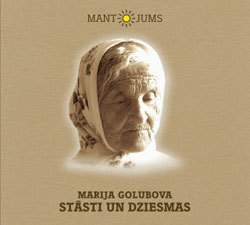
Don’t you dare make fun of Marija Golubova

With the release of Marija Golubova: Stāsti un dziesmas, the Rīga-based UPE Recording Co. has begun a new series of recordings named Mantojums (Inheritance). The compact disc is one of three titles released last December.

Marija Golubova is a simple country woman from the far northeastern corner of Latvia, very near the border with the Abrene region, which is currently under Russian control. Stories and songs have always been an important part of her life, and on Stāsti un dziesmas (Stories and Songs) we hear a few of the stories from her long life—from walking barefoot through the snow after her husband’s arrest to her father’s recipe for beer to her admiration of ants and the whole of nature.

In between the stories, Golubova sings about a dozen of her songs, most of which are not part of the average Latvian’s repertoire. But it’s exactly for that reason that I was very happy to listen to the CD, because I like to hear new songs. All of the songs are, of course, sung in the Latgallian dialect, and two are Russian songs. In “Voi toutīt, kūkacīt,” Golubova sings a long string of verses to a melody more commonly known for its soldier words (“Div’ dūjiņas”). Another is a Jāņi song with the ļeigū refrain. Some of the other songs are: “Lec, saulīte, rijtā agri,” “Voi celinu man nabeja,” “Toutīts mani carādams,” “Patijk man tis kaļnins,” “Tī bej labi olu dzerti,” and “Skanu baļsini palaidu.”

It seems that most of the songs are in minor keys, not uncommon for Latvian songs. But it’s too bad that the CD does not include the song texts, because deciphering them just by listening to them is difficult. Most listeners will also really have to concentrate to understand even half of Golubova’s stories because of the heavy dialect.

There’s no way of putting it nicely—Golubova is an old lady, her voice cracks and goes in and out of tune, and she’s probably a few teeth short, too. But don’t you dare make fun of her. She still has amazing strength and confidence behind her 97-year-old voice, deep emotion in her stories, and a difficult life to describe.

Marija Golubova: Stāsti un dziesmas is not something you would put on as pleasant background music at your next dinner party. But it is an important and interesting recording for those who appreciate oral history and the real “roots” of folk music.

The other two recordings released in December are Pasaules radīšana, featuring creation stories told by Leons Krivāns, and Putnu un zvēru valoda, with stories about the language of birds and animals told by Pēteris Liepiņš.

Details

Marija Golubova: Stāsti un dziesmas

Mantojums

UPE Recording Co.,  2003

UPE CD 056
President to visit Portugal

Latvian President Vaira Vīķe-Freiberga will visit Portugal from Sept. 13-16 to meet with political and business leaders in Lisbon and Porto, the president’s press office has announced.

Vīķe-Freiberga will meet Sept. 14 with Portuguese President Jorge Fernando Branco de Sampaio as well as with members of the country’s parliament. She also is expected to speak to city officials in Lisbon.

On Sept. 15, the Latvian president will meet with Prime Minister Pedro Santana Lopes, attend a business forum and give a speech, “Latvia in the New Europe,” at Universidade Lusiada.

A visit to Porto, Portugal’s second largest city, is on the schedule for Sept. 16. Vīķe-Freiberga will meet with local political and business leaders, as well as unveil a memorial at the Latvian honorary consulate in Porto.

Vīķe-Freiberga will be accompanied on the visit by her husband, Imants Freibergs.

Andris Straumanis is a special correspondent for and a co-founder of Latvians Online. From 2000–2012 he was editor of the website.

Līgo collection sounds a tad too contemporary

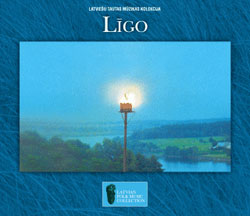
Līgo, the latest compact disc in UPE Recording Co.‘s Latvian Folk Music Collection doesn’t sound like the Jāņi celebration I was at earlier this summer. Of course, the basic songs and the “līgo” refrains would have fit in. But this recording is more of an exercise in musical arrangement, more of an “art recording” by former Iļģi member Zane Šmite, Ilze Grunte and Mārtiņš Tauriņš.

Jāņi is the Latvian summer solstice celebration—the longest day and shortest night of the year—and “līgo” is the typical refrain of the summer solstice songs. “Līgo” means a type of swinging or swaying, also in the sense that in early summer everything in nature, as well as human activity, is “in full swing.” Jāņi tends to be a boisterous and exuberant celebration. But there is also a mystical side to Jāņi that often goes unnoticed: the quiet miracle of nature in full bloom and a yearning to become a part of it. It seems that this CD has tried to capture some of that mysticism, by way of modern arrangements of ancient folk tunes.

The CD begins with birds chirping and softly sung verses proclaiming that Jāņi is the holiest day of the year. This reverie is interrupted by a horn announcing the arrival of the loud neighbors and jāņabērni (Jāņi celebrators). The second and third songs are again quieter. Grunts and overtone singing make the fourth song, “Jāņu nakti nepazinu,” very masculine, almost macho. The next song, “Uz avotu līgot gāju,” has an easy-listening sound to it, while “Teku, teku” makes beautiful use of echoes. (Or is it a round? It’s hard to tell, but the result is entrancing.). Whispers and heavy breathing give “Sijāju uguni” a slightly disjointed sound. It is followed by an unruly version of the song-game “Dimdaru, damdaru.”

Līgo ends with one of my favorite Jāņi melodies. Against a background of static-like rain and with understandable tiredness in her voice—because it is a tradition to stay awake all night at Jāņi—the singer sings a farewell to Jānis, the namesake of the celebration, and tells him that everyone will be awaiting his return next year.

Mostly guitar, bass and nature sounds accompany the stylized songs of Līgo. If they are all, in fact, traditional melodies, then some of them are well hidden in the arrangements. As always in the Latvian Folk Music Collection, the liner notes provide the full text and translation for every song.

With nature at its fullest and all of the festivities taking place outdoors, Ive always felt like singing loudly at Jāņi. That’s why at first the mostly reserved manner of Līgo seems kind of out of place. That said, the CD does have that mystical feeling and is pleasant to listen to, although some may wonder whether it’s a bit too contemporary to be included in a collection of folk music.

Details

Līgo

Latviešu tautas mūzikas kolekcija

UPE Recording Co.,  2003

UPE CD 047