These stories for kids are good for adults, too

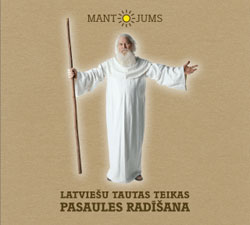
Latviešu tautas teikas: Pasaules radīšana (Latvian Folk Tales: The Creation of the World) is a collection of 24 tales read in standard Latvian by a professional reader. Leons Krivāns reads clearly and with the right amount of expression—pleasant to listen to, but not too overdone. Kaspars Tobis provides bits of background music (mostly meditative synthesizer) and sound effects, but it still probably goes without saying that this compact disc is primarily for those listeners who understand the Latvian language.

The recording is part of the “Mantojums” series produced by UPE Recording Co. of Rīga. The first three recordings in the series were released in December.

As the title suggests, most of the tales are about the creation of various parts of the world: how the land was formed; how the hills and roads, the stars and the Big Dipper, the rainbow, the big river, and the dew were created. Most are clever explanations and many involve God and the foolish devil, but a couple of the tales are kind of silly. There are three tales about fire, and even a tale about solar and lunar eclipses.

The tales were selected from the collections of the well-known Latvian folk tale collectors Ansis Lerhis-Puškaitis (1859-1903) and Pēteris Šmits (1869-1938).

Lerhis-Puškaitis began already as a child to write down the stories and tales he heard from classmates in his dormitory, and by the end of his life he had recorded around 6,000 folk tales and fairy tales. He always tried to keep the tales true to the speakers dialect and speech idiosyncrasies.

Šmits was a linguist who eventually devoted more and more of his time to the collection of Latvian folklore. He published collections of folk beliefs, folk songs, traditional designs, and mythology in addition to a 15-volume collection of folk tales and fairy tales.

I recommend Latviešu tautas teikas: Pasaules radīšana to anyone who enjoys listening to folk tales. It’s great for children, but great for adults, too.

The other two recordings in the “Mantojums” series are Marija Golubova: Stāsti un dziesmas, featuring Marija Golubova telling stories and singing songs from her long life, and Putnu un zvēru valoda, with stories about the language of birds and animals told by Pēteris Liepiņš.

Details

Latviešu tautas teikas: Pasaules radīšana

Mantojums

UPE Recording Co.,  2003

UPE CD 054
Don’t you dare make fun of Marija Golubova

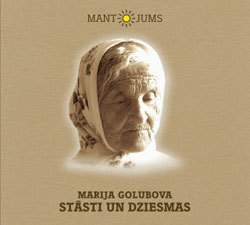
With the release of Marija Golubova: Stāsti un dziesmas, the Rīga-based UPE Recording Co. has begun a new series of recordings named Mantojums (Inheritance). The compact disc is one of three titles released last December.

Marija Golubova is a simple country woman from the far northeastern corner of Latvia, very near the border with the Abrene region, which is currently under Russian control. Stories and songs have always been an important part of her life, and on Stāsti un dziesmas (Stories and Songs) we hear a few of the stories from her long life—from walking barefoot through the snow after her husband’s arrest to her father’s recipe for beer to her admiration of ants and the whole of nature.

In between the stories, Golubova sings about a dozen of her songs, most of which are not part of the average Latvian’s repertoire. But it’s exactly for that reason that I was very happy to listen to the CD, because I like to hear new songs. All of the songs are, of course, sung in the Latgallian dialect, and two are Russian songs. In “Voi toutīt, kūkacīt,” Golubova sings a long string of verses to a melody more commonly known for its soldier words (“Div’ dūjiņas”). Another is a Jāņi song with the ļeigū refrain. Some of the other songs are: “Lec, saulīte, rijtā agri,” “Voi celinu man nabeja,” “Toutīts mani carādams,” “Patijk man tis kaļnins,” “Tī bej labi olu dzerti,” and “Skanu baļsini palaidu.”

It seems that most of the songs are in minor keys, not uncommon for Latvian songs. But it’s too bad that the CD does not include the song texts, because deciphering them just by listening to them is difficult. Most listeners will also really have to concentrate to understand even half of Golubova’s stories because of the heavy dialect.

There’s no way of putting it nicely—Golubova is an old lady, her voice cracks and goes in and out of tune, and she’s probably a few teeth short, too. But don’t you dare make fun of her. She still has amazing strength and confidence behind her 97-year-old voice, deep emotion in her stories, and a difficult life to describe.

Marija Golubova: Stāsti un dziesmas is not something you would put on as pleasant background music at your next dinner party. But it is an important and interesting recording for those who appreciate oral history and the real “roots” of folk music.

The other two recordings released in December are Pasaules radīšana, featuring creation stories told by Leons Krivāns, and Putnu un zvēru valoda, with stories about the language of birds and animals told by Pēteris Liepiņš.

Details

Marija Golubova: Stāsti un dziesmas

Mantojums

UPE Recording Co.,  2003

UPE CD 056

President to visit Portugal

Latvian President Vaira Vīķe-Freiberga will visit Portugal from Sept. 13-16 to meet with political and business leaders in Lisbon and Porto, the president’s press office has announced.

Vīķe-Freiberga will meet Sept. 14 with Portuguese President Jorge Fernando Branco de Sampaio as well as with members of the country’s parliament. She also is expected to speak to city officials in Lisbon.

On Sept. 15, the Latvian president will meet with Prime Minister Pedro Santana Lopes, attend a business forum and give a speech, “Latvia in the New Europe,” at Universidade Lusiada.

A visit to Porto, Portugal’s second largest city, is on the schedule for Sept. 16. Vīķe-Freiberga will meet with local political and business leaders, as well as unveil a memorial at the Latvian honorary consulate in Porto.

Vīķe-Freiberga will be accompanied on the visit by her husband, Imants Freibergs.

Andris Straumanis is a special correspondent for and a co-founder of Latvians Online. From 2000–2012 he was editor of the website.