Government survives no confidence vote

The government of Prime Minister Indulis Emsis has survived a vote of no confidence. Members of the Saeima, Latvia’s parliament, defeated a no-confidence resolution offered by the leftist Tautas saskaņas partija (National Harmony Party) in a 45-32 vote.

Emsis, whose minority coalition government took power in March, has seen his administration targeted by critics from both the left and the right. Especially vocal has been the conservative Jaunais laiks (New Era) party, led by the previous prime minister, Einars Repše.

Members of the National Harmony Party and of New Era supported the resolution, but members of parties that have a presence in the government voted against the resolution, according to Latvian media reports.

No one abstained in the Sept. 16 vote, although members of the conservative Tēvzemei un Brīvībai/LNNK (For Fatherland and Freedom/LNNK) and the leftist Par cilvēka tiesībām vienotā Latvijā  (For Human Rights in United Latvia) did not cast ballots.

Andris Straumanis is a special correspondent for and a co-founder of Latvians Online. From 2000–2012 he was editor of the website.

Two Latvian stars create romantic album

Klusums starp mums

What would be more natural than to put two major musical stars of the Latvian Reawakening period together on one record? Quite possibly the best known and most recognizable male and female voices from the late 1980s, Ieva Akurātere and Igo (Rodrigo Fomins), came together in 1990 to sing songs with lyrics by Igo and music by Aivars Hermanis. The result, Klusums starp mums, was originally released on vinyl in 1991 and was re-released on compact disc in 2003 as part of MICREC’s “Latviešu populārās mūzikas klasika” series.

I had picked up this record back in 1991 simply because both artists were familiar. My perception back then was that while the performance itself was of high quality, the songs were a bit lackluster. I listened to the album a few times, then filed it away somewhere amongst my parents’ large record collection. I am not sure if I listened to it again after that.

As it turns out, what I think now is not much different than what I thought then. Production and performance are first rate, but the songs aren’t strong enough to warrant regular repeat listening.

Besides Akurātere and Igo, performing on the album are Aivars Hermanis on guitars, keyboards and percussion, Eduards Glotovs on bass, and Oļegs Upenieks on percussion.

The CD is labeled as “the sexiest Latvian music album” and I will not disagree with that statement (mainly due to the minimal competition for that title among Latvian releases.) The label also gives the general idea of the album—romantic songs about love and intimacy and such things. The entire album has a very “subdued” feeling, most likely intentional, as many of the songs have Akurātere and Igo practically whispering into their respective microphones.

The CD doesn’t just have songs, but also some unusual interludes, mainly dialogue between Akurātere and Igo that seems to me a bit out of place.

Hermanis’ guitar playing is quite tasteful in a number of places, including on the song “Ēnas zīmē mūsu stāvus,” in which he plays a number of nice acoustic runs.

Probably my favorite song on the album is the final one, “Par klusumu.” The combination of Akurātere and Igo works best here. With barely more than just an acoustic guitar, the vocal melodies allow the singers to shine, and the result is a very pretty song.

I didn’t like the record the first time around because I expected something a bit different (Akurātere at the time was with Pērkons and Igo with Remix, both well-known Latvian rock bands). Perhaps I expected something more in that vein. For whatever reason, even now when I know what to expect these songs don’t really stay with me after listening.

The liner notes (which include all lyrics, as well as an essay by music publicist Daiga Mazvērsīte) state that this record was a bestseller at the time of its initial release. That shows you what I know. This is a very relaxed record. It works well as a romantic album. The record is not quite up there with, say, Marvin Gaye, but it holds its own.

If nothing else, this record once again proves the vocal talents of both Akurātere and Igo, as well as the talents of Hermanis. The remastering also sounds great. Thanks also must be given to MICREC for continuing to re-release classic and significant albums in Latvian music history—and not just those by Raimonds Pauls! Hopefully they will get to Akurātere’s solo album, too.

If you are looking for some light, romantic music that just happens to be in Latvian, look no further.

Details

Klusums starp mums

Ieva & Igo

MICREC,  2003

MRCD 224

Egils Kaljo is an American-born Latvian from the New York area . Kaljo began listening to Latvian music as soon as he was able to put a record on a record player, and still has old Bellacord 78 rpm records lying around somewhere.

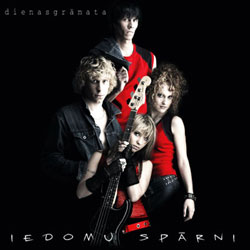
Iedomu Spārni’s debut surprises with its variety

Iedomu spārni

It’s happening. Slowly but surely, the alternative music scene is surfacing in Latvia. It used to be that I’d hear a music clip of some no-name punk band and I would want to cry. It was that bad. Oh, sure, there were groups that put out a good effort, but all they got were screaming (singing) and terrible static (music) that was unclear and unsatisfying. However, the group Iedomu Spārni with their debut album Dienasgrāmata could teach the struggling wannabes a thing or two. Call me crazy, but I think there’s just something about clarity to vocals and instrumentals that makes sense.

When the compact disc arrived in the mail, it was like Christmas. Each track held something different and likable. With a mixture of peppy punk rock, dark rock, regular rock, moving ballads, a bit of funk, and songs that could very well be numbers in a musical, Iedomu Spārni completely blew away my expectations.

The group, formed in 2000 by Ieva Zēģele, Jānis Dreiškins and Jānis Kuršs, likes to experiment with their talents and resources, making for a sound that is never repetitive and far from boring. Lead singer Zēģele has vocals that match that of Evanescence’s lead vocalist Amy Lee; Iedomu Spārni even has a few tracks that remind me of Evanescence and other dark rock groups. The only difference is that instead of depressing lyrics about loneliness and heartache, Iedomu Spārni carries more of the angstful “take that” or “you’ll be sorry later” feel that so many punk bands have. Perhaps the best way to describe them at this point is as a “dark punk” band (think Finch or Brand New).

Also appearing on the album is keyboardist Alīna Melngaile, who was with the band from 2002-2004. Now in her place, according to the band’s Web site, is guitarist Toms Skujiņš.

The first track on the album, “Zaiga,” is the song I think would fit in a rock-musical. It’s a song about how love screws with one’s brain, but with carefree and fun lyrics put to rock music. I can just imagine a large group of people dancing on stage in perfect time. Right off the bat, the thing that I like the most is that I can hear the guitar, bass guitar, percussion, keyboard, and… and… no synthesizer?  What?! Amazing! This caught me off guard. Then again, it’s only the first track. Maybe it’s a waste to think it could last. Wrong.

Track two, one of my favorites, starts out with a funky guitar and percussion duet. It immediately gets the head-bobbing response. This song is a motivational speech about not letting what others think or say get to you. Perfect, considering the song is called “Dumpinieku dziesmiņa” (Rebel Song). With this song not only do I like the continuing lack of synthesizer, but I like that even though this is a song about rebellion, it’s not your run-of-the-mill, “damn the man” rebellion. The main point is to live for yourself: “Ja vēlies kļūt par enģeli, uzadi sev spārnus / Ja gribi aizmirst neveiksmes – meklē citus vārtus / Kad jūties slikti – skaļi bļauj /un neļauj, lai Tev neatļauj!”

Right on!

Track three, “Nāc man līdz,” is another one of my favorites. The vocals start out smoothly and quietly, but with the feeling that they’re being pushed tempo-wise, if even the tiniest bit. Then, at one minute and 16 seconds it all breaks loose. Ripping vocals filled with emotion with instrumentals to match. Unfortunately, the fast-paced section of the album is pretty much over at this point. The rest of the CD, starting with track four, is more sonorous and ballad-like, bringing out that bit of dark-rock. Iedomu Spārni proves very well that they can play many different styles and emotions.

For a few of the later tracks the band even brought in some outside help. For track 10, “Enģeļu čuksti,” the group was joined by the string quartet of the Jāzeps Mediņš Music College to create a very moving and beautiful track, making it one of the best on the entire album. And on the last track, a remix of track eight, “Glāb,” Latvian rapper Gustavo lends a hand, adding an interesting new twist to the original.

From a clean cut-looking band to a sound that rocks, Iedomu Spārni is a welcome addition to my CD collection. The final thing I enjoyed about this album is that there are no English tracks to be found. At this point, I don’t think they need to attempt any, but if they do, I hope it’s good. Either way, from my mind to my heart to me standing on my desk chair, to Iedomu Spārni and their first album, a standing ovation.

Details

Dienasgrāmata

Iedomu Spārni

Gailītis-G,  2003

GGCD 314

On the Web

Iedomu Spārni

The Web site for the band Iedomu Spārni includes biographical information, samples of music, video clips and a forum for fans. EN LV