


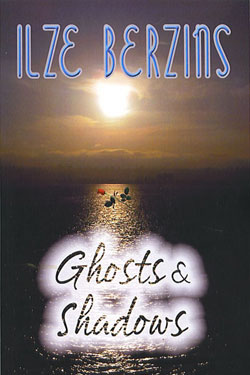
Uldis Lapins, the seemingly shifty pastor of the Latvian church in the Canadian capital of Ottawa, may be trying to bilk the members of his congregation out of their life savings. But then, halfway through Ilze Berzins’ latest thriller, Ghosts & Shadows, he is reported to have died, apparently a victim of his peanut allergy.
The novel is one of Berzins’ better efforts. Rich characters combine with an eventually captivating plot for a story that should be of interest to anyone looking for a Latvian krimiķis in the English language. However, readers familiar with Berzins’ earlier stories will find that Ghosts & Shadows owes some of its success to the characters and efforts at plot development in those works.
It is courageous of Berzins to tackle this story, set as it is in Ottawa’s Latvian community. Writing about the place you know best, and for Berzins that is Ottawa, can lead to compelling prose, but also can raise the hackles of the locals. No doubt some readers will try to draw parallels with people they might know in real life.
Ghosts & Shadows, released in November, is the seventh mystery novel and the eighth book overall by Berzins. A second-generation Latvian-Canadian, Berzins also is an artist.
Berzins takes a long time to build up the drama in Ghosts & Shadows, a characteristic of her previous novel, Kolka (2004). It takes 47 pages—seven admittedly short chapters—for Berzins just to paint her protagonist.
Ghosts & Shadows is told from the first-person viewpoint of Anastasia Karsubova, Stasia or Stacy for short, the daughter of a Russian father and a Latvian mother. She’s a 40-something loner who hangs out with Ottawa’s older Latvian generation. Her one-time lover, a Latvian-American journalist named Andris Ripa, supposedly was killed years ago while covering a story in Rīga. Her dog, Bear the Rottweiler, has gone missing. Geez, this almost makes Stasia sound like the subject of a bad Latvian country song.
But there is more to Stasia than that. Like in Kolka, Berzins delves into the psyche of her protagonist. Stasia floats in and out of the past, fantasizing about returning to the Rīga she remembers from her time there from 1994-1998 (at this point readers familiar with Berzins’ work may be tempted to pull out their copy of her autobiographical Happy Girl): “When I was there ten years ago, Riga was a brawling bully of a town, an endless unstoppable crime spree, a chaotic feast of cheap booze, fattening food and eye-popping urban decay. I loved every moment of it. But now I hear all that’s gone and I wonder if I’d ever want to go back.”
However, Stasia may remind some of Birdie Finch, the protagonist in Kolka. Like Stasia, Birdie lived alone in Ottawa. Like Stasia, Birdie’s closest relationship was with a person much older than she. Like Stasia, Birdie spent a lot of time caught up in memories and dreams, although Birdie’s were darker than those of Stasia’s.
Also figuring strongly in Ghosts & Shadows is Alex Stromanis, who is tormented in his old age by memories of the night the Wilhelm Gustloff, a German cruise ship, was torpedoed in January 1945 by a Soviet submarine. He lost his wife and baby. The ship, extremely overloaded with refugees fleeing the advancing Soviet forces, had sailed from Gdynia, a port near Gdansk, Poland. Estimates of the number of dead range from 7,000 to more than 9,000 men, women and children, making it—as several sources note—the worst maritime disaster on record.
In a suitcase in his home, Stromanis keeps a satchel he rescued from that horrific night. In the satchel are thousands of Imperial Russian gold coins.
And then there’s Tamara Nemerova, a voluptuous Russian from Rīga who has come to Ottawa ostensibly to lure local Latvians to spend their money on a tour of the homeland. She knows Stasia from when she lived in Latvia, and before Stasia knows it, Tamara has managed to move into the spare room in her house.
A variety of other characters populate the novel, many of whom are carefully colored by Berzins. The reader might be frustrated that it takes so long for something to happen, but the last 100 of the 244-page Ghosts & Shadows have plenty of twists to make up for the slow start. The result is an entertaining tale of corruption and swindle set in Canada and Latvia.
More information about Berzins and her books is available from her Web site, ilzeberzins.com.
Details
Ghosts & Shadows
Ilze Berzins
Ottawa: Albert Street Press, 2005
ISBN 0-9686502-7-9
