
Instrumenal cello rock may not be for all

Melo-M

Orchestral string instruments are cool. They are cool whether they are being used to play the music of Mozart, Beethoven, Vasks or any other composer dead or living. And they’re also cool when used in nontraditional ways, such as when playing cover versions of Latvian pop and rock hits. That’s what the Rīga-based cello trio called Melo-M does on its debut album, the self-titled Melo-M.

The group released the compact disc last June on the Platforma label. The 10-track album may not be what listeners initially expect. Rather than rock music stripped down to mellow cellos, Melo-M sounds like almost full-on rock, but without the vocals. These guys get some amazing sounds out of their instruments. When I first listened to the album, I could have sworn keyboards and a guitar also could be heard, but I have been assured by the group’s manager that only cellos and drums are used.

Formed in late 2004, Melo-M plays what is described as “instrumental cello rock.” It’s part of the “classical crossover” genre popularized by groups such as Finland’s Apocalyptica, a cello-playing trio perhaps best known for its interpretations of the music of heavy metal band Metallica. On the day Melo-M released its album last year, the Latvian trio warmed up the audience for a concert by Apocalyptica in Rīga’s Skonto Hall.

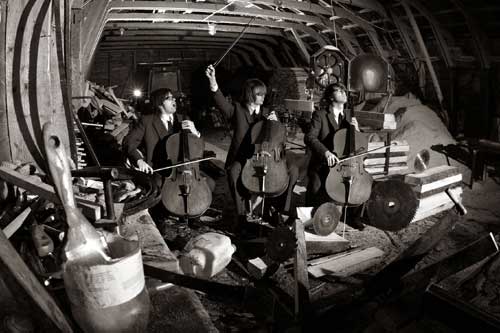
Melo-M’s members include three cellists with classical training: founder Kārlis Auzāns, who also plays guitar with the pop group Autobuss debesīs; Valters Pūce, whose father Valts leads the Marana vocal group, and Antons Trocjuks, who, like Auzāns and Pūce, has done well in international cello competitions. Trocjuks has replaced Kristaps Bergs, the original third member of the band who appears on the album. Vilnis Krieviņš plays drums on the album. Melo-M is short for melomanija (melomania), the excessive passion for music.

For listeners unfamiliar with the history of Latvian rock music, some of the tracks on the CD may not immediately register. That’s the case with the opening song, “Rock on the Ice,” a composition by Jānis Lūsēns. Today Lūsēns is known in part for his work for theatre and rock opera, but in 1980 he was a founder of Zodiaks, an electronica and disco group that gained wide popularity throughout the Soviet Union and Eastern Europe. “Rock on the Ice” is off the group’s landmark album, Disco Alliance.

I will admit that I didn’t immediately take to “instrumental cello rock,” especially when cover versions are involved. Invariably I tried to imagine what the original recording sounded like, and in a couple of instances was not happy with Melo-M’s version. Pagan metal band Skyforger’s “Kad Ūsiņš jāj” (“When Ūsiņš Rides”, from the band’s Pērkoņkalve album) needs the guitars, the heavy bass and the growling vocals. And Linga’s “Atdodies man” just isn’t the same without Gvido Linga’s voice.

But the third track, “Dzimtā valoda” (“In the Native Language”) by Ainars Virga of the Liepāja guitar rock group Līvi, comes off sounding like a true anthem, the cellos pulling on the patriotic heart strings. The song, released in 1985, gained popularity as Latvia’s push for renewed independence gathered steam. It’s followed by “Dzejnieks,” another Līvi tune, in which Krieviņš and his drums nicely set the pace for what the cellos do.

I could have done without “Kvazimodo dziedājums” (“Quasimodo’s Song”), composed by Zigmārs Liepiņš for the rock opera “Parīzes Dievmātes Katedrāle.” I enjoy the song, but would have liked Melo-M to take on another more traditional rock tune instead. Raimonds Pauls’ “Undīne” also seems out of place on this album, but does show the range of material Melo-M is willing to cover.

The eighth track is the only one featuring a vocal, and that’s just in the introduction to “Sapumpurots zars” (The Budding Branch), also known as “Dziesma par sapumpuroto zaru,” a song by the rock group Pērkons composed by Juris Kulakovs. Melo-M’s version is a good take on the classic.

Also covered are “Trubadūrs” by Imants Kalniņš and “Zem diviem karogiem” by Jumprava.

Melo-M tours the United States during February, with concerts scheduled in Rockville, Md.; Cleveland, Ohio; Kalamazoo, Mich.; Minneapolis; Chicago; Seattle, Wash., and in Los Angeles. The tour also was to include Autobuss debesīs singer Marts Kristiāns Kalniņš, son of composer Imants Kalniņš, but he was forced to pull out on a doctor’s advice.

If you get a chance, take in a concert and decide whether “instrumental cello rock” is for you. If it is, Melo-M is worth adding to your collection.
Melo-M

Melo-M includes three classically trained musicians who play “instrumental cello rock.” (Photo courtesy of Melo-M)

Details

Melo-M

Melo-M

Platforma Records,  2005

PRCD 150

Andris Straumanis is a special correspondent for and a co-founder of Latvians Online. From 2000–2012 he was editor of the website.

Melo-M adds Minneapolis to U.S. tour

The Latvian “instrumental cello rock” group Melo-M has added a performance in Minneapolis to its February tour of the United States, according to the American Latvian Youth Association.

Melo-M—the members of which include Kārlis Auzāns, Valters Pūce and Antons Trocjuks—was formed in late 2004. The group has released one album, the self-titled Melo-M, which includes cover versions of 10 Latvian pop and rock classics.

The band originally was scheduled to tour with Marts Kristiāns Kalniņš, lead singer of the pop group Autobuss debesīs, but Kalnīņš took ill and a doctor advised he not travel, according to Vija Vīksne, president of the youth association (Amerikas Latviešu Jaunatnes apvienība, or ALJA).

Auzāns, who plays guitar with Autobuss debesīs, formed Melo-M. Pūce, son of vocal group Marana leader Valts Pūce, and Kristaps Bergs became the original two other members of the trio. Last summer, Trocjuks replaced Bergs. All the band members have classical cello training and have fared well in international competitions.

Concerts are scheduled:

  • In Washington, D.C., on Saturday, Feb. 4, in the Latvian Ev.-Lutheran Church of Washington, D.C., 400 Hurley Ave., Rockville, Md. The concert begins at 7:30 p.m. Admission is USD 25 or, for senior citizens and college students, USD 20. Children and high school studens will be admitted free. The event is sponsored by the Latvian Organizations of Washington. For further information, telephone Anita Juberte at +1 (301) 869-3127.
  • In Cleveland on Saturday, Feb. 11, in the United Latvian Ev. Lutheran Church of Cleveland, 1385 Andrews Ave., Lakewood. The charity program includes champagne and refreshments beginning at 5:30 p.m., dinner at 6 p.m. and the concert at 7 p.m., followed by a ball. Admission to the entire program is USD 50. General admission to the concert and ball is USD 25, admission for senior citizens and students is USD 20. For further information, telephone Brigita Puķite at +1 (216) 577-4370 or Franz Bauer at +1 (440) 320-5959.
  • In Kalamazoo on Sunday, Feb. 12, in the Union Bar & Grille, 125 Kalamazoo Mall, Kalamazoo. The concert begins at 4 p.m. In advance tickets cost USD 25 for adults, USD for youth to age 21, USD 5 for children to age 13. Tickets may be ordered by credit card by telephoning the Union Bar & Grille at +1 (269) 384-6756. Ask for the “February 12th Latvian Concert.” Tickets also may be ordered by check, payable to “Kalamazoo Latvian Association,” from Viktorija Krieva, 2526 Bach Ave., Portage, MI 49024. Further information is available by telephoning from Malda Pūtele, +1 (269) 353-8320.
  • In Minneapolis on Friday, Feb. 17, in the Latvian House, 2337 Central Ave. N.E., Minneapolis. The concert begins at 7 p.m. Admission is USD 20 for adults, USD 10 for students, and free for children. Refreshments will be available.
  • In Chicago on Saturday, Feb. 18, as part of a Valentine’s Day program and dance, in the Latvian House, 4146 N. Elston Ave., Chicago. A social hour is scheduled at 5 p.m., followed by the concert at 6 p.m., a broadcast of a Latvian hockey game at 7 p.m. and the dance at 9 p.m. General admission to the entire program is USD 35, but for ALJA members and supporters admission is USD 30. General admission to the concert is USD 25, but for ALJA members and supporters admission is USD 20. General admission to the hockey game broadcast and dance is USD 15, but for ALJA members and supporters admission is USD 10. Tables for eight persons may be reserved by contacting Vija Vīksne by e-mail at vijavara@aol.com or by telephone at +1 (310) 850-6940.
  • In Seattle on Friday, Feb. 24, in the Latvian Center, 11710 3rd Ave. N.E., Seattle. Admission is USD 20 for adults, USD 10 for students. For further information, telephone Jānis Kramēns at +1 (425) 941-2753.
  • In Los Angeles on Sunday, Feb. 26, in the Latvian Community Center, 1955 Riverside Drive, Los Angeles. The concert begins at 12:30 p.m. Admission is USD 20. Refreshments will be available by donation. For further information, telephone Vīja Vīksne at +1 (310) 850-6940.

The concert series is sponsored by ALJA. Further information about the concert tour is available by visiting www.alja.org.

Andris Straumanis is a special correspondent for and a co-founder of Latvians Online. From 2000–2012 he was editor of the website.

President awards first Spīdola scholarships

The first two President’s Scholarships, supported by the Latvian sorority Spīdola and financed largely by donations from Latvian-Canadians in the Toronto area, have been awarded to two women in Latvia studying to be language and literature teachers.

Zane Lūse, a philology student at the University of Latvia, and Kristīne Lele, a philology student at the Rēzekne Higher Education Institution (Rēzeknes Augstskola), were presented the scholarships Feb. 1 in Rīga by President Vaira Vīķe-Freiberga, the president’s press office said.

The sorority, of which Vīķe-Freiberga is a member, initiated the scholarship last year to honor the president’s work in academics and in government. Vīķe-Freiberga retired in 1998 as a professor at the Université de Montréal, where she specialized in psychology and linguistics.

During a June benefit in the Latvian Canadian Cultural Centre attended by the president, about CAD 60,000 was raised for the scholarship, according to the cultural center’s Web site.

The scholarship is administered by the Vītolu Fonds, begun in 2002 by Vilis and Marta Vītols, who repatriated to Latvia from Venezuela and began Māras banka (now owned by Finland’s Sampo Bank).

Andris Straumanis is a special correspondent for and a co-founder of Latvians Online. From 2000–2012 he was editor of the website.