The first Latvian newspaper in decades to be published abroad is aiming to become part of the information diet of the growing number of Latvians living in Ireland.
Called Sveiks!, the tabloid-format biweekly newspaper is published by a Dublin-based company that also puts out newspapers in Lithuanian, Polish and Russian. But unlike earlier emigré Latvian papers, Sveiks! is prepared by journalists who work from editorial offices in Rīga.
The first issue of the colorful tabloid appeared April 27, said co-editor Inga Zaļā.
“The initiative to create the newspaper came from both sides, from Ireland and from Latvia,” Zaļā told me in an e-mail. “The Irish publisher was looking for contacts in Latvia to start publishing a newspaper, while we were looking for contacts to help us realize an idea to create a newspaper. That’s how we met.”
Professional journalists put the paper together in Rīga, and then it is delivered electronically to the publisher in Dublin. There 5,000 copies are printed and distributed for sale around Ireland. Sveiks! sells for EUR 0.99 and is distributed in Eastern European stores in Dublin, Cork, Galway, Sligo and elsewhere.
Five years ago, publisher Sergey Tarutin founded Nasha Gazeta (Our Gazette) for Russians living in Ireland, according to Ireland’s Marketing Magazine. His company now also puts out Lietuvis (The Lithuanian) and Polska Gazeta (Polish Gazette).
The 20-page Sveiks! contains news from Ireland and Latvia, reports about various events, and some features, said Zaļā, who runs the paper along with Liene Akmene. Sections in the paper include politics, society, economy, culture and foreign news. Like many true “immigrant” newspapers, as distinct from “ethnic” newspapers, Sveiks! also provides advice important to Latvian guest workers. Estimates vary, but at least 20,000 Latvians are said to be living and working in Ireland.
Sixty percent of the newspaper is editorial content and 40 percent is advertising. In the long term, that’s a ratio that might work against Sveiks!. To be viable, commercial newspapers typically run more advertising than editorial content.
The fact that the newspaper is prepared by journalists in Rīga rather than Dublin may seem odd, but it’s a model that already is being used by two other Latvian emigré publications. Laiks, the weekly newspaper for Latvians in the United States, moved its editorial and production functions to Rīga from New York in 2002, following the lead of Brīvā Latvija, the European Latvian paper. Only Latvija Amerikā in Canada and Austrālijas Latvietis in Australia are still created in their respective host countries.
Still, the model presents problems, the editors admit.
“Sure, the fact that we are separated (from Ireland) is inconvenient,” Zaļā said, “but we can offer the most important news because some news is sent to us by the publisher and Latvian media use the Internet to follow events in Ireland, so news about Latvians we get from the Latvian wires. We do not yet have permanent correspondents in Ireland, but in time I think we will, because we have cooperation from people who—although they are not professionals—want to write for this publication.”
The paper also has good relations with the recently formed Latvian Society in Ireland.
Sixty years ago, when trained journalists were among the Latvians who ended up in Europe’s Displaced Persons camps, publishing newspapers served an immediate and transitory need. The papers let readers know about what was happening in the camps and, as best they could, about what was happening in occupied Latvia. As the time neared to leave the camps, the papers also offered news about the migration process. When they arrived in the United Kingdom, the United States, Canada and Australia, these journalists continued their work in the face of an uncertain future. The fact that four major exile newspapers still exist is remarkable, even as they struggle with decreasing circulation figures and the question of how to lure young readers.
Whether Sveiks! has potential will be driven by a number of factors. Starting off in Rīga, rather than returning to it, may not necessarily give Sveiks! an edge. If the paper’s potential is to be realized—and if the Latvian population of Ireland continues to grow—I would not be surprised to see at least one editor installed in Dublin.
Given the global trend of young readers to get much of their news from the Internet, Sveiks! will soon have to have an online presence. Sveiks! expects to have its own Web site at some point, the editors told me.
If a miracle occurs or if Latvian politicians finally figure out how to increase wages so that workers are not drawn to distant lands, Sveiks! may not have much of a future at all. If the thousands of Latvians now in Ireland move back, the paper’s readership will disappear. For now, at least, Sveiks! has secured a place in Latvian press history.
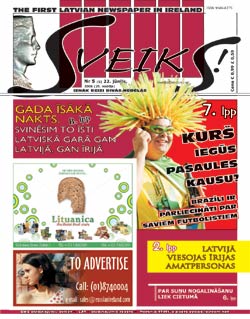
The cover of the June 22 issue of Sveiks! highlighted stories on Jāņi and the World Cup.
Andris Straumanis is a special correspondent for and a co-founder of Latvians Online. From 2000–2012 he was editor of the website.


