


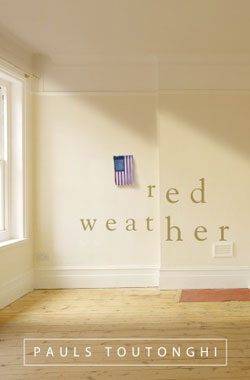
Yuri Balodis, the protagonist of Pauls Toutonghi’s engaging novel Red Weather, has a problem. He, the teenaged son of escapees from Soviet Latvia, has fallen in love with Hannah Graham, a committed socialist. His infatuation leads him to join the blue-eyed Hannah in her early-morning attempts to sell the Socialist Worker to uninterested workers in Milwaukee’s downtrodden Third Ward.
Yuri’s father Rudolfs is not impressed. He drags Yuri off the street, embarrassing him in front of his new left-leaning friends.
“Communists,” he tells Yuri, “are like goats. They come into your house. They eat everything. They sleep everywhere. They make an awful noise. Then, just before they leave, they shit on the furniture.”
Though a steadfast fan of capitalism, Yuri’s father is not one of its prime beneficiaries. Rudolfs Balodis is a part-time night janitor at Jack Baldwin Chevrolet, a position he endures by remaining “continually and slightly intoxicated.” He is a dedicated consumer of bourbon and Pabst, whose watery alcoholic eyes speak of multiple disappointments. All he wants now is for his son to grow up as a real American, free from the tortured past of his immigrant parents—a past Rudolfs has put so thoroughly behind him that it could have been lived by another person.
Yuri’s parents revel in things like electricity. They love their adopted city, redolent of sauerkraut and beer, in the way only collapsed cities can be loved. (A former industrial giant, it can now come up with no better slogan than “Milwaukee, a Great Place on a Great Lake.”) Yuri’s mother Mara has decorated their apartment with advertisements for consumer goods cut from magazines and covered with plastic. She adores Yuri and calls him bučina, or little kiss. She and Yuri’s father speak a frequently hilarious English filtered through Latvian speech patterns. Rudolfs Balodis is in the habit of calling everyone “my darling,” and has an aversion to contractions, while Mara can close an argument with: “Simply shut up, Yuri. I am telling you this as your mother.”
The inevitable collisions between the Latvian past and the American present are both funny and poignant. Yuri’s parents are Latvian with a Soviet inflection, and Yuri’s quietness and lack of communality (as evidenced by his preference for reading in his room) are perceived by them as gratuitous, and slightly suspect. They come from Soviet housing developments surrounding Rīga where the walls were, according to Yuri’s mother, “thin as flour,” and where “everyone was quiet, all the time, because if you said anything, made any noise at all, someone would make a note and call the secret police and you would disappear. So be happy for reading in here with me and being together with all this nice electricity.” He is not permitted even to learn Latvian; his parents want him to be as purely American as a soap bubble, or one of the endless sitcoms on television.
But the Latvian past muscles its way into their lives. After a cryptic telephone call, Yuri’s parents inform him that they will be receiving visitors from Latvia: Rudolf’s old friend Ivan and his wife. Ivan, his father informs Yuri, was his closest friend until Rudolfs stabbed him in the leg just before leaving Latvia. How Ivan feels about this event now is anyone’s guess.
Red Weather is an ode to the painful trajectory of Rudolfs Balodis’s life. Drunk, swaying under the stars on their little apartment balcony, he still embodies a doomed gallantry that can express itself only in humorous asides, a bravery only slightly compromised by its possessor’s complete inebriation.
Sometimes the sheer magnitude of Rudolfs makes Yuri seem small, almost fetal. It’s as though any normal adolescent anger towards his father has been smothered in retrospective filial guilt. Yuri seems oddly muted, like an updated prodigal son from an Anna Brigadere story, or an endlessly observant and self-effacing narrator in a Charles Dickens novel.
In Red Weather, the story goes off in all directions, a road movie that never quite leaves town—but isn’t that the story of adolescence? Part of the chaos, and the delight, is in the meeting of two worlds that are completely unknown to each other, yet strangely familiar. The Latvian past informs the American present, and in the end brings certain essential facts to light. The disorder is not entirely resolved, but this too seems natural and satisfying. According to Toutonghi, an old Latvian proverb states that every good story has at least one bad joke. Red Weather provides both.
Details
Red Weather
Pauls Toutonghi
2006: Random House, 2006
ISBN 0307336751
On the Web
Pauls Toutonghi
Pauls Toutonghi, whose debut novel is Red Weather, is half Latvian, half Egyptian, as visitors to his official Web site may learn. EN
Where to buy
Purchase Red Weather from Amazon.com.
Note: Latvians Online receives a commission on purchases.
