Latvia’s independence celebrations this year may appear to be nothing special. Nov. 18 will mark 88 years since the nation’s leaders declared Latvia’s independence from imperial Russia, and it will be 15 years since the renewal of freedom. Neither anniversary is necessarily the sort of round number that carries additional symbolism.
But for Latvian communities abroad, at least two interesting factors may be noted. First, this year Nov. 18 falls on a Saturday, meaning that fuller attention and richer programs may be possible because the local Independence Day observation does not have to be crammed into a few hours after the workday. Second, with the expansion of Latvian migration especially into Western Europe, it appears more communities are planning programs this year.
For those unable to attend an event in person but who will be at a computer, Latvian President Vaira Vīķe-Freiberga’s Independence Day speech is scheduled for broadcast on Latvian State Radio at 20:00 hours Latvian time (18:00 GMT).
Here is a list of some of the events around the world, as reported by the Latvian Ministry of Foreign Affairs and the newsletters and Web sites of community organizations.
Australia
Australian Capital Territory: In the Canberra community, Independence Day celebrations will take place at 7 p.m. Nov. 24 in the Immanuel Church Hall, 37 Burnie St.,
Lyons. The program includes a lecture by writer Anna Žīgure and various musical performances.
New South Wales: Latvian Independence Day will be marked at 7:30 p.m. Nov. 18 in the Sydney Latvian House, 32 Parnell St., Strathfield. The program includes a speech by Anna Žigūre and a performance by Sidnejas Latviešu vīru koris, directed by Daina Jaunbērziņa and accompanied by pianist Sandra Draguna and violinist Vēsma Upeniece. The event is sponsored by the Selonija sorority.
South Australia: On Nov. 17, a commemoration is scheduled at 6 p.m. in the Adelaide Latvian Cooperative Latvian House “Tālava,” 4 Clark St., Wayville. The program includes a lecture by the writer Anna Žīgure and a concert. On Nov. 18, Independence Day will be marked beginning at 9:30 a.m. with a program at the Adelaide Latvian Cooperative Latvian House “Tālava,” 4 Clark St., Wayville. The program includes a flagraising, invocation by the Rev. Māris Lukaševics and a speech by Anna Perejma. An 11 a.m. service is scheduled in St. Peter’s Latvian Church, 23 Rose Terrace, Wayville.
Victoria: Two days of events are scheduled in the Melbourne community. A flagraising is scheduled at 10 a.m. Nov. 18 on the grounds of the Consulate of Latvia, 2 Mackennel St., East Ivanhoe. At noon, the Melbourne Latvian School “Daugava” will mark Independence Day with a program in the Latvian House, 3 Dickens St., Elwood. On Nov. 19, an Independence Day celebration is scheduled at 2 p.m. in the Latvian House. The program includes a lecture by writer Anna Žīgure.
Canada
Ontario: Latvian Independence Day commemoration will run from the evening of Nov. 17, throughout the day Nov. 18 and conclude Nov. 19 at the Latvian Canadian Cultural Centre, 4 Credit Union Drive, Toronto. Activities begins at 5 p.m. Nov. 17 with dinner. An exhibit of crafts opens at 6 p.m., followed by opening of an art exhibit at 7 p.m. A program of music and pictures begins at 8 p.m. “Diena Latvijai” (A Day for Latvia) is the title of the center’s Nov. 18 commemoration. The day begins with a flag-raising ceremony at 7:30 a.m., followed by breakfast at 8 a.m. A program for children, “Mana Latvija” (My Latvia), is scheduled at 9 a.m. A grand opening of the Latvian Credit Union’s new office in the center also is scheduled at 9 a.m. At 9:30 a.m., Agra Asmus-Vāgnere and other will present a program entitled “Ceļš uz mājām” (The Way Home). A panel discussion led by Auseklis Zaķis and featuring youth from the Latvian community is scheduled at 10:45 a.m. Lunch will be served at noon. At 12:55 p.m., visitors to the center will be able to watch the Nov. 18 speech by Latvian President Vaira Vīķe-Freiberga. Speeches by Vizma Valaine and Vizma Vanovska, lecturers at the Latvian University of Agriculture, are set for 2 p.m. The center’s formal observance of Independence Day is scheduled at 4 p.m. A concert by the women’s choir Vizma, which hails from Dobele, Latvia, is set at 5:30 p.m. Dinner will be served at 6 p.m., followed by a social evening beginning at 7:30 p.m. An evening for youth, organized by the Latvian National Youth Association in Canada, begins at 9:30 p.m. Sunday, Nov. 19, will see a continuation of the observances with an 11 a.m. Independence Day service in St. John’s Latvian Ev. Lutheran Church, 200 Balmoral Ave., Toronto. Lunch will be served at noon, followed by a 2 p.m. screening of Tēvreize, a film about church history in the 20th century.
Québec: Latvian Independence Day will be observed at 16:00 hours Nov. 18 in the Latvian Center, 3955 Provost, Lachine. On the program is a speech by Edgars Kirš and a concert by Atbalss, a Latvian ensemble from Montréal. Dinner will follow the program. Admission is CAD 20 for adults, CAD 15 for students and CAD 10 for children to age 16.
Europe
Belgium: Latvians in Belgium and Luxembourg are invited to an Independence Day celebration Nov. 18 in Brussels. The event begins at 17:00 hours with an ecumenical service in Eglise Ste. Catherine, place Ste. Catherine, Bruxelles. The service will be led by the Rev. Pēteris Dupats and Deacon Klāvs Bērziņš and will include musical performances by Brussels Latvian Choir and cellist Anda Mende. At 19:00 hours, the celebration continues at La Tentation (Centro Galego), 28 rue de Laeken, Bruxelles. The program includes addresses by Raimonds Jansons, Latvia’s ambassador to Belgium and Luzembourg, and Egils Gulbis, chairperson of the Latvian Society in Belgium. Dinner will follow at 20:00 hours. The folk dance troupe Vērtumnieki performs at 21:30 hours, followed by a ball at 22:00 hours with music provided by DJ Artis Volfs from Radio SWH. Admission at the door is EUR 40, but for members of the Latvian Society of Belgium it is EUR 25. Children to age 12 will be admitted free. Further information is available from www.latvieshi.be.
Germany: Several events are scheduled across Germany, which over the past several years has seen a growing Latvian population thanks to students and workers who have moved to the country.
- Berlin: A speech by Ambassador Mārtiņš Virsis and an exhibit of painting by Valdis Ķikuts, known for his work with maritime scenes, will highlight an Independence Day observance Nov. 17 in the Embassy of Latvia in Berlin, the Latvian Foreign Ministry announced. The observance is intended for Berlin-based diplomats, German politicians and business people, and the media. On Nov. 18, the embassy will host an Independence Day program for the Berlin Latvian community. The program is to include a performance by the Latvian Society of Berlin’s choir.
- Hamburg: An Independence Day celebration is scheduled at 17:00 hours Nov. 18 in Mendelsohn-Saal, Hochschule für Musik und Theater, Milchstrasse, Hamburg. On the program is an address by Andris Zemītis and a concert by flutist Ieva Rūtentāle and pianist Gints Rācenis. Coffee will be available after the program. Participants are asked to bring food to share.
- Münich: Latvians in Münich will mark Independence Day with an observance beginning at 15:00 hours Nov. 18 in the Heilig Geist church, Hugo Troendle Str. 53, Münich. The program begins with a religious service led by the Rev. Jogita Mingina. A concert and social hour will follow. Participants are asked to bring food to share, although sausage and sauerkraut will be available for purchase.
- Münster: Latvia’s independence will be celebrated at 15:00 hours Nov. 18 in the Lettisches Centrum Münster, Salzmannstr. 154, Münster. The program includes an address by Māra Sīmane and a concert by flutist Liene Krole, cellist Ieva Puriņa and guitarist Dirk Bischof. Dinner will follow the program.
Ireland: An Independence Day celebration is scheduled at 16:00 hours Nov. 18 in the Teacher’s Club, 36 Parnell Square, Dublin 1. The event is open only by invitation from the Embassy of Latvia. The event is cosponsored by the embassy, the Latvian Society in Ireland and the Latvian Association for Latvians in Ireland. For further information, visit the embassy’s Web site.
Sweden: An Independence Day observation organized by the Embassy of Latvia is scheduled Nov. 17 in the Grünewald Hall of the Stocholm Concert Hall, Hötorget 8, Stockholm. The program includes a concert by the Altera Veritas chamber ensemble. The ensemble includes Ieva Mežgaile on kokle, Marko Ojala on accordeon, Andis Klucnieks on flute and Anda Zaborovska on kokle.
United Kingdom: A number of Independence Day observances are scheduled across the United Kingdom, according to the Latvian-British Web site www.labrit.co.uk:
- Bristol: A program in English from 15:00-17:00 hours in the Training Room, YHA Building, 14 Narrow Quay, Bristol. The program includes a presentation, “Our Trip Round Latvia, June 2006.”
- Coventry: A celebration is planned at 15:00 hours Nov. 18 in Mūsmājas, Priory Hill, Woolton, Coventry. The event includes a religious service and refreshments.
- Doncaster: An Independence Day observance is planned at 17:00 hours Nov. 25 in the Daugavas Vanagi Fund hall, 88 Kings Road, Doncaster.
- Guernsey: The first public performance by a singing group from the island’s Latvian community will be part of the Independence Day observation scheduled at 19:00 hours Nov. 19 at St. Martin’s Community Centre, St. Martin’s. Flutist Liene Sējāne and guitarist Kristaps Grasis will perform as well. Admission is GBP 7 for members of the Guernsey Latvian Association, GBP 10 for others.
- Halifax: An observance is scheduled at 15:00 hours Nov. 18 in the Daugavas Vanagi Fund hall, 8 Lord Street, Halifax.
- Leeds: An observance is planned at 14:00 hours Nov. 19 in the Daugavas Vanagi hall, 2 Mexborough Avenue, Leeds. The folk ensembles Kamoliņš and Dūdalnieki will perform.
- Leicestershire: A program begins at 15:00 hours Nov. 19 at the Straumēni rest home, Catthorpe Manor, Catthorpe, Leicestershire. A religious service and a performance by the Straumēni mixed choir are on the program. Refreshments will be available. Admission is by donation.
- London: An Independence Day celebration is scheduled at 18:00 hours Nov. 18 in Westminster Cathedral Hall, Ambrosden Avenue, London. The program includes an address by poet Juris Kronbergs and a concert featuring Kronbergs, Liene Sējāne and Kristaps Grasis. Refreshments will be available after the concert. The program is organized by the Embassy of Latvia, the Latvian National Council in Great Britain and the London section of the Daugavas Vanagi Fund.
United States
District of Columbia: Māris Riekstiņš, Latvia’s ambassador to the United States, will be the featured speaker during an Independence Day observance at 2 p.m. Nov. 18 in the Latvian Ev.-Lutheran Church of Washington, D.C., 400 Hurley Ave., Rockville. Also on the program is a concert by mezzosoprano Laila Saliņa and pianist Uga Grants. Champagne and refreshments will be available after the program. Admission is USD 20. The event is sponsored by the Latvian Organizations of Washington, D.C.
Latvians in the Washington, D.C., area also may take in the Laila Pakalniņa film Ķīlnieks (The Hostage), a film by Latvian director Laila Pakalniņa, is scheduled to be screened at 7 p.m. Nov. 17 and at 1 p.m. Nov. 18 in the American Film Institute’s Silver Theatre, 8633 Colesville Road, Silver Spring. The screening is part of the 2006 European Union Film Showcase hosted by the institute. Ķīlnieks is a thriller focused on a Slovenian who hijacks an airplane and redirects it to Rīga. He releases all the passenger save for an 8-year-old Latvian boy whom he befriends. The 74-minute feature was filmed earlier this year in Latvia, Estonia and Slovenia. The film is in English and Latvian with English subtitles. Tickets are USD 9.25 for general admission and USD 7.50 for seniors, students and AFI members. Tickets may be purchased online for no service fee at www.AFI.com/Silver or at the AFI Silver Theatre and Cultural Center box office during normal box office hours (one half hour before the first show of the day). Recorded programming information will be available at +1 (301) 495-6700; general theater information is at +1 (301) 495-6720.
An Independence Day service begins at 11 a.m. in the Latvian Ev.-Lutheran Church of Washington, D.C., 400 Hurley Ave., Rockville.
Illinois: A speech by Jānis Kukainis, chair of the World Federation of Free Latvians, and a performance by singer Ieva Akurātere will highlight Independence Day observations that begin with a religious service at 4 p.m. Nov. 18 in the Zion Latvian Ev.-Lutheran Church, 6551 W. Montrose Ave., Chicago. The program starts at 5 p.m. with an invocation by the Rev. Krists Kalniņš. Following the speech by Kukainis, a concert will feature Akurātere, the Chicago Men’s Choir directed by Māra Vārpa, the Zion Church Choir directed by Ingrīda Jennings, and pianist Sarma Aļļa. A social hour will follow the program. Admission to just the program is USD 15. Admission to the program and social hour is USD 30. The event is organized by the Association of Chicago Latvian Organizations.
Michigan: Valdis Pavlovskis, head of the Information Office of the American Latvian Association, will present an address during an Independence Day observance scheduled at 11:30 a.m. following the service in St. Paul Latvian Ev.-Lutheran Church, 30623 West Twelve Mile Road, Farmington Hills. The program includes a concert by pianist Laila Upīte.
Minnesota: Ēriks Krūmiņš, director of the American Latvian Association’s Office of Support and Aid to Latvia, will be the guest speaker during an Independence Day program at 2 p.m. Nov. 18 in the Latvian Ev.-Lutheran Church of Minneapolis and St. Paul, 3152 17th Ave. S., Minneapolis. Admission is by donation starting at USD 8.
New Jersey: Independence Day will be celebrated with a program beginning at 2 p.m. Nov. 18 at Priedaine, 1017 Highway 33 East, Freehold. The program includes an address by Jānis Student, chair of the New Jersey Latvian Society, an invocation by the Rev. Ieva Pusmucāne-Kineyko, and a speech by Juris Draguns, a professor emeritus from Penn State University. A performance by the New York Latvian Concert Choir, directed by Andrejs Jansons, follows. A hot buffet will be available after the program. Admission is USD 20. For further information, visit www.priedaine.org.
New York: The women’s vocal ensemble Putni from Latvia performs at 8 p.m. Nov. 17 in St. Joseph’s Church Yorkville, 404 E. 87th St., New York. The concert program is to include mostly Latvian music by composers such as Pēteris Vasks, Maija Enfelde, Valts Puce, Anita Mieze, Juris Vaivods and others. The concert is organized by the New Amsterdam Singers and is part of a U.S. tour sponsored by the cultural organization TILTS. For further information about Putni, visit www.music.lv/putni.
An Independence Day program begins at 2 p.m. Nov. 18 in the Latvian Ev.-Lutheran Church of New York, 234 Valentine Lane, Yonkers. On the program is an address by Solveiga Silkalna, Latvia’s ambassador to the United Nations, and a concert by the vocal ensemble Putni. A social hour with wine and hors d’oeuvres will follow. Admission is USD 25.
Ohio: A celebration of Latvian independence is scheduled at 4 p.m. Nov. 18 in the United Latvian Ev. Lutheran Church of Cleveland, 1385 Andrews Ave., Lakewood. The program includes presentations by Juris Mežinskis and European Parliament member Ģirts Valdis Kristovskis, as well as a musical performance by Agnese Fišere, William Cook and Līga Zemesarāja.
Pennsylvania: An Independence Day service begins at 11 a.m. Nov. 19 in St. John’s Latvian Lutheran Church, 301 N. Newtown Street Road, Newtown Square. An commemorative event featuring the Latvian school will follow the service.
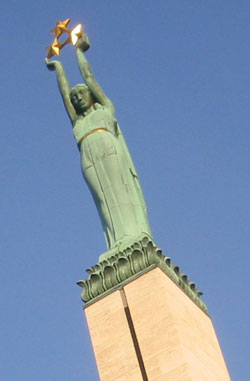
Latvia’s independence, symbolized by the Freedom Monument in downtown Rīga, will be marked Nov. 18. Latvian communities around the world also will observe the day. (Photo by Andris Straumanis)
Andris Straumanis is a special correspondent for and a co-founder of Latvians Online. From 2000–2012 he was editor of the website.