Lordi, save us from Ukraine in Eurovision

The more I listen to Latvia’s entry in this year’s Eurovision Song Contest, the more I have come around to believing Bonaparti.lv and the song “Questa Notte” (This Night) have a good chance of not disappointing fans.

The concept, which involved assembling six well-known Latvian male singers and having them croon a song in Italian, seemed a bit strange at first. But strange has a way of standing out at Eurovision. Finland’s lizard-monster-clad, hard rocking Lordi—which won last year’s contest—certainly attests to that.

Bonaparti.lv includes six tenors: Andris Ābelīte, Andris Ērglis, Normunds Jakušonoks, Roberto Meloni, Zigfrīds Muktupāvels and Kaspars Tīmanis.

The group’s first appearance in Eurovision will be May 10 during the semi-final in Helsinki. Bonaparti.lv will perform last in the field of 28 contestants. In the telephone voting at the conclusion of the performances, the tenors will have to land in the top 10 to advance to the May 12 final. The top 10 semi-finalists will join 14 other countries in the final. The 14 others include the top 10 winners from last year’s contest plus France, Germany, Spain and the United Kingdom, which automatically get into the final because of their size.

Latvia should make it through to the final, but probably has little hope of winning outright. Some of the online oddsmakers, such as those at betdirect in Liverpool, England, give Latvia a 20/1 chance of winning the final. Online bookmaker Stan James is less optimistic, suggesting a 50/1 chance. Both betdirect and Stan James also posit that Ukraine—horrors!—has a 6/1 chance of an outright victory.

Because of uninspired performances or poor songs, sure losers in the semi-final are going to be the entries from Belarus (Koldun, “Work Your Magic”); Iceland (Eiríkur Hauksson, “Valentine Love”);  Malta (Olivia Lewis, “Vertigo”); Montenegro (Stevan Faddy, “Ajde Kroči”); Norway (Guri Schanke, “Ven a bailar conmigo); Portugal (Sabrina, “Dança Comigo); Switzerland (DJ BoBo, “Vampires are Alive”), and Turkey (Kenan Dogulu, “Shake It Up Shekerim”). Of course, that’s just my opinion. Some oddsmakers, for example, give Belarus more than a fighting chance to advance out of the semi-final and even win the contest.

One of my favorites of a few Eurovisions ago is Macedonia’s Karolina Gočeva. She returns to represent her country this time with “Mojot Svet” (My World), a tune about music and the Balkan soul. I hope she makes it into the top 10 semifinalists.

My other candidates for the top 10 semi-finalists:

  • Bulgaria’s Elitsa Todorova and Stoyan Yankoulov, who try the drum-driven and ethnic song “Water,” singing it in Bulgarian.
  • Israel’s Teapacks with the song “Push the Button,” which is either a clever political commentary or a badly done joke. The song begins with the lyrics, “The world is full of terror, If someone makes an error, He’s gonna blow us up to biddy biddy kingdom come.”
  • The island nation of Cyprus, which puts forward Evridiki and her performance of “Comme Ci, Comme Ça.”
  • Georgia and its entry, “Visionary Dream” performed by 20-year-old Sopho, which might stand a chance in part because of the singer’s strong voice.
  • The rock band Kabát from the Czech Republic, which performs “Mála Dáma” with a restrained energy that might appeal to viewers who want their music without visual gimmicks.
  • Andorra’s punk rockers Anonymous, performing “Salvem el Món,” which could do well especially among younger Eurovision voters. The band, which also gets the song-writing credits, has a nice energy.
  • Slovenia and singer Alenka Gotar, whose years of voice training may pay off. The song “Cvet z Juga” comes alive with her range and operatic talent.
  • Hungary’s Magdi Rúzsa, who will sing “Unsubstantial Blues,” a tune penned by Imre Mozsik. The composer was born in the United States, but moved permanently to Hungary in 1989.

Of those countries already in the final, my greatest fear is of Ukraine. Representing the nation of the Orange Revolution is Verka Serduchka with the song “Dancing Lasha Tumbai.” Serduchka is the stage persona of Andrii Danylko, who performs in a costume that brings to mind an overgrown Teletubby clad in aluminum foil. The song is equally ridiculous. (Ukraine’s Ruslana Lyzhicko won Eurovision in 2004 with her song “Wild Dances.”)

On the Eurovision scale of the ridiculous to the sublime, Bosnia & Herzegovina’s Maria Šestić‘s performance of “Rijeka bez imena” (River of Sorrow) scores toward the latter. It is a powerful entry. Bosnia & Herzegovina also already is in the final based on the nation’s success in last year’s Eurovision contest.

Lithuania also is in the final, thanks to last year’s sixth place showing by LT United, which performed the in-your-face song, “We Are the Winners.” This year’s entry is 4FUN, a five-member band fronted by lead singer Julija Ritčik, which will perform the mellow song, “Love or Leave.”

Of the entries already in the final, my vote would go to Ireland. For once, the nation has a decent entry, “They Can’t Stop the Spring,” performed by the well-known folk band Dervish. And you can’t beat the opening lyrics: “The curtain has been raised, The wall no longer stands, And from Lisadell to Latvia, We’re singing as one clan.”
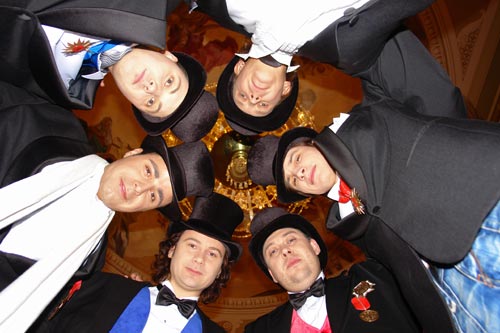
Bonaparti.lv

Latvia’s entry in this year’s Eurovision Song Contest is the Italian-language song “Questa notte,” performed by six well-known singers teamed as Bonaparti.lv.
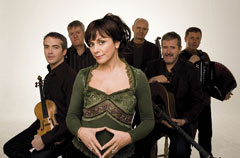
Dervish

During the Eurovision Song Contest, Irish folk band Dervish will perform “They Can’t Stop the Spring,” a song that makes reference to Latvia.

Andris Straumanis is a special correspondent for and a co-founder of Latvians Online. From 2000–2012 he was editor of the website.

Will the referendum change Latvia’s politics?

Latvia’s political intrigues took another turn when by May 2 enough citizens had signed for a referendum to be held on President Vaira Vīķe-Freiberga’s halting of the government’s security services legislation.

In Latvia’s complex system of parliamentary and presidential checks and balances, the president has the power first to return a bill first passed by the Saeima, but then if the bill is passed again unaltered, the president has a further power of refusing assent for two months. This automatically triggers the collection of signatures to see if a referendum is to be held.

This was the first case in post-Soviet, independent Latvia that the president has taken this step. Vīķe-Freiberga—and many others—argued that the security services legislation allowed too many parliamentarians and their officials access to state secrets, concerns also expressed by the NATO defense alliance. And the president warned such access may also be used for internal politics and gain by “oligarchs.” I have previously written about the extraordinary response to this by the government and ruling coalition: they immediately moved to repeal this and other controversial legislation, claiming continually that a referendum was not needed and hoping not enough signatures would be collected. The government-friendly newspaper Neatkarīgā Rīta Avīze, owned by coalition accomplice and now jailed Ventspils Mayor Aivars Lembergs, as late as the morning of May 3 still ventured an article that “most likely, not enough signatures would be collected.” For the ruling coalition, the referendum has been its first major obstacle to an otherwise arrogant and roughshod career of dodgy legislation and appointments, and of ignoring advice and criticism. The question now is will it be fatal for a coalition that only a few months ago looked so invincible?

Two considerations are relevant here.

First, the saga of the referendum is by no means over. When the referendum is held, the question must be approved by 50 percent plus one of those participating, and there can be little doubt about such a result. But for the referendum to count, it has to attract at least half the number of the voters who voted in the previous Saeima elections. With around 61 percent of those eligible voting in 2006, in this case some 453,730 citizens are required to cast a vote one way or the other, just over double the number who signed petitions to hold the referendum. Getting these votes out may not be easy, particularly if the government is successful in portraying the referendum as now unnecessary. Judging from the fury of comments on Internet and letters-to-the-editor pages, Latvia is deeply divided over this issue. 

If the referendum does not get the required numbers, the ruling coalition no doubt would claim a victory and endorsement of its policies and legitimacy. The stakes are very high.

Second, the brouhaha surrounding this referendum and the coalition’s politics has seen numerous voices asking for the resignation of this government. It should be said at once that there is no necessary link between such a referendum result and the staying or going of a government; they are quite separate issues. Yet the question is not going away.

For those now suddenly fascinated by what other surprises the Latvian constitution holds, in fact the president does have the power to call a new Saeima election. If she announces such a decision, a referendum must be held, and if the referendum supports the president, then the Saeima is dissolved and new elections are held. If the referendum does not support the president, then the president must resign—a remarkably fair constitutional requirement it would seem. Some have been calling for this, and in response some of the wilder conspiracy theories emanating from government supporters are that such a course of action of creating a false crisis for the president to act was precisely planned by the “usual suspects”: the president, the Jaunais laiks (New Era) party and the Soros Foundation.

The strongest voices calling for resignation of the government come indeed from the oppositional New Era, still trying to overcome its own internal wrangling over leadership and direction, but the president seems in no hurry to move at all. Nevertheless a referendum result supporting the president would put extra strains on the coalition.

Adding drama to this mix is the position of the president herself. Vīķe-Freiberga’s term ends in two months and the ruling parties are doing everything to try to find “their” candidate for this position. A highly politicised presidential selection by the Saeima is likely, which the ruling coalition hopes will never be against its legislation.

The referendum on the halted security legislation will be held between one and two months time. But a number of other issues may have an impact on how all this is played out.

The much-delayed border agreement with Russia has been signed and now must be ratified by the Saeima, confirming present borders and ipso facto giving up Latvia’s claim to the Abrene region that was part of pre-war Latvia. This will now be challenged in the Constitutional Court, with an uncertain outcome, but one likely to only be decided in the northern autumn. But there is considerable public concern over this agreement, which came without the previously desired accompanying declaration of Latvia’s historical relation to Russia and its border.

Much more immediate are recent events in Estonia and the widespread disturbances there over relocation of a Soviet war memorial from the centre of Tallinn to a military cemetery. Egged on by a massive anti-Estonian campaign from Russia, the resulting two-day violent confrontations put a question mark over the wisdom of Estonia’s politicians’ desires to tamper with such a symbol, and over the course of social integration in Estonia more generally. They also underlined Russia’s still antagonistic relations with Estonia, a heady mix with lessons for Latvia.

Within Latvia two more issues hold unpredictable potential. Great anticipation exists over the pending trial of Lembergs, with many of his political and business colleagues increasingly distancing themselves from him. This seems to be having little impact on other powerful co-oligarchs such as Andris Šķēle and Ainars Šlesers, who continue to exert influence even though suggestions of malpractice and corruption increase. The thuggish Šlesers, head of Latvijas Pirmā partija (First Party of Latvia), has also become politically active on a new front, forging closer link to the pro-Moscow Saskaņas centrs (Harmony Center) and together with Interior Minister Ivars Godmanis proposing that noncitizens be allowed to vote in municipal elections. Godmanis wants—wait for it—a referendum on this issue, a potentially explosive proposal and one in which, among others, Russia will be deeply interested. It is all stirring the pot, and hoping, inter alia, to take attention away from the referendum at hand.

The coming referendum on halting the security legislation comes at a politically rollercoaster time.


Latvija sākas mūsu sirdīs

Mīļā Latvijas tauta! Sveicu jūs Latvijas Republikas Neatkarības deklarācijas pasludināšanas dienā! 4. maijs vienmēr atgādinās par dienu, kad tika pieņemts drosmīgs lēmums, kas ļāva pārcirst vardarbīgi uzspiesto saiti ar totalitāru režīmu. Šī izšķiršanās bija jāizdara vispirms katram Latvijas cilvēkam savā sirds balsojumā, un katram Augstākās padomes deputātam tā bija politiski jāapliecina ar savu “jā” vai “nē”, pieņemot “Deklarāciju par Latvijas Republikas Neatkarības atjaunošanu”.

Lēmums nebūt nebija vienbalsīgs, un tieši tāpēc ir tik svarīgi uzturēt liecības par šo dienu dzīvā piemiņā, no paaudzes paaudzē nododot tālāk atmiņas un izpratni par 4. maiju, cilvēkiem, kuri ticēja neatkarības atjaunošanai, un apstākļiem, kādos Latvijas atguva savu neatkarību. Šīs liecības jārāda skolās, lai atgādinātu – dzīve var būt sarežģīta, bet valstiskuma un brīvības vērtības nekad nedrīkst aizmirst. Brīvības dziļajai vērtībai ir jāuzticas ar visu spēku un nodošanos, lai cik ilgu laiku kādreiz prasītu tās īstenošana, un savstarpējā pleca un atbalsta sajūta tautā ir ceļš, kas padara tuvāku kopēja mērķa sasniegšanu.

Gādāsim arī turpmāk par to, lai brīvības un solidaritātes gars stāvētu pāri mūsu ikdienas rūpēm un darbiem, vadot mūs vienmēr pa Latvijas valsts nostiprināšanas un tautas labklājības ceļu! Latvija sākas mūsu sirdīs. Sargāsim to vienmēr kā lielāko dārgumu!