The exodus to Ireland—and to the Web

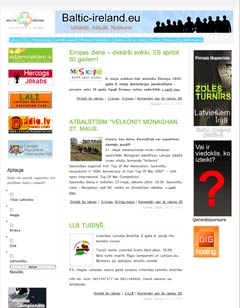
Baltic Ireland Web site

The newest Web site for Latvians living on the Emerald Isle is called Baltic Ireland.

Thousands of Latvians (according to latest Irish census statistics, officially around 14,000) have voted with their feet since Latvia joined the European Union in 2004 and have moved to Ireland, a prosperous nation with numerous opportunities. Many have moved with the intent to only stay for a short while and earn enough for a specific purpose, others are fed up with their life in Latvia and do not plan to return.

The Latvians who have moved to the “Emerald Isle” are scattered throughout the whole of Ireland, with a large proportion now living in Dublin and its surrounds. With such a large number of Latvians living in Ireland it comes as no surprise that they have started to form Latvian organisations and various interest groups—and even have several Web sites. Even though the percentage of Latvians interested in such organised activities is quite minimal, the hope is that the Latvian saying “kur ir, tur rodas” (loosely translated: the more the merrier) will apply in future.

The first Web site worth mentioning is that of the Embassy of Latvia. This would seem the first logical port of call for Latvians in Ireland. But the embassy’s role is purely to represent Latvia in Ireland, so the Web site doesn’t have any further information about Latvian activities in Ireland or offer any further information for those who are planning to relocate there.

Three Latvian societies have been founded in Ireland in the past few years. The first one, founded in 2005, is Latviešu Biedrība Īrijā (Latvian Society in Ireland). LBI’s statutes state that among it’s main aims are maintaining the culture, language and ethnic identity of Latvians living in Ireland. The society’s Web site also acts as an information source for those who need help with relocation to Ireland with a list of links to Irish government information brochures and sites. This is not all the site is concerned with. Visitors also can find out what the newly formed Latvian organisations are up to. Among these are the Latvian mixed choir, the Latvian folk-dance group “Jampadracis,” the Latvian School “Saulgriezīte,” Latvian church services and hockey team Latvian Hawks .

Latvians, as is their nature, are not content to stop with one society. In 2006 another society, Latviešu Apvienība Latviešiem Īrijā (Latvian Society for Latvians in Ireland), was founded in Dublin. Its aims are very similar to those of LBI. According to LALI’s Web site, the society “acts in the interests of Latvians in Ireland and deals with issues that are of interest to Latvians who are living in Ireland for a shorter or longer length of time.”

As Latvian organised activities gain momentum, the Latvians living on the western coast of Ireland (numbering around 2,000) can now also proudly say they have an organisation to represent them—the Limerick Latvian Society, founded in April. The society does not have a Web site yet but news of the organisation’s aims and future plans can be found on the new Baltic Ireland site.

Baltic Ireland, just launched at the beginning of May, wants to incorporate all Latvian activities, not discriminating among those hosted by one society or another. In its introductory comments the Web site states that it is created for “…Latvians in Ireland and their relatives, friends and acquaintances in Latvia. The main aim of the portal is to provide information on what is happening in Ireland…We hope, with your assistance, to create a portal that ‘rocks’ and dispel the myth that all Latvians in Ireland are ‘mushroom-pickers.’”

Latvians in Ireland also have a paper-based source of news and information. The weekly newspaper Sveiks can be purchased in Russian and Polish grocery stores in Dublin, Cork, Galway, Sligo and other towns. The paper is edited in Rīga but printed and distributed by the Russian-language newspaper Nasha Gazeta in Dublin.

Details

Daina Gross is editor of Latvians Online. An Australian-Latvian she is also a migration researcher at the University of Latvia, PhD from the University of Sussex, formerly a member of the board of the World Federation of Free Latvians, author and translator/ editor/ proofreader from Latvian into English of an eclectic mix of publications of different genres.

PBLA slams Saeima over inaction on Estonia’s troubles

In a sharply worded open letter to Latvia’s parliament, the World Federation of Free Latvians has criticized legislators for not acting quickly to support Estonia in the face of verbal attacks from Russia over the controversial removal of a downtown Tallinn monument to World War II-era Soviet soldiers.

The federation is “deeply disappointed” in the Saeima’s “reluctance, delay and fear” in supporting Estonia, the letter states. The May 8 letter is signed by the board of the federation (known in Latvian as the Pasaules brīvo latviešu apvienība, or PBLA).

To save face, the Saeima should adopt a resolution of support for Estonia, the PBLA said.

The PBLA’s concern stems from Russia’s reaction to Estonia’s removal of the Bronze Soldier from Tallinn’s Freedom Square, as well as plans to relocate the remains of 14 Red Army soldiers from an area near the monument. Estonia’s Russian-speaking minority viewed the statue’s removal as an affront, leading to two days of unrest April 26-27 during which hundreds were arrested, dozens were injured and one man—a Russian citizen and permanent resident of Estonia—died. The Latvian embassy in Tallinn also was attacked.

Estonia has blamed Russia for fomenting the unrest, for cyberattacks on Estonian government Web sites that followed the unrest, for a siege by a youth organization of the Estonian embassy in Moscow and for what it says are distorted Russian media reports on the situation in Tallinn.

Estonia’s foreign minister, Urmas Paet, in a May 1 statement called on the European Union to defend Estonia’s interests.

“The issue of the Bronze Soldier and vandalism in Tallinn are Estonia’s internal matters but the coordinated activities undertaken against Estonia by Russia are a matter of the entire European Union,” Paet said in the statement.

Russia has had strong words of its own.

“We are all outraged by this sacrilege, blasphemy and the methods used to disperse the demonstrators who tried to defend the sacred object, put up in memory of Europe’s liberation,” Sergey Lavrov, Russia’s foreign minister, said during an April 27 press conference in Norway, according to ministry’s Information and Press Department.

The PBLA criticized ruling Latvian coalition parties for failing to bring a resolution to the floor during the Saeima’s first meeting after the Tallinn riot. Opposition parties did propose a resolution, but it was defeated.

The PBLA wants the Saeima to adopt a resolution supporting the Estonian government and its sovereign decisions, condemning the vandalism and theft that occurred in the streets of Tallinn, condemning high Russian officials and members of parliament who have attempted to meddle in Estonia’s internal affairs, and condemning Russian authorities for their unwillingness to end the blockade of the Estonian embassy in Moscow and to guarantee the safety of embassy personnel in accordance with the Vienna Convention on Diplomatic Relations.

Andris Straumanis is a special correspondent for and a co-founder of Latvians Online. From 2000–2012 he was editor of the website.

Referendum scheduled for July 7

A referendum on changes to two national security laws will take place July 7 in Latvia and at polling stations abroad, the Central Election Commission announced May 8 in Rīga. The announcement came after the commission certified that more than 214,900 citizens signed petitions demanding the referendum.

The referendum will consist of two questions about whether to revoke amendments approved March 1 by the Saeima, Latvia’s parliament, to the National Security Law and the State Law on Security Institutions.

Although the parliament already has rescinded the amendments, the referendum must still go forward. Some observers and politicians see the vote as a test of confidence in the parliament and the coalition government led by Prime Minister Aigars Kalvītis.

The amendments initially were pushed through in January by the Cabinet of Ministers while the Saeima was in recess. Government officials said the amendments allowed for greater oversight of state security operations, but opponents—including President Vaira Vīķe-Freiberga—said the changes allowed politicians access to potentially sensitive information and caused concerns among NATO defense allies.

Ironically, the referendum is scheduled on Vīķe-Freiberga’s last day as president. She concludes her second term July 7.

The Saeima approved the amendments on Feb. 1, but Vīķe-Freiberga vetoed them. After the parliament overrode the veto on March 1, the president suspended implementation of the amended laws, which put in motion a petition drive for a referendum on the amendments.

At least 10 percent of the number of voters in the last parliamentary election, or 149,064 citizens, had to sign the petitions to call the referendum. According to the Central Election Commission, a total of 214,966 citizens signed the petition for a referendum on changes to the National Security Law, while 214,906 signed the petition for a referendum on changes to the State Law on Security Institutions. The final numbers reported May 8 were nearly 3,000 more than initially reported May 3, when the commission announced provisional results.

Thirty-two stations were set up to gather signatures in embassies and consulates abroad, in addition to more than 600 stations in Latvia.

For the referendum to count, at least half the number of voters in the last Saeima election, 453,730 citizens, must cast ballots July 7. For the amendments to be revoked, more than 50 percent of votes cast must be in favor of the referendum questions, the Central Election Commission explained in a press release.

The commission has not yet announced where polling stations will be established abroad.

Andris Straumanis is a special correspondent for and a co-founder of Latvians Online. From 2000–2012 he was editor of the website.