Latvian groups nominated for MTV Europe award

Two popular music groups from Latvia, Tribes of the City and Double Faced Eels, are among five bands nominated for Best Baltic Act in the MTV Europe Music Awards.

The awards ceremony is scheduled Nov. 1 in Münich, Germany, and will be hosted by American rapper Snoop Dogg.

Both Latvian groups have had good success at home and outside the country. Tribes of the City, an alternative group originally known as The Movies, released the album For the Sleepy People in 2006. The six-member band is fronted by lead singer Ksenija Sundejeva. Double Faced Eels is a four-member band that describes its music as alternative pop rock even though it often sounds like punk. The band earlier this year released its second album Kurš gribēja nogalināt Džūliju? Nezinu, bet trāpīja mums.

It may tough for either of the Latvian groups to win the award because the award last year was won by the Latvian group Prāta Vētra (Brainstrom) and because this year there is tough conmpetition from the Estonian band S.U.N., whose leader is Tanel Padar, winner of the Eurovision Song Contest in 2001.

Also in the competition for Best Baltic Act are Lithuanian singer-songwriter Jurga (Jurga Seduikyte) and the popular trio Skamp, also from Lithuania.

In the competition New Sounds of Europe, the Latvian alternative band Astro’n’out is among 18 acts nominated. Astro’n’out, which released its first album Kuš kuš last year, is fronted by Māra Upmale.

For further information on the music awards, and to vote for favorite musical acts, visit ema.mtv.tv.

Raitis Freimanis lives in Stockholm, Sweden, and is a founding member of the Latvian-Canadian band Skandāls.

Savieši album has favorites and more treasures

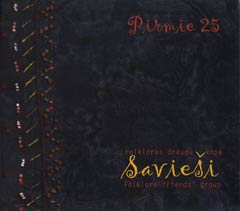
Pirmie 25

When you find a compact disc with your favorite song on it—particularly when it’s a less-often heard Latvian folksong—you buy it. This is precisely what happened when I saw the CD Pirmie 25 by Latvia’s folk ensemble Savieši. Fortunately, the CD contains a number of treasures and is worth buying for more than just one song. 

Although Savieši has been in existence for a number of years, it only recently released its first CD. The recording’s 25 songs offer a wide variety musically, geographically and historically. Savieši was formed in 1980 by the now well-known ethnomusicologist Valdis Muktupāvels. The group’s mentors were Skandenieki, widely known as the grandparents of the Latvian folk movement.

Most of the songs on the CD are sung a cappella, but a few are accompanied by instruments such as kokle, trejdeksnis or a drum, and there is one instrumental dance tune, “Augškojenieku dancis.”

The first six songs are from the group’s early years. They have the simple yet pleasant sound of Latvian folk music recorded in the 1980s.

The song for which I bought the CD is “Dziedātaju māsu devu.”  I knew only three verses, but on the CD the song is five verses long. The lyrics are about the power of song—how very Latvian!

One song I have grown to love thanks to this CD is “Saule rāja mānestiņu,” which has beautiful lyrics about the sun, moon and stars, as well as a lovely harmony.

The songs that I enjoyed most were the ones which showcased the pure strength and energy of Latvian music.  One example is “Es piedzimu māmiņai,” another song about the importance of song. In this tune the men drone while the women sing the lyrics, an effective method that Savieši employs more than once for those that are considered women’s songs.

“Zīdit, zīdit, uora pļovas” is a powerful song that makes me want to quickly learn the Latgallian lyrics so that I can sing along from the depths of my lungs. The Savieši version makes it sound like there are several dozen people singing, although in reality I imagine that no more than a dozen did.

The CD contains several rather uncommon songs. One is “Kur tu teci miega pele,” a peaceful children’s lullaby. It has a “pai pai” refrain that I’d never heard and, like so many Latvian folk songs, a great little story. Two songs, “Pa vējame es dziedāju” and “Suni reja, vilki kauca,” were first collected by a member of Savieši in Lithuania in 1988. Both of these songs have melodies unlike anything one would hear among other Latvian folk songs. Another interesting song is “Gotiņ, gotiņ, lelo,” which follows few of the conventions we are used to when it comes to traditional Latvian songs.

Of course, not all Latvian songs are about happy events such as weddings or about the beauty of nature.  “Svātdin agri buoryneite” is about an orphan girl visiting her deceased mother’s grave and crying about the treatment she receives from her new stepmother. Even if one were unable to understand the lyrics, one would sense from the heartbreakingly beautiful melody that the song is not about a joyful topic.

The liner notes contain a short history of Savieši both in Latvian and Eglish. The notes also contain lyrics for each song, but unfortunately no English-language synopsis. My favorite thing is that the listings for many songs also indicate from which area of Latvia they come, and often in what year the songs were first collected. Additionally, several list the name of the person from whom the song was collected. Many Latvians are familiar with Krišjānis Barons, who collected folk songs in the late 1800s and early 1900s, yet few people know that enterprising individuals continued to collect Latvian folk songs for many years after that. This CD includes songs collected in surprising years such as 1940 and 1945, and as recently as 1988 and 1991, when members of Savieši undertook expeditions to collect folksongs in areas such as Lubāna (in Latgale, Latvia’s eastern region) and Lithuania’s Butinges Sventaja. 

The CD also contains a couple dozen photographs of Savieīi through the years. These can only be looked at by using a computer.

Overall Pirmie 25 is an excellent CD that will be enjoyed by anyone who appreciates Latvian folk music.

Details

Pirmie 25

Savieši

Savieši,  2007

Six years on and Microsoft goes fully Latvian

It started back in September 2001 when Microsoft Latvia launched the first Latvian version of MS Word 2002. Then two years later MS Excel, MS Powerpoint and MS Outlook in fresh 2003 versions joined the suite and got the Latvian treatment as well. The latest version of the most popular office software for Windows, MS Office 2007, released just before Jāņi this year, has now gone all the way. Not only has the complete suite of applications (Word 2007, Excel 2007, Powerpoint 2007, Outlook 2007, Access 2007, MS Publisher 2007, MS InfoPath 2007 and MS Groove 2007) been adapted for the Latvian language, but the underlying operating system, more commonly known as Microsoft Vista, has learnt Latvian as well.

It seems like that in this latest localisation effort no stone has been left unturned. The control panel, online help, warning dialogs, informational messages—everywhere you look—using either Windows or the Office applications the local Latvian user can just about get by without knowing a single word of English. Even the printed guides and packaging are in Latvian. And no wonder, since this has been the largest localisation project in the Baltics to date and took the combined team efforts of Microsoft Latvia and the localisation company Tilde nearly 18 months to complete. The timing of the project presented challenges with work beginning as early as January 2006—more than a year before the release of Windows Vista itself. To add further pressure on the localisation teams, the effort had to be multiplied by three as Microsoft insisted that all three Baltic language versions be released at the same time this summer.

With more than 10 years of experience in localisation and technical translations Tilde was once again chosen to produce all three Baltic language versions. To deal with new concepts and terminology, Tilde also worked closely with the Latvian Academy of Sciences’ Terminology Commission. The results of that collaboration have now become available at the terminology Web sites www.termini.lv and www.eurotermbank.com.

It is welcoming to see that they have not always followed the current trends and simply adapted variations of the English terms, but have made a concerted effort to find more appropriate and easier-to-guess Latvian words and expressions. After all, what is the point of producing a Latvian version if you are only adding a Latvian ending to the English word?

Did you know that cilne refers to a window tab, starpliktuve is clipboard, vadības panelis is the control panel, iestatījumi refers to settings, darbvirsma is desktop, mapes is folders, uzdevumjosla is Windows taskbar, ekrānsaudzētājs is screensaver, izšķirtspēja is screen resolution, pievienojumprogrammas are software add-ons and noklusējuma programmas are default programs? Some terms introduced with Microsoft Vista include sānjosla (Windows Sidebar), sīkrīki (Windows gadgets), emuārs (blog), Windows sapulču telpa (Windows Meeting Space), ciparslēgs (digital locker), vecāku kontrole (parental controls), zibatmiņa (USB flash drive), RSS plūsma (RSS feed) and vilkšana un nomešana (drag-and-drop). One of the more unusual terms pikšķerēšana for phishing. Who can guess what a pikšķerēšanas filtra iestatītjums is?

To enter Latvian letters with all the garumzīmes and mīkstinājumi (also referred to as diacritics) you need to hold down the right ALT key while pressing the appropriate letter. Hit ALT and “a” to get ā, ALT SHIFT s to get Š and so on. It is interesting to note that under this arrangement the controversial palatalised r or ŗ is supported, but o-macron or ō is not. Microsoft’s implementation of the Latvian keyboard driver, also referred to as “Latviešu (QWERTY),” isn’t as convenient as the ~ or ’ dead-key approach used widely in Latvia (with the WinLogs, WinLat and Birojs Latvian software writing packages). Microsoft has decided to stick to its own universal standard for entering foreign language characters.

In terms of proofing tools, MS Office 2007 includes only the Latvian spellchecker and hyphenator modules, both of which have also been licensed from Tilde. If this is not enough and you need the multiple language dictionaries (Latvian-English, Latvian-German, Latvian-Russian, Latvian-Latvian), thesaurus, grammar-checking and a bunch of additional fonts for the Baltic languages as well, you’ll definitely want to look at the separate add-on package called Birojs 2005.

The Latvian localised versions of MS Vista and MS Office 2007 are available for purchase only in Latvia and are at the same price as the regular English versions. Although the software products have been available now for several months there hasn’t been any active marketing and they are yet to appear on store shelves of the leading computer stores. When I recently inquired both at Elkor and Technoland in Rīga I received only blank stares and the salespeople directed me to the English versions on display. Price can normally be a decider and definitely helps the spread the word, so Microsoft could possibly do well to consider discounting the Latvian version as it has with previous versions.

For those who already have invested in the English version of Office 2007 and want to give the Latvian interface a go, then for around USD 25 you can download the Microsoft Office 2007 Language Pack for Latvian. Similar packages are also available for Estonian and Lithuanian. The Windows Vista Language Pack that allows you to latvianise your English version of Windows Vista is not yet available, but is expected to be downloadable by the end of the year.
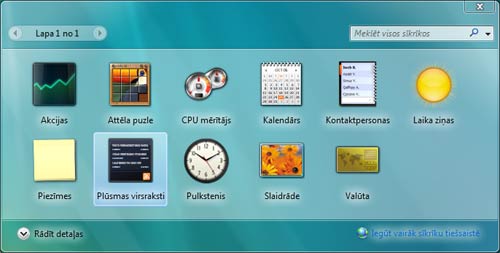
Windows gadgets

Everything in Windows Vista, even the Windows gadgets or sīkrīki, has been Latvianized.