Six years on and Microsoft goes fully Latvian

It started back in September 2001 when Microsoft Latvia launched the first Latvian version of MS Word 2002. Then two years later MS Excel, MS Powerpoint and MS Outlook in fresh 2003 versions joined the suite and got the Latvian treatment as well. The latest version of the most popular office software for Windows, MS Office 2007, released just before Jāņi this year, has now gone all the way. Not only has the complete suite of applications (Word 2007, Excel 2007, Powerpoint 2007, Outlook 2007, Access 2007, MS Publisher 2007, MS InfoPath 2007 and MS Groove 2007) been adapted for the Latvian language, but the underlying operating system, more commonly known as Microsoft Vista, has learnt Latvian as well.

It seems like that in this latest localisation effort no stone has been left unturned. The control panel, online help, warning dialogs, informational messages—everywhere you look—using either Windows or the Office applications the local Latvian user can just about get by without knowing a single word of English. Even the printed guides and packaging are in Latvian. And no wonder, since this has been the largest localisation project in the Baltics to date and took the combined team efforts of Microsoft Latvia and the localisation company Tilde nearly 18 months to complete. The timing of the project presented challenges with work beginning as early as January 2006—more than a year before the release of Windows Vista itself. To add further pressure on the localisation teams, the effort had to be multiplied by three as Microsoft insisted that all three Baltic language versions be released at the same time this summer.

With more than 10 years of experience in localisation and technical translations Tilde was once again chosen to produce all three Baltic language versions. To deal with new concepts and terminology, Tilde also worked closely with the Latvian Academy of Sciences’ Terminology Commission. The results of that collaboration have now become available at the terminology Web sites www.termini.lv and www.eurotermbank.com.

It is welcoming to see that they have not always followed the current trends and simply adapted variations of the English terms, but have made a concerted effort to find more appropriate and easier-to-guess Latvian words and expressions. After all, what is the point of producing a Latvian version if you are only adding a Latvian ending to the English word?

Did you know that cilne refers to a window tab, starpliktuve is clipboard, vadības panelis is the control panel, iestatījumi refers to settings, darbvirsma is desktop, mapes is folders, uzdevumjosla is Windows taskbar, ekrānsaudzētājs is screensaver, izšķirtspēja is screen resolution, pievienojumprogrammas are software add-ons and noklusējuma programmas are default programs? Some terms introduced with Microsoft Vista include sānjosla (Windows Sidebar), sīkrīki (Windows gadgets), emuārs (blog), Windows sapulču telpa (Windows Meeting Space), ciparslēgs (digital locker), vecāku kontrole (parental controls), zibatmiņa (USB flash drive), RSS plūsma (RSS feed) and vilkšana un nomešana (drag-and-drop). One of the more unusual terms pikšķerēšana for phishing. Who can guess what a pikšķerēšanas filtra iestatītjums is?

To enter Latvian letters with all the garumzīmes and mīkstinājumi (also referred to as diacritics) you need to hold down the right ALT key while pressing the appropriate letter. Hit ALT and “a” to get ā, ALT SHIFT s to get Š and so on. It is interesting to note that under this arrangement the controversial palatalised r or ŗ is supported, but o-macron or ō is not. Microsoft’s implementation of the Latvian keyboard driver, also referred to as “Latviešu (QWERTY),” isn’t as convenient as the ~ or ’ dead-key approach used widely in Latvia (with the WinLogs, WinLat and Birojs Latvian software writing packages). Microsoft has decided to stick to its own universal standard for entering foreign language characters.

In terms of proofing tools, MS Office 2007 includes only the Latvian spellchecker and hyphenator modules, both of which have also been licensed from Tilde. If this is not enough and you need the multiple language dictionaries (Latvian-English, Latvian-German, Latvian-Russian, Latvian-Latvian), thesaurus, grammar-checking and a bunch of additional fonts for the Baltic languages as well, you’ll definitely want to look at the separate add-on package called Birojs 2005.

The Latvian localised versions of MS Vista and MS Office 2007 are available for purchase only in Latvia and are at the same price as the regular English versions. Although the software products have been available now for several months there hasn’t been any active marketing and they are yet to appear on store shelves of the leading computer stores. When I recently inquired both at Elkor and Technoland in Rīga I received only blank stares and the salespeople directed me to the English versions on display. Price can normally be a decider and definitely helps the spread the word, so Microsoft could possibly do well to consider discounting the Latvian version as it has with previous versions.

For those who already have invested in the English version of Office 2007 and want to give the Latvian interface a go, then for around USD 25 you can download the Microsoft Office 2007 Language Pack for Latvian. Similar packages are also available for Estonian and Lithuanian. The Windows Vista Language Pack that allows you to latvianise your English version of Windows Vista is not yet available, but is expected to be downloadable by the end of the year.
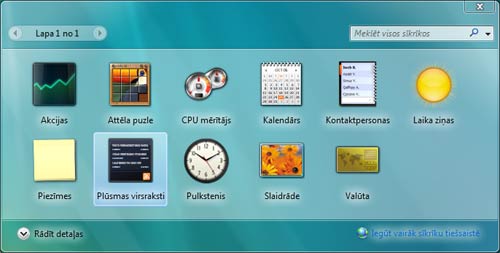
Windows gadgets

Everything in Windows Vista, even the Windows gadgets or sīkrīki, has been Latvianized.

Author emerges content after life as a victim

Battered Heart

Aina Segal’s life was scarred, like that of thousands of other refugees the world over, displaced from their homeland by circumstances out of their control, compelled to start their life afresh in a new world with strange customs and little understanding of their plight. Segal was born in Latvia in 1934. After a picture-perfect childhood as an only child in a well-to-do family, World War II shattered her life into a million pieces. They needed to be put back together slowly, her psyche set back on an even keel, through the course of her later adult life in the United States. Hence the title of the book, Battered Heart. Thankfully, a heart that can be battered can also be healed.

War, it seems, affects each individual differently. Some may appear relatively unscarred, others turn to drink. Others internalise their traumas but maintain a brave exterior. Their pain is masked by the need to survive, to work and to feed their families. A sense of guilt for having survived may start to snowball. Faith in a higher being takes on a certain role in the healing process. For others a sense of apathy and clinical depression sets in, making them unable to “snap out of it.” For some, it takes a few years to regain a life and function as normal, if there is such a state. For others it takes a lifetime of soul-searching and therapy.

Segal seems to have reached a state of contentment in her life after a lifetime of anger, guilt and blame for the bad cards that Fate has dealt: dealing with a complex relationship with her mother; surviving the war; living in a Displaced Persons’ camp; starting life afresh on a different continent with no language and a completely different set of values and customs; the tragic loss of her only child, Kim, to cancer, and a string of bad relationship choices. All contributed to Segal viewing herself as a victim of circumstances, never the one who could be the one in charge.

Life took a positive turn when Aina met Norman, who was supportive like no other person had been in her life. The love and commitment of her new partner, coupled with a conversion to Judaism, her education and later career successes, close friends and a good therapist and a realisation that her connection with her horse, Minka, is an essential for her emotional well-being—all provide the stability and healing needed.

Part of Segal’s healing has been the unfolding of her career as a psychotherapist. The soul-searching required during her studies, especially a master’s degree in psychology at Queens College where two years of personal psychoanalysis was compulsory as part of the course, all set Segal on the road to accepting herself for who she is. No doubt writing Battered Heart has also been therapy in itself.

The book clearly shows the triumph of the human spirit. Every person’s life is in a constant state of flux. The onus is then on each of us to take on the challenges that are inevitable in life. The victim will always find someone else to blame and, more often than not, circumstances, fate, God—call them what you will—are responsible for our lot in life. The circumstances may be extreme, as in Aina’s case: war, displacement, loss of loved ones. No matter what the circumstance you face the defining thing is your response. Are you a victim or are you a survivor? How do you cope with the grief of a loss of a loved one, of one’s childhood, one’s homeland? How ready are you to adapt to new situations? Every person has to find their own coping mechanism, work through their own issues, often with the help of others, but ultimately by themselves, for themselves. Only then can we say we are free of the past and ready for the future and the beauty of its uncertainty.

Details

Battered Heart

Aina Segal

Sarasota, Fla.:  The Peppertree Press,  2006

ISBN 1934246069

Where to buy

Purchase Battered Heart from Amazon.com.

Note: Latvians Online receives a commission on purchases.

Daina Gross is editor of Latvians Online. An Australian-Latvian she is also a migration researcher at the University of Latvia, PhD from the University of Sussex, formerly a member of the board of the World Federation of Free Latvians, author and translator/ editor/ proofreader from Latvian into English of an eclectic mix of publications of different genres.

Newest ambassador to Canada presents credentials

Latvia’s newest ambassador to Canada, Marģers Krams, has presented his letter of accreditation to Canadian Gov. General Michaëlle Jean, according to the Latvian Ministry of Foreign Affairs.

In an Oct. 2 ceremony in Ottawa, both officials discussed the two countries’ cooperation, especially in their military missions in Afghanistan. Jean noted the success of last year’s visit to Canada by now former President Vaira Vīķe-Freiberga, as well as cooperation between the University of Latvia and the Université de Montréal.

In her discussion with Krams, the issue of establishing visa-free travel from Latvia to Canada also was addressed. The European Union’s top justice official recently threatened Canada with retaliation if it fails to move on the issue of visa-free travel for the EU’s newest members, including Latvia. Franco Frattini in September told journalists that Canadian travelers could face introduction of visa requirements if their country does not act soon, according to media reports.

Krams told Jean that one of his duties will be to strengthen Latvia’s contact with the Latvian community in Canada.

Krams replaces Atis Sjanītis, who now is Latvia’s ambassador to Ukraine and Moldova. Krams is Latvia’s fourth ambassador to Canada.

Andris Straumanis is a special correspondent for and a co-founder of Latvians Online. From 2000–2012 he was editor of the website.