ALA says June 16 wrong for Russian culture day

The planned June 16 start of a festival of Russian culture in Latvia is “demeaning and unacceptable,” the American Latvian Association says in an open letter to Helēna Demakova, Latvia’s minister of culture.

The Oct. 5 letter, signed by ALA Chairman Mārtiņš Duhms, comes in response to an announcement that a protocol has been signed by Latvian and Russian officials for a cultural exchange. Latvia’s “culture days” in Russia are scheduled to start Oct. 16 with guest performances in Moscow by the Latvian National Opera. Events will continue through April.

Russia’s “culture days” are scheduled to begin June 16 with a guest performance by the Russian State Academic Grand Theatre during the Rīga Opera Festival.

“The ALA board considers that the scheduled dates of the Russian Culture Days in Latvia are very close to the dates of tragic events in the history of the Latvian state,” Duhms wrote, adding that the association in principle supports the idea of cultural exchange between the two countries.

However, the date is unacceptable and should be changed, the ALA said.

June 14 marks the start of the 1941 deportations from occupied Latvia at the hands of Soviet troops. June 15 is the date of the 1940 attack by Soviet forces on the Latvian border post at Masļenki. June 16 is the date in 1940 when the Soviet Union issued an ultimatum demanding its troops be allowed to enter Latvia. And June 17, 1940, marks the start of the illegal occupation of Latvia by the Soviet Union, the ALA board said in the letter.

“Latvians in the United States still are painfully aware of the effect these events had on the state of Latvia and the fate of the Latvian people,” Duhms wrote, “and view this time as a time of sorrow.” The arrival of Russia’s delegation on June 16 would be an insult to Latvians who suffered during the Soviet occupation, especially because the Russian government still has not officially recognized or apologized for the occupation of the Baltic states, Duhms added.

Russian officials have gone as far as acknowledging the Soviet Union annexed the Baltic states in 1940, but argue that if the countries were annexed then they were not occupied.
Andris Straumanis is a special correspondent for and a co-founder of Latvians Online. From 2000–2012 he was editor of the website.

Latvian groups nominated for MTV Europe award

Two popular music groups from Latvia, Tribes of the City and Double Faced Eels, are among five bands nominated for Best Baltic Act in the MTV Europe Music Awards.

The awards ceremony is scheduled Nov. 1 in Münich, Germany, and will be hosted by American rapper Snoop Dogg.

Both Latvian groups have had good success at home and outside the country. Tribes of the City, an alternative group originally known as The Movies, released the album For the Sleepy People in 2006. The six-member band is fronted by lead singer Ksenija Sundejeva. Double Faced Eels is a four-member band that describes its music as alternative pop rock even though it often sounds like punk. The band earlier this year released its second album Kurš gribēja nogalināt Džūliju? Nezinu, bet trāpīja mums.

It may tough for either of the Latvian groups to win the award because the award last year was won by the Latvian group Prāta Vētra (Brainstrom) and because this year there is tough conmpetition from the Estonian band S.U.N., whose leader is Tanel Padar, winner of the Eurovision Song Contest in 2001.

Also in the competition for Best Baltic Act are Lithuanian singer-songwriter Jurga (Jurga Seduikyte) and the popular trio Skamp, also from Lithuania.

In the competition New Sounds of Europe, the Latvian alternative band Astro’n’out is among 18 acts nominated. Astro’n’out, which released its first album Kuš kuš last year, is fronted by Māra Upmale.

For further information on the music awards, and to vote for favorite musical acts, visit ema.mtv.tv.

Raitis Freimanis lives in Stockholm, Sweden, and is a founding member of the Latvian-Canadian band Skandāls.

Savieši album has favorites and more treasures

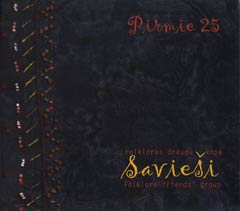
Pirmie 25

When you find a compact disc with your favorite song on it—particularly when it’s a less-often heard Latvian folksong—you buy it. This is precisely what happened when I saw the CD Pirmie 25 by Latvia’s folk ensemble Savieši. Fortunately, the CD contains a number of treasures and is worth buying for more than just one song. 

Although Savieši has been in existence for a number of years, it only recently released its first CD. The recording’s 25 songs offer a wide variety musically, geographically and historically. Savieši was formed in 1980 by the now well-known ethnomusicologist Valdis Muktupāvels. The group’s mentors were Skandenieki, widely known as the grandparents of the Latvian folk movement.

Most of the songs on the CD are sung a cappella, but a few are accompanied by instruments such as kokle, trejdeksnis or a drum, and there is one instrumental dance tune, “Augškojenieku dancis.”

The first six songs are from the group’s early years. They have the simple yet pleasant sound of Latvian folk music recorded in the 1980s.

The song for which I bought the CD is “Dziedātaju māsu devu.”  I knew only three verses, but on the CD the song is five verses long. The lyrics are about the power of song—how very Latvian!

One song I have grown to love thanks to this CD is “Saule rāja mānestiņu,” which has beautiful lyrics about the sun, moon and stars, as well as a lovely harmony.

The songs that I enjoyed most were the ones which showcased the pure strength and energy of Latvian music.  One example is “Es piedzimu māmiņai,” another song about the importance of song. In this tune the men drone while the women sing the lyrics, an effective method that Savieši employs more than once for those that are considered women’s songs.

“Zīdit, zīdit, uora pļovas” is a powerful song that makes me want to quickly learn the Latgallian lyrics so that I can sing along from the depths of my lungs. The Savieši version makes it sound like there are several dozen people singing, although in reality I imagine that no more than a dozen did.

The CD contains several rather uncommon songs. One is “Kur tu teci miega pele,” a peaceful children’s lullaby. It has a “pai pai” refrain that I’d never heard and, like so many Latvian folk songs, a great little story. Two songs, “Pa vējame es dziedāju” and “Suni reja, vilki kauca,” were first collected by a member of Savieši in Lithuania in 1988. Both of these songs have melodies unlike anything one would hear among other Latvian folk songs. Another interesting song is “Gotiņ, gotiņ, lelo,” which follows few of the conventions we are used to when it comes to traditional Latvian songs.

Of course, not all Latvian songs are about happy events such as weddings or about the beauty of nature.  “Svātdin agri buoryneite” is about an orphan girl visiting her deceased mother’s grave and crying about the treatment she receives from her new stepmother. Even if one were unable to understand the lyrics, one would sense from the heartbreakingly beautiful melody that the song is not about a joyful topic.

The liner notes contain a short history of Savieši both in Latvian and Eglish. The notes also contain lyrics for each song, but unfortunately no English-language synopsis. My favorite thing is that the listings for many songs also indicate from which area of Latvia they come, and often in what year the songs were first collected. Additionally, several list the name of the person from whom the song was collected. Many Latvians are familiar with Krišjānis Barons, who collected folk songs in the late 1800s and early 1900s, yet few people know that enterprising individuals continued to collect Latvian folk songs for many years after that. This CD includes songs collected in surprising years such as 1940 and 1945, and as recently as 1988 and 1991, when members of Savieši undertook expeditions to collect folksongs in areas such as Lubāna (in Latgale, Latvia’s eastern region) and Lithuania’s Butinges Sventaja. 

The CD also contains a couple dozen photographs of Savieīi through the years. These can only be looked at by using a computer.

Overall Pirmie 25 is an excellent CD that will be enjoyed by anyone who appreciates Latvian folk music.

Details

Pirmie 25

Savieši

Savieši,  2007