The International Ice Hockey Federation celebrates its 100th anniversary this year and as a gesture to the birthplace of hockey, this year’s World Championship is being held in Canada from May 2-18. Eight countries are competing in Québec City, Québec, and another eight are in Halifax, Nova Scotia. The semi-finals and finals will be held in Québec City. Latvia played in Halifax in a tough preliminary round group with Canada, the United States and Slovenia.
Approximately 1,000 Latvian fans arrived in Halifax to support the team. Most were from Latvia but others came from Toronto, Montréal and Halifax itself. A few arrived from the United States.
Four years ago, Latvia’s national team was one of the oldest. This year the team is noticeably younger and less experienced. The average age is 27. Even though more than a half of the team has played at some point in North America either as juniors or pros, most now play in Europe. Two players were based in Latvia last season and only three played in North American. Defenseman Kārlis Skrastiņš, the most prominent Latvian NHLer, did not participate due to a hand injury. Several American Hockey League (AHL) players were tied up with the playoffs and did not make it either, apart from talented Boston Bruins AHL minor-leaguer Mārtiņš Karsums, who arrived on May 10.
It is worth noting that with the changing of the guard on the national team, approximately two-thirds of the players are now ethnic Latvians.
Given the lack of experience playing the physical North American game, Latvia had a tough time against the United States and Canada, losing 4-0 and 7-0, respectively. The shots on goal differential against the U.S. was a lopsided 24-49, but against Canada a decent 30-37.
These results pointed to Latvia’s relatively weak offence when compared to the top teams. At a post-game conference Canadian coach Ken Hitchcock commented that Latvia missed a lot of chances but if they forced the net like teams in North America, the result could have been different.
Latvia’s game against Slovenia was critical for both teams. Slovenia had also lost both its games to the same opponents. The winner on May 6 would move to the qualification round while the loser would go to the relegation round and try to stave off demotion to the next tier. The Slovenes had NHL star Anze Kopitar and in Robert Kristan a hot goalie. They were not to be taken likely. However, this time Latvia won, 3-0. Aleksandrs Ņiživijs scored on a penalty shot midway through the second period while Aleksejs Širokovs added another goal. He pocketed a final empty net goal in the last minute. The Latvian team and fans finally got to see their flag raised and were able to sing their national anthem, “Dievs, svētī Latviju!”
In the first game of the qualification round, Latvia played Finland on May 9 losing 2-1 even though the team was outshot 64-27. The hero of the game was goaltender Edgars Masaļskis, who kept Latvia in the game. Two days later, Latvia beat Norway 4-1. The game against Germany on May 12 and results from other games will be deciding factors where Latvia places and whether it will make the quarterfinals.
Among the players, goaltender Masaļskis put in an excellent performance and is arguably Latvia’s most valuable player in this year’s championship. Also worth mentioning are the three Rēdlihs brothers: Miķelis, Krišjānis and Jēkabs, who played together on the team. Captain Rodrigo Laviņš put in a solid performance and Arvīds Reķis was a tower of strength on defense. Centres Jānis Sprukts and Herberts Vasiļjevs added experience down the middle. Forwards Lauris Dārziņš and Armands Bērziņš created a lot of opportunities but often failed to finish. Even though Karsums joined the lineup without being able to practice with the team, he put in a solid two-way performance against the Norwegians.
Los Angeles Kings forward and enforcer Raitis Ivanāns was the only NHLer on Latvia’s roster. At 6 feet, 4 inches (1.92 meters) and 220 pounds (100 kilograms), he brought a strong physical presence to the ice. Even though he took several needless penalties, he was quick to wade into the fray when the Americans and Canadian started charging Latvia’s goaltenders and to help out Latvia’s smaller forwards. His thundering check against a Slovenian player arguably helped Latvia break out of the 0-0 tie. This was Ivanāns debut at the World Championship and he showed those who thought he could only fight the value of a physical game.
During the championship, each team played one game in historical uniforms. In the game against Canada, instead of the usual maroon-white-maroon or white-maroon-white jerseys, Latvia wore dark blue replica uniforms from the 1936 Olympics.
Fans enjoy Halifax
Even though Latvia will likely not make it to the medal round, Latvia’s fans have once again been among the best. They were a common sight on the streets and in the bars of Halifax with their team’s jerseys. Their drums, horns, songs and chants were deafening at the Halifax Metro Centre venue easily surpassing what Canadian fans could muster when prompted by the electronic scoreboard.
Latvia’s fans got a lot of media attention and they were popular among the locals, even more so when Latvians supported Canada in games that Latvia did not play. Canadian fans would often take pictures of Latvians and were eager to share a beer or two. On the way to the Latvia–Slovenia game, two Canadians were overheard discussing who they should support. One said that he had never seen the likes of Latvian fans and, as a result, he was supporting Latvia.
Long-time Latvian Haligonian Roberts Dambergs had lined up The Economy Shoe Shop bar and restaurant complex as a home for Latvians. After Latvia’s games, hundreds of fans would show up. With support from the Rīga club Četri balti krekli, the complex’s Seahorse Tavern was rechristened Halifax balti krekli (Halifax White Jerseys) for the championship. Aldaris Zelta beer was served along with local brews and musicians Gunārs Meijers and Normunds Jakušonoks performed. Dambergs also created a Web site, Hokejs Halifaksā, with useful information for arriving fans. The information was also published in a ceļvedis or tourist guide that was distributed to departing fans in Latvia.
On days when Latvia did not play, Latvian fans spread out to check out Halifax, the famous Citadel from British colonial days, the renovated waterfront, the world famous Peggys Cove fishing hamlet and even farther to the Bay of Fundy to see the world’s highest tides. The World Championship was also an opportunity for Latvian enterpreneurs to visit local businesses and look for trade opportunities, as was reported in the Halifax Chronicle Herald.
On May 3 Latvia’s ambassador to Canada, Marģers Krams, hosted a reception at the Halifax World Trade Centre. Among the guests were Kirovs Lipmans, president of the Latvian Ice Hockey Federation; board member and former Latvian President Guntis Ulmanis; the team’s General Manager Māris Baldonieks; the team, including players, staff and coach Oļegs Znaroks; the Latvian federation’s Canadian representative Viesturs Zariņš; a number of younger Latvian fans from Toronto including Latvian Hockey Fan Club in Canada co-president Vilnis Blūms, and local Latvians led by Dambergs.
Before the championship, Latvia played an exhibition game against Belarus on April 26 in Montréal where both teams held their training camps. The score was tied 0-0 after regulation and an overtime period. It was finally settled in a shoot-out. Belarus won in the eight round. About 200 noisy Latvian fans from Montréal and Ottawa, plus a few from Toronto, were there to support Latvia. Following the game, the team came out to greet the fans and sign autographs.
For those Latvians in attendance, this year’s World Championship in Halifax has been a momentous occasion. Hockey is not only the most popular sport in Latvia but it plays a positive role in consolidating Latvian society. Hockey also creates a positive image for Latvia in the world worth its weight in gold.
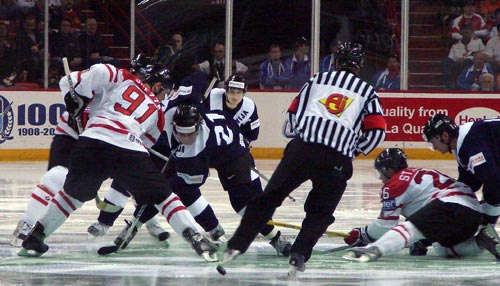
Latvian player Armands Bērziņš, sporting a dark blue jersey similar to those worn by the 1936 Latvian Olympic team, takes the faceoff against Canada. (Photo by Viesturs Zariņš)

A flyer advertises the availability of a Halifax tavern for Latvian fans—complete with musicians from Latvia.


