Midsummer offers hope the sun will come up tomorrow

Latvia awaits the longest day of the year in what seems to many like the longest year in their lives. Especially if you are trying to balance a budget. Your own, or a government’s.

But the summer solstice on June 21 is a turning point. Spring ends, summer begins, the days get shorter, the nights get longer, and plants, animals and other living things all feel a shift in the world around them.

In ancient times when people watched the sun rise and fall every day with great care, the solstice was a singular event and signaled a significant change in cosmic direction. If you were used to one climactic pattern from January until June, you got ready for the reverse in the second half of the year. You hoped the same applied to your fortunes.

Those who live in steel and concrete cities with fluorescent sunsets, or in tropical climes where the sun is always around, may not relate much to the wonders of the summer solstice. But up here on the 57th parallel by the Baltic Sea where the sun goes away to hide for months on end, and sometimes barely comes up for a few hours, the month of June is a month to be treasured.

For reasons I can’t begin to explain, Latvians celebrate Midsummer’s Day on June 23. We call it Līgo Day, and the day after that we call Jāņi. For Latvians, this is both their favorite holiday and also their oldest. We’re fairly certain that our ancestors have been singing and dancing around bonfires at this time of the year for several thousand years.

Latvians celebrate the solstice by gathering flowers, decorating everything, building bonfires, drinking beer, singing songs, eating cheese, dancing in circles and staying up all night.

It’s very important to stay up all night in Latvia on June 23, because if you don’t, the sun won’t rise the next day. We have special songs you have to sing when the sun goes down, or else it won’t come up again in the morning. We light the bonfires before sunset so that the wandering sun can find a light once it approaches Latvia again. We do all this with ritual tenacity, and our ancestors have been doing the same thing, year after year, for countless centuries. So far, it has worked. The sun has always risen on June 24.

In the last week, the Latvian government, parliament, business community and their social partners have also been working around the clock to avoid an economic catastrophe. The entire world has been watching as Latvia has struggled with massive budget cuts, painful gross domestic product drops, struggling businesses, and growing unemployment lines. The finest economic minds in the world have taken up their rhetorical swords and have been bashing each other daily in a global debate over whether Latvia should devaluate its currency or not.

But as I write, the lat is still pegged to the euro. The government has agreed on a 500 million lat budget reduction, and the parliament has approved it. Now we await the International Monetary Fund and European Commissoin to give their nod of approval.

And we go out to the countryside, to build bonfires, pick flowers and fill pitchers of freshly brewed beer. We also stroll out into the forest in search of fern blossoms. You can find fern blossoms only at this time of the year, and if you don’t believe they exist, you will never find one.

If it sounds like Latvians look for a little magic around this time of the year, you are right. It can’t hurt. After all, we are facing another turning point in our lives. But one thing we know for sure. The sun will come up tomorrow.
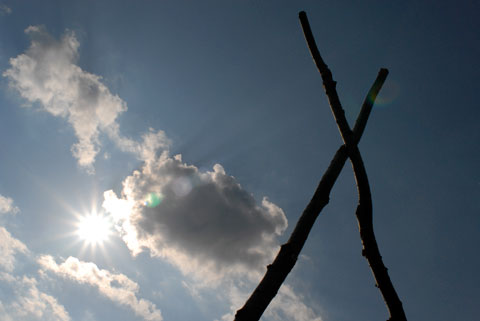
Midsummer

The Midsummer holiday marks a turning point, and for Latvia perhaps things will get better. (Photo by Andris Straumanis)
Prime minister apologizes for Latvia’s hard times

Prime Minister Valdis Dombrovskis has apologized to the Latvian people for the serious tests they will have to endure as the country struggles to emerge from its economic crisis and avoid bankruptcy.

At the same time, the prime minister said in a statement released June 18, conflict will not solve the problem. The announcement came as several hundred people gathered in the Esplanade in downtown Rīga for a demonstration organized by the Free Trade Union Confederation of Latvia (Latvijas Brīvo arodbiedrības savienība, or LBAS) to protest the effects on workers of deep cuts to the national budget.

“Even though during the so-called ‘fat years’ I have not worked in the government coalition,” Dombrovskis said in his statement, “at this moment I wish to apologize to the people of Latvia for the situation and for the tests that we all will have to endure.

“I recognize that I cannot promise well-being tomorrow at lunchtime,” he continued, “but I know I am doing all that is possible to stop Latvia’s heavy fall.”

The Saeima on June 16 approved LVL 500 million in cuts to this year’s budget, which government leaders hope will clear the way for a package of international loans to be released to the country. Without the money, Dombrovskis said in his statement, the government by August will not be able to make salary, pension and other payments.

The sweeping cuts to the national budget have claimed their first political casualty. Health Minister Ivars Eglītis stepped down June 17 to protest what a 10 percent decrease in his ministry’s budget will mean to health care in Latvia.

“This is a decisive time for our nation, and we do not have many options,” the prime minister said in his statement. “Latvia faces bankruptcy, from which we can save ourselves only by sharply reducing state expenditures and hoping for the international loan.”

The other option would be to slash the budget even further, thereby putting even more pressure on society, Dombrovskis said.

Latvia’s national budget now foresees spending LVL 4.6 billion this year. The budget will have to be cut by another LVL 500 million in 2010 and again in 2011, officials have said.

The trade unions understand the need for cuts to state spending, LBAS Chairman Pēteris Krīgers said in a press release announcing the June 18 demonstration.

“But we know that there are different ways to save, with an eye toward development or without it,” Krīgers said. “Even while saving it is possible to make new jobs and create new opportunities. Latvians have always survived thanks to their capacity to work. That is why we should be given the opportunity to work!”

In a speech before the Saeima, President Valdis Zatlers admitted the country’s leaders have not been prepared to deal with the crisis.

“In my opinion,” the president said, according to a transcript of his speech, “we must all not only acknowledge, but also accept responsibility for the fact that our decisions often have been incorrect, actions have been incorrect, we have lacked political will, lacked economic and management far-sightedness, we have badly run our country.”

He urged members of parliament to work even through the summer to address the next phase of budget cuts and to involve the public in the decision-making process.

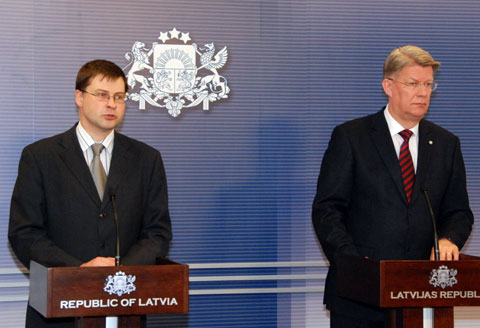
Dombrovskis and Zatlers

Prime Minister Valdis Dombrovskis (left) and President Valdis Zatlers speak June 11 to reporters following a meeting in which the government and social partners reached an agreement on budget cuts. (Photo by Aivis Freidenfelds, State Chancellery of Latvia)

Andris Straumanis is a special correspondent for and a co-founder of Latvians Online. From 2000–2012 he was editor of the website.

Health minister steps down as Latvia faces budget reforms

Latvia’s Health Minister Ivars Eglītis has resigned, saying he will not be responsible for what cuts in the government budget will mean to medical care in the country.

Eglītis, a member of the People’s Party (Tautas partija), announced his resignation June 17, a day after the Saeima approved a sweeping LVL 500 million reduction in the national budget. He is the first minister to leave the coalition government headed by Prime Minister Valdis Dombrovskis.

A significant portion of the cuts—LVL 45 million—is to come from the Ministry of Health and will require changes to health care delivery. The amended national budget now foresees spending LVL 4.6 billion, but taking in just LVL 4 billion. The health ministry’s revised budget anticipates spending LVL 453 million this year.

“Without creating the social protection system for those patients to whom the lack of money already forbids to receive timely and qualitative medical help, further health budget cuts were not acceptable because those are disproportionate to the social responsibility of the sector,” Eglītis said in a statement released by the health ministry. “As (a) doctor and health care specialist I cannot accept that.”

Dombrovskis has accepted Eglītis’ resignation.

“In this crisis situation the minister for health has chosen the easiest way as it is clear that the health care system is facing a process of complicated, urgent and essential reforms,” Dombrovskis said in a prepared statement. “The decision will require political will and determination, and conviction that the end result is adequate for such a health care model which should already have been introduced some years ago. If the minister honestly admits to be unable to manage these reforms, his resignation is sensible and acceptable.”

Dombrovskis also said he is awaiting the People’s Party’s recommendation on who should replace Eglītis.

After a meeting with the prime minister, President Valdis Zatlers told a press briefing that Latvia needs a health minister who is confident in their abilities.

“And this minister must be found as soon as possible,” Zatlers said. “I would even say today, so he could start work tomorrow.”

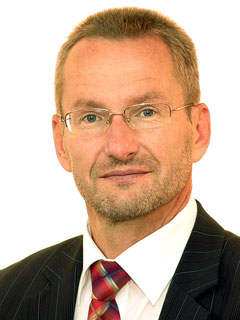
Ivars Eglītis

Ivars Eglītis

Andris Straumanis is a special correspondent for and a co-founder of Latvians Online. From 2000–2012 he was editor of the website.