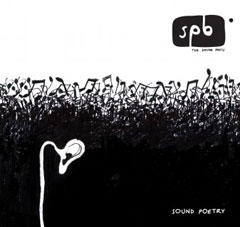
In 2006, five guys formed a collective “quite accidentally,” becoming The Sound Poets—or S.P.B. This accident partially stems from the fact that most of the band members took academic degrees in subjects related more to the business world than to that of the arts. Through the band’s Web site, one gains the perception that they started their “band life” based more on a crap shoot than anything else.
But factor in the various Radio SWH victories, a MTV Baltic video debut and the outright talent, one has to take this perception and disregard it. The band released its debut album, Sound Poetry, in December.
S.P.B. has enjoyed single-by-single success since 2007 (with its first single “Pearl Tears” reaching the Radio SWH Top 20 No. 1 in March) and has been readily introduced to the Latvian rock sector, by performing in both the 2007 Baltic Beach Party and the PositivusAB Festival. But even with all of this, I have to say that the band seems to have remained rather unknown. I myself only stumbled upon it when browsing the MySpace pages of local Latvian bands. To its credit, S.P.B. had something that made me want to know more.
The five members who make up S.P.B. are Jānis Aišpurs (vocals, keyboards and guitars), Ingars Viļums (bass, guitars and keyboards), Andris Buiķis (drums), Normunds Lukša (guitar) and Artūrs Eglītis (keyboards and back-up vocals). In all honesty, the music itself is good, but the unique sound of S.P.B. rests mostly on its vocals.
The album’s first track, “Ikaros,” is a nice a capella bit. It makes you hold your breath as your senses strain to catch each note of the romantically tuned intro. And then you’re pitched the line “I think it’s beautiful day to spread my wings and die.” Take it in now: This is how S.P.B. works.
The majority of the album is ethereal vocals and catchy beats mixed with lyrics that are unnaturally and shockingly dark for the bright-eyed group of guys smiling up at you from the album’s disc jacket. I still don’t know what to think, how I feel or if I should be tapping my foot to songs about self-doubt and uncertainty.
The album continues with vocal and sound plays in a track aptly named “Poet,” wherein S.P.B. tests the waters with reverb, echoes and something that feels like you’re in a tunnel. “Poet” is one of the strong points of the album, a charming song that reminds me of one of Ben Folds Five’s less annoying songs. Other than that, Sound Poetry is a slow ride. Most of the time, it is the refrains alone that save each individual track from becoming mundane.
One more song that in no way falls into that rut is track five, “Another Day.” The song, my favorite on the album, has a very involving introduction and an overall catchiness. It seems to include everything you need to “get” S.P.B.: delightfully “bipolar” vocals, variations in the themes of the song, free application of synthesizers and a good beat.
One thing S.P.B. does well is tackle sounds—all kinds of them. Many tracks sound like they might have been recorded in a cement tunnel or in a tiled bathroom. Other tracks include such additions as stomping boots, restaurant clatter and traffic on a rainy day. While listening, you at times feel as if you’re in a traveling performance and as an audience member are tasked with keeping up with the band. All of these things are little hooks that could either keep you listening “for just a few seconds more” or that could make you hit the eject button on your stereo system.
The sixth track, “Body Selling,” takes the album from slightly off-beat relationship songs to a more serious and potentially uncomfortable subject matter. What sells this track for me is the aforementioned sound of stomping boots and clapping hands, elements that lend the song something both intoxicating and eerie. I personally get antsy after this track, a point at which I feel like I’ve gotten everything I can out of the album.
Still, S.P.B. manages to putter on through to the last track, where it teeters on the fence with a mini-ballad (“Feeling Behind”) I don’t remember enough about to really comment on. S.P.B. won’t be readily liked by everyone. However, there is also no doubt that this mixture of innocent, teen movie sounds and dull razor blade lyrics will catch your attention. This may make you feel uncomfortable or disjointed, but this is what poets do best—they test the boundaries of their audiences by purposely pushing previously unpushed buttons and touching on topics that might otherwise stay uncovered.
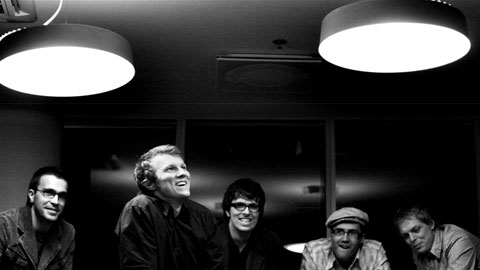
The five-member Latvian band Sound Poets, or S.P.B., was formed in 2006. (Publicity photo)
Details
Sound Poetry
Sound Poets
SPB Records, 2008
PMP3133
Track listing:
Ikaros (intro)
Poet
Pearl Tears
The Moon
Another Day
Body Selling
It Takes Me
Spinning the Sun Around Fingers
Breaking Bounds
Pilgrim
The Doors
Feeling Behind