Two poems by Brūveris published by literary journal

Two poems by Pēters Brūveris of Latvia have been published in the latest issue of the biannual Michigan-based literary journal Absinthe.

Brūveris, born in 1957 in Rīga, has won numerous awards for his work. He has published eight collections of his poetry. Brūveris also has written children’s books, librettos, song lyrics and text for animation films, as well as done literary translation, according to the journal.

The poems, “Tombs” and “Untitled,” were translated by Ināra Cedriņš of Chicago. She edited the 1984 collection, Contemporary Latvian Poetry, published by the University of Iowa Press. Cedriņš is now working on a new anthology of Baltic poetry, according to the journal.

The journal also has a blog, Absinthe Minded, and a MySpace page.

Absinthe

The latest issue of Absinthe includes two poems by Pēters Brūveris.

Andris Straumanis is a special correspondent for and a co-founder of Latvians Online. From 2000–2012 he was editor of the website.

Latvia reports first case of H1N1

A woman who traveled to the United States and Canada is the first verified case of the H1N1 flu in Latvia, the Public Health Agency in Rīga has announced.

The woman returned to Latvia on June 21 on a Berlin to Rīga flight on airBaltic, the agency said in a June 23 press release. The woman exhibited symptoms on the flight and was hospitalized as soon as the flight landed.

The agency has recommended that passengers who were on the flight monitor their health during the next five days. Symptoms of H1N1, according to the World Health Organization (WHO), are flu-like and include fever, cough, headache, muscle and joint pain, sore throat and runny nose. If such symptoms are observed, a spokesperson for the Latvian agency said, the person should contact their family physician or the Public Health Agency’s epidemiologist at +371 67271738.

Health officials were prepared for this first case in Latvia, the agency said in the press release. The agency has notified German officials of the case so they can organize assistance for passengers who traveled with the woman from Canada to Germany.

WHO on June 11 labeled the spread of the virus as a pandemic.

“Globally, we have good reason to believe that this pandemic, at least in its early days, will be of moderate severity,” WHO Director-General Margaret Chen said in a statement. “As we know from experience, severity can vary, depending on many factors, from one country to another. On present evidence, the overwhelming majority of patients experience mild symptoms and make a rapid and full recovery, often in the absence of any form of medical treatment.”

According to WHO, a total of 52,160 cases of H1N1 have been reported around the word as of June 22. In all, 231 people have died as a result of the virus. No cases of the virus have been reported in Lithuania, but Estonia has had five. The United States, Mexico and Canada remain the top three countries in the number of infections.

Andris Straumanis is a special correspondent for and a co-founder of Latvians Online. From 2000–2012 he was editor of the website.

Practice makes for better Midsummer celebrations

Several years ago Ilga Reizniece of the folk-rock group Iļģi began a campaign to popularize traditional Latvian methods of celebrating the summer solstice. The campaign, called “Piedzīvosim Jāņus”, consisted of various folklore groups and folklore-minded individuals leading short seminars that were open to the public.

These took place throughout the month of June at various locations throughout Latvia. Each seminar was a bit different, since each group or individual focused on those songs and traditions and aspects of the celebration that were important to them.

The seminars were fairly popular, and I’m happy that they still continue today, although this year’s financial crisis has toned down the advertising effort and publication of song booklets.

I have taken part in a few “Piedzīvosim Jāņus” seminars, both as a spectator and as part of a group leading a seminar. This June, however, I helped organize an informal seminar at a friend’s house near Burtnieki in northern Latvia. In other words, this gathering was not on the published list of “Piedzīvosim Jāņus” seminars. But it must be one of the things that Reizniece had hoped would eventually happen: friends getting together on their own, learning songs, trying out dances, thinking about and preparing to include some “folkloric” elements in their own summer solstice celebrations. 

I’ll admit that our gathering began a bit stiffly, everyone (mostly women, since most of their husbands “weren’t interested in that sort of thing”) sitting in a circle and singing songs from photocopied booklets. But the pace picked up when we refreshed a few of the typical solstice dance-games.

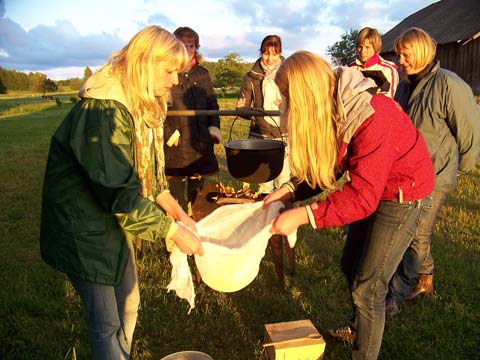
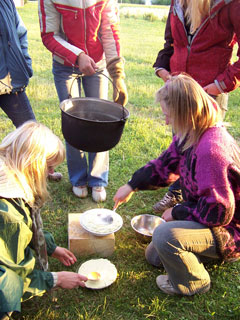
Later in the evening we made caraway cheese—Jāņu siers—outside over a small fire and discussed the different ways of “tying” the cheese. Later still we rested in the sauna, and then the last couple of night-owls finished off the evening by singing ballads (sans photocopied booklets) around the bonfire. OK, not the sort of thing that excites machos… but you’ve got to start somewhere.

What we pretty much ended up doing was holding a rehearsal about two and a half weeks before the popular celebration. Not a very spontaneous, organic thing to do (did our great-grandmothers ever hold rehearsals for Jāņi?), but probably necessary in our times. Next year’s celebration will already feel a bit more natural to this group of friends.

Preparing traditional Midsummer cheese

The traditional Jāņu siers is drained of water through a cheesecloth by a group of Latvians practicing Midsummer traditions. (Photo by Amanda Jātniece)

Preparing traditional Midsummer cheese

Cheese is placed in bowls to set, following a method used in Vidzeme. (Photo by Amanda Jātniece)