


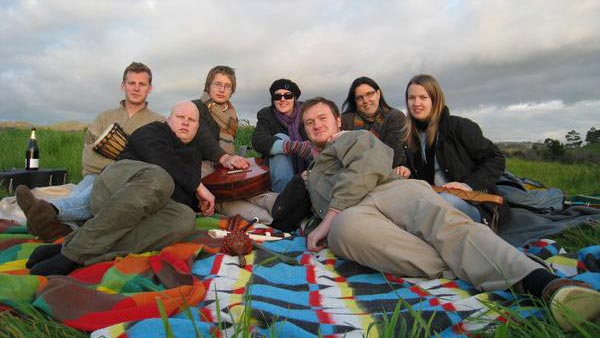
Zigrīdas Kalpi unites two Latvian-Australian folk ensembles, Zigrīda Ansamblis and Kalnu Kalpi. (Publicity photo)
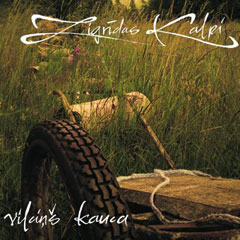
Vilciņš kauca is an EP compact disc released by Zigrīdas Kalpi, a collaborative project between seven third-generation Latvian-Australians living in Adelaide and Brisbane.
These talented musicians, inspired by traditional Latvian folk music, arranged their favourite songs and produced the recording. The songs are well-known Latvian folk melodies, but the group’s unique interpretations are refreshing. Even the most familiar tunes ring with a new quality.
Kalnu Kalpi is a male folk group from Adelaide that sings ancient Latvian war songs and Zigrīda Ansamblis is a female kokle group from Brisbane. The two groups have been playing independently for many years, performing at Australian Latvian arts festivals such as Jaunatnes dienas and Kultūras dienas. Through their common interest in Latvian folk music, members of the two groups forged friendships and developed a mutual respect for each other’s musical ability. Recently, they united and have played together as Zigrīdas Kalpi during the 2008 Kultūras dienas in Sydney and at the National Folk Festival in Canberra this year.
Both Zigrīda Ansamblis and Zigrīdas Kalpi tracks have received airtime on ABC FM, an Australia-wide national radio broadcast.
The members of Zigrīdas Kalpi are Aleksandrs Šmits (percussion, voice), Ance Deksne (kokle, melodica, percussion, voice), Krišjānis Putniņš (guitar, percussion, voice), Mārtiņš Medenis (recorder, percussion, voice), Matīss Biezaitis (bass guitar), Tija Lodiņa (percussion, voice) and Valda Biezaite (vargāns, recorder, percussion, voice).
Vilciņš kauca features traditional Latvian instruments including the kokle, the recorder and the vargāns (Jew’s harp). The melodica replaces the sound usually produced by an accordion and the songs often rely on a guitar and bass guitar accompaniment. These are not traditional instruments, however, with the contemporary arrangements less conventional sounds integrate well with the traditional melodies.
“Gaismeņa ausa,” sung in the Latgalian tongue, speaks of light dawning as the sun rises early in the morning. The recorder and guitar accompaniment evokes a medieval sound. Powerful male and female vocal harmonies give the song strength in contrast with the breezy instrumentals. The unique voices of the individual members of Zigrīdas Kalpi are characteristic to the sound of the EP and I found the more times I listened to the disc, the more I could separate individual voices and appreciate the vocal harmonies in each song.
The title track “Vilciņš kauca” (The Wolf Howled) is a favourite of many Zigrīdas Kalpi fans who first heard the song when the group performed it at Kultūras dienas. The song is about a man going to Rīga with his wolf to buy his father tobacco. Zigrīdas Kalpi arranged the song as a reggae number but still preserving the folk element. Hearing this song performed live, it is impossible to resist moving your body to the beat and getting into the funky groove folk-reggae. A recording studio removes the audience and the subtle audio and visual cues from a performance that can make a song sound fantastic, so to hear this song at its best, enjoy it live (or the next best thing—YouTube).
The EP only includes five songs, not enough to satisfy the senses, but enough to demonstrate the musical capability of these musicians. In “Gula meitiņa” the combinations of kokle and bass guitar, and percussion accents and vocal overtones, create a rich musical tapestry. In “Div’ dūjiņas,” a song about two doves sprinting through the air and two soldiers riding on horseback to war, the recorder harmonies race over the drum beats and clapping sticks, which keeps the song moving at a fast pace like the doves and the horses. The haunting vocal arrangements in “Lēni lēni” give a sombre and musically sensitive conclusion to the CD, indicative of the musical intuition of Zigrīdas Kalpi.
Hopefully, the members of Zigrīdas Kalpi will continue their joint musical projects and more folk-reggae tracks are to come.
Details
Vilciņš kauca
Zigrīdas Kalpi
2009
On the Web
draugiem.lv
The group’s page on the Latvian social networking site draugiem.lv. LV
Zigrīdas Kalpi
Formed in 2008, Zigrīdas Kalpi joins two Latvian-Australian folk groups, Zigrīda ansamblis and Kalna kalpi. The group’s official Web site includes information on ordering the EP compact disc. EN LV
Zigrīdas Kalpi on MySpace
The group’s page on MySpace includes samples of its music. EN
