Long-time New York basketball coach receives two honors

The prestigious New York Metropolitan Basketball Writers Association has named Indulis Ray Raņķis 2009 All-Met Men’s Division III Coach of the Year.

He was also awarded Coach of the Year honors by the Atlantic Region National Association of Basketball Coaches and the City University of New York Athletic Conference (CUNYAC).

The awards were announced in April and March, respectively.

Raņķis, in his 26th season at CUNY’s Baruch College, is the longest-serving men’s basketball coach in CUNYAC history. Baruch recorded a perfect 13-0 record in the regular season and a berth in the 2009 conference championship game.

This season Raņķis coached the Bearcats to a 23-6 record and the program’s third appearance in the NCAA Tournament. His teams have won nine CUNY North Division Championship titles.

A 1970 graduate of DeWitt Clinton High School in the Bronx, Raņķis played college basketball for Lehman College where he was selected First Team All-CUNYAC and inducted into the Lehman College Sports Hall of Fame.

Raņķis also is a 25-year veteran player and coach for the New York Latvian basketball team Rakte, which has won 10 titles in the American Latvian Association’s “Finālspēles” tournament. Raņķis twice won the Visvaldis Melders Memorial Award as the tournament’s outstanding basketball player as well as has received the Imants Štāls Memorial Cup for outstanding basketball contributions on and off the court. In 1993, he was inducted into the Latvian Sport Hall of Fame for achievements in sports outside of Latvia, receiving the Latvian Sports Council’s “Lielā nozīme” award.

Raņķis, along with his wife and two children, resides in New Rochelle N.Y. He also serves as associate athletic director at Baruch and starts the 2009-2010 basketball season with 367 career victories.
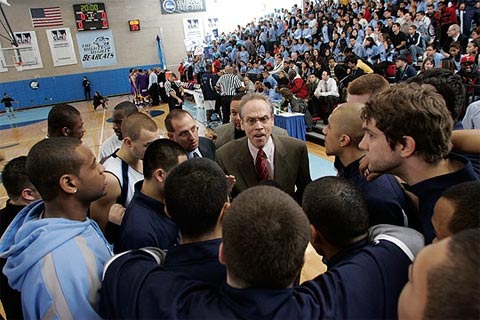
Raņķis talks to players

Coach Indulis Ray Raņķis talks to his Baruch College players during a break in a game. (Photo courtesy of Baruch College)

Rīga gets nod to be a European Capital of Culture in 2014

Rīga is expected to be one of two cities designated as a European Capital of Culture in 2014, raising its profile across the continent, officials announced in a Sept. 15 press conference in Latvia.

The designation, expected to be confirmed by the European Union’s Council of Ministers next spring, could provide Latvia’s capital city with a boost in tourism and other investment.

“This is the beginning of a great adventure,” Ján Figel’, the member of the European Commission responsible for education, training, culture and youth, said in a press release.

Rīga was one of three Latvian finalists for the title. Cēsis, which marked its 800th anniversary in 2006, and the Baltic Sea port of Liepāja also were under consideration.

“I am delighted with Rīga’s success and would like to congratulate the local authorities and the team that prepared the application,” Figel’ said. “Rīga has great potential for being the European Capital of Culture. Bearing this title for one year will certainly place this city in the spotlight and create enormous potential for it to develop locally and raise its profile across Europe.”

Figel’ noted that Latvian officials have plenty of work ahead to benefit fully from the designation. According to the European Commission, being chosen a European Capital of Culture requires an “exceptional” program of cultural events take place during the year a city has the designation. The events should highlight the city’s European character and must involve its citizens.

Rīga Mayor Nils Ušakovs said the designation will help strengthen Rīga’s and Latvia’s role in the Baltic Sea region.

“All inhabitants of the state will benefit in 2014, because Rīga is prepared to be the gateway to Latvia,” the mayor said in a press release.

Ojārs Kalniņš, director of the Latvian Institute, also expressed pleasure with the designation.

“It’s no secret that Rīga has been the diring force of Latvia’s tourism boom in recent years,” he told Latvians Online in an e-mail. “I think this decision gives a clear signal to the state and city governments that continued development of Latvia’s tourism infrastructure is one the keys to our economic recovery. This is clearly an advantage for the city of Rīga, but we must learn how to turn it into an economic benefit for all of Latvia.”

Rīga would share the designation with the Swedish city of Umeå.

Vilnius, Lithuania’s capital, is one of two European Capitals of Culture this year. Estonia’s capital, Tallinn, will share the designation with Turku, Finland, in 2011.

The first European Capital of Culture was Athens in 1985.

Andris Straumanis is a special correspondent for and a co-founder of Latvians Online. From 2000–2012 he was editor of the website.

Latvian bassist wins ARD Music Competition

A young Latvian double bass musician has survived two weeks of competition in Munich, Germany, to win this year’s ARD Music Competition. Gunārs Upatnieks also won the audience prize, competition organizers announced.

Upatnieks was one of 94 double bass players who applied to the competition. Only 39 were admitted by contest officials.

Competition began Aug. 31 and advanced to the Sept. 8 finals, when competitors had to perform with the Symphonieorchester des Bayerischen Rundfunks.

Stanislau Anishchanka of Belarus won second prize in double bass, while Olivier Thiery of France and Ivan Zavgorodniy of Ukraine shared third prize.

Musicians also competed in voice, violin and harp.

All winners will now perform in a series of concerts in Munich: Sept. 16 with the Münchner Rundfunkorchester; Sept. 17 with the Munich Chamber Orchestra; and Sept. 18 with Symphonieorchester des Bayerischen Rundfunks.

Upatnieks, who studied at the Jāzeps Vītols Latvian Academy of Music in Rīga, has done well in other international music competitions. He won the solo competition in the 2007 International Society of Bassists competiton and took first prize in the 2008 Sperger International Competition in Ludwigslust, Germany.

Andris Straumanis is a special correspondent for and a co-founder of Latvians Online. From 2000–2012 he was editor of the website.