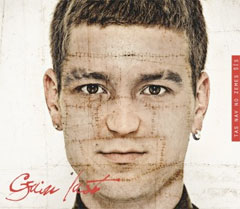
Gain Fast’s second album heads in wrong direction

Tas nav uz zemes šīs

Gain Fast’s first album came out in 2007 with a decent amount of commotion—a new concoction of musically inclined, fresh-faced guys with a heart for alternative (possibly Christian) rock. What’s not to like?

But it was entirely by accident and surprise that I learned of the group’s second album Tas nav uz zemes šīs, which came out in 2008 somewhat quietly and with unfortunately little to show for itself. That being said, what one might expect to be a “big bang” before Gain Fast would be put on pause instead, for the most part turns out to be a little lethargic and disappointing.

Since then there hasn’t been much said of the group and, after putting out its sophomore effort the guys decided to take a “well-deserved break.” Several of the group’s members are trying their hands at different projects, among them lead singer Kaspars Zlidnis, who not only has put out a solo single, but has started making on-screen appearances (as the host of the Latvian youth reality TV show “Jaunie Rīgas sargi” (The New Defenders of Rīga) as well as starring in the movie Somebody).

Tas nav uz zemes šīs came out after the release of three singles, “Smaids” (Smile), “Cik laimīgi esam” (How Lucky We Are) and the title track “Tas nav uz zemes šīs” (It’s Not in this World). Gain Fast is made up of Zlidnis (vocals), Didzis Bardovskis (bass), Andžejs Grauds (drums), Gatis Vanags (guitar) and Oskars Tretjuks (keyboard).

The first track of Tas nav uz zemes šīs, “Man nevajag sirdi” (I Don’t Need a Heart), has a funk underbeat to it and is very laid back. But it completely lacks the drive of the first album and does nothing to make me want to keep listening on. The only reason I do keep listening is because I’m waiting for Track 3, “Cik laimīgi esam.”

“Cik laimīgi esam” would technically be my favorite track of the album, though in hindsight I understand it’s more for how the song sounds instead of what it is. The lyrics aren’t all that original. In truth what first drew me to the song was the music video for it. Catchy ‘80s guitar and keyboard combinations lead you through a message about how people take their lives for granted and how even when something is going well, we’re reluctant to admit this is so. I take the song as a nice homage to the double-negative way of looking at the world that Latvians are so accustomed to expressing. The sound is a little reminiscent of the group’s first album, and is at least more dynamic than the first track. I also definitely suggest checking out the corresponding music video.

After that the album is rather unrefined sounding. There are parts where I actually cringe at what I’m hearing and I start to think I know why the album wasn’t highly publicized. Although the album has merit in that each song is different from the last, there isn’t a lot to write home about, unless you count cynical cut-downs. Like the title track? Gaaah! Longest four minutes and 15 seconds of my life. But then oh, scratch that, because I hadn’t been introduced to Track 10 yet.

Another of the album’s “hits” is “Smaids,” which has a more polished sound to it, but is relatively sappy for my tastes. The song is, however, a bit more of a favorite than “Cik laimīgi esam” because of the lyrics: “Vārdu tik daudz šai pasaulē, bet izmantojam mēs tikai nedaudz no tiem. Vai vēlies būt vel tuvāk, vel mazliet tuvāk tikai nedaudz?”

It’s kind of a despair-ridden questioning plea that does pull on the heartstrings. The song also sounds less cookie-cutter because of the breaks in Zlidnis’ voice as he belts out the higher notes. It’s the most grown-up and real sounding piece of the album.

What irks me the most about this compact disc is the incessant use of words like life, heart, love, feelings and togetherness. No, I’m neither jilted nor an emotional void; I’ve cried during a peanut butter commercial before. These words just strike a chord and leave me with two disturbing thoughts: 1) are these words that the music business thinks tween and teenage girls want to and will swoon over? and 2) Dear Lord, are these words that I, as a teenage girl, swooned over?

It’s at this point that I wonder if it’s OK to feel embarrassed or want to take back my gushing response to the band’s first album in 2007, Viss mainījies. But then I go back and listen it and see that there has been a gross decrease in quality. Tas nav uz zemes šīs sits stunted in comparison to its older sibling. Luckily, such online music stores as Platforma Music or DoReMi provide picky listeners such as myself the option of only buying the few tracks that stand out.

The music is all over the place and not in a good way. I can’t really make heads or tails of all of it, minus the two songs I’ve mentioned favorably. True, there are a few bits that are nice touches, such as the choral ending to Track 6, “Saules gaisma” (Sunlight), and the excellent guitar line to the closing track, “Miega dziesma” (Lullaby). The most pressing matter would seem to be for the group to invest in a Latvian thesaurus, or maybe read some of Latvia’s great poets for inspiration in the usage of words. Different ones. Latvian is a rich smorgasbord of literary language, but Gain Fast seems to have skipped out on the buffet and is snacking on power bars.

Details

Tas nav uz zemes šīs

Gain Fast

Platforma Records,  2008

PRCD220

Track listing:

Intro

Man nevajag sirdi

Cik laimīgi esam

Par spīti cerībām un sapņiem

Šīs dienas

Saules gaisma

Ir kāds vārds

Smaids

Tas nav uz zemes šīs

Miega dziesma
Zatlers visits U.S., to speak at U.N.

It’s not every day the president comes to your school, but for some New York pupils Sept. 20 will be that day. Latvian President Valdis Zatlers will visit the school at the New York Latvian Ev.-Lutheran Church as he starts a week-long visit to the United States.

Zatlers’ agenda for the week, according to the president’s press office, is focused on events at the United Nations, where the 64th General Assembly is meeting.

The president’s visit will include a speech to political science and international relations students at Yale University in New Haven, Conn.; participation in a U.N.-organized summit on global climate change as well as in the Clinton Global Initiative, as well as one-on-one meetings with other world leaders.

Details of the president’s week in the United States include:

  • Sept. 20: Participation in a 10 a.m. church service in the New York Latvian Ev.-Lutheran Church, 4 Riga Lane, Melville, including visiting the Latvian school and meeting members of the Latvian community.
  •  Sept. 21: Lunch with orthopaedics professor Kristaps Keggi of the Yale School of Medicine, with medical school Dean Robert Alpern, as well as a visit to the school and a meeting with orthopaedics students. Zatlers also will speak to political science and international relations students on “Transatlantic Dynamics After the Global Economic Crisis,” scheduled at 4 p.m. in Room 203, Luce Hall, 34 Hillhouse Ave., New Haven. A reception will follow in The Macmillan Center.
  • Sept. 22: Participation in the U.N. organized summit on global climate change. Zatlers also will attend the fifth annual meeting of the Clinton Global Initiative, an effort started by former U.S. President Bill Clinton to encourage governments, the private sector and non-governmental organizations to collaborate on solving world problems.
  • Sept. 23: Participation in the opening ceremony of the U.N.‘s 64th General Assembly; meetings with several heads of state; visiting with representatives of the American Jewish Congress, the American Jewish Committee and B’nai B’rith International; and participation in a reception hosted by U.S. President Barack Obama in honor of the General Assembly.
  • Sept. 24: Participation in a roundtable discussion organized by Daris G. Dēliņš, Latvia’s honorary consul in New York, and meeting with President Fatmir Sejdiu of Kosovo. Zatlers is scheduled to address the U.N. General Assembly at 5 p.m. Eastern time.
  • Sept. 25: Meeting with businessman and philanthropist George Soros.

Accompanying the president will be First Lady Lilita Zatlers. She wll attend the second annual World Focus on Autism, which will headed by Ban Soon-taek, wife of U.N. Secretary-General Ban Ki-moon.

Latvian Foreign Minister Māris Riekstiņš also is expected to participate in the U.N. General Assembly, according to a press release from the ministry. He is scheduled to have meetings with his counterparts from Canada, Israel, Kazakhstan, Malta, Montenegro and Serbia. Riekstiņš also is to participate in meetings with other European Union foreign ministers, as well as with Baltic and Nordic foreign ministers.

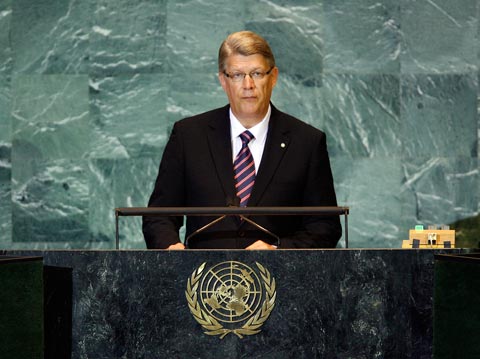
Zatlers at U.N.

Latvian President Valdis Zatlers speaks in September 2008 to the 63rd General Assembly of the United Nations. (Photo by Marco Castro, courtesy of the United Nations)

Andris Straumanis is a special correspondent for and a co-founder of Latvians Online. From 2000–2012 he was editor of the website.

Capitalizing on Rīga

Don’t expect Rīga to be completed if it becomes a European Capital of Culture in 2014. According to legend, Rīga can never be “finished,” or it will sink to the bottom of the Daugava River.

But you can expect the unexpected in 2014. That’s because Rīga’s successful candidacy for this prestigious honour was based on an ambitious cultural programme that carries the provocative title of “Force Majeure.” If you’ve only seen this term in legal contracts, get ready to expand your cultural consciousness. The French term refers to an “overwhelming force” or an extraordinary event that occurs beyond all normal expectationns. As the name alone implies, the creative minds behind Rīga’s application are definitely aiming for the extraordinary.

In its application, Rīga said it would focus on culture as “the spiritual and intellectual dimension of mankind, manifesting itself through any form of human activity, and expanding the understanding of culture through liaisons with other spheres of life. It is a liaison between generations, traditions and the digital world, it means overcoming historically established barriers.”

You can find out more about the project on the Web page, www.kultrix.lv. Rīga has four years to prepare and you will no doubt be hearing a lot more about it in the future.

Rīga was chosen by a jury representing various European Union (EU) institutionns, including the European Parliament and the European Commission. Clearly the Rīga application, which offers six intriguing thematic lines, was impressive and original. But what else could have made the Europeans decide in favour of Latvia’s bustling Baltic Sea capital?

I assume some of them have already been to Rīga at least once. It’s an experience you don’t forget, especially if you didn’t know what to expect before you arrived. If the jury members were fans of the game Monopoly, they may have been swayed by Rīga’s selection in 2008 to become one of the world’s 22 most popular cities to be included in World Edition of the game, called “Monopoly – Here and Now.” Rīga garnered the second highest number of votes after Montreal, and thus won the honour of becoming the “Park Place” of the new global game.

Then again, they may remember the Rīga NATO Summit in 2006, when 26 national leaders met here to decide the future of transatlantic security. U.S. President George Bush liked the city so much, he came here twice.

But that’s all history, and the only thing more interesting than Rīga’s storied past is its promising future. Back in 2001, Rīga had the biggest birthday party of its life when millions of Latvians celebrated its 800th anniversary. In 2014 and Rīga will be 813 years old, and it looks like all of Europe (and beyond) will be celebrating with us (just in time for Latvia to take over the presidency of the European Union in 2015).

As for the legend mentioned earlier, as far as legends go, it really is true. According to a 15th century chronicler of Latvia, a fisherman once got lost in the Baltic Sea and encountered a huge sea monster.

The monster asked where the fisherman was from, and he answered, “Rīga.”

So the monster asked, “Is Rīga finished yet?”

The fisherman said, “No, not yet. We’re still building it.”

“Alright then,” the sea monster responded, “but when Rīga is completed, tell me, and I’m going swim into the Daugava, slap it with my tail and sink the city to the bottom of the river.”

So we can assure the EU and all our international friends that in 2014, when Rīga becomes the European Capital of Culture, it will be ready for you. But if any sea monsters ask, tell them it’s still a work in progress.