Trinity College picks composer Ešenvalds for residency program

Latvian composer Ēriks Ešenvalds will spend two years beginning in October perfecting his craft as a “fellow commoner” at the University of Cambridge’s Trinity College in Great Britain.

Trinity announced the appointment on March 25, noting that the 34-year-old Ešenvalds is the latest in a series of artists who for 30 years have been supported by the college’s Fellow Commoners in Creative Arts program. Each artist spends two years in residence at Cambridge.

Composers chosen by Trinity in years past include Nicholas Maw, Judith Weir, Thomas Adès, Deirdre Gribbin, Richard Causton and Tarik O’Regan.

Ešenvalds, born in 1977 in Priekule, is “the next big thing in musical mysticism,” according to critic Richard Morrison of The Times of London.

Ešenvalds received his bachelor’s degree in 2002 and his master’s in composition in 2004 from the Latvian Academy of Music, where he studied under Selga Mence.

A recipient of numerous scholarships and winner of various awards, Ešenvalds is known for compositions such as “Iespadi Sāremā” and “Légende de la femme emmurée.” His compositions have appeared on more than a dozen recordings.

For more on Ēsenvalds, visit his website, www.eriksesenvalds.com.

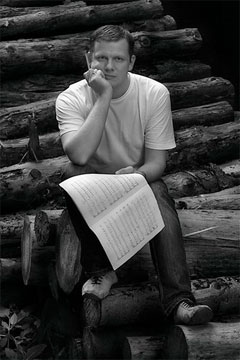
Ēriks Ešenvalds

Composer Ēriks Ešenvalds will spend the next two years at Trinity College in Cambridge, England. (Photo by Aivars Krastiņš)

Andris Straumanis is a special correspondent for and a co-founder of Latvians Online. From 2000–2012 he was editor of the website.

Brigita Liepiņa, editor and active Melbourne community member, dies

Brigita Liepiņa, a longtime member of the Melbourne Latvian community and former editor of the weekly newspapaer Austrālijas Latvietis, died March 16. She was 80.

Liepiņa was born July 30, 1930, in Daugavpils to Mārtiņš and Alīda Slociņš. Her father was a draughtsman with the railways.

Liepiņa had completed the local primary school when the Second World War interrupted life in independent Latvia. In 1944, when the Soviet army approached Latvia for the second time, the Slociņš family, like many other Latvians, sought refuge in the West. As a family of a railway employee they were able to take the train to the seaport of Ventspils. The family, including Brigita and her younger sister, Ilga, left Latvia by ship on Oct. 13, 1944, the day the Russians captured the Latvian capital of Rīga.

At the end of the war the family was in a refugee camp in Itzehoe, Western Germany, where Liepiņa completed her high school education.

The family then chose to emigrate to Australia.

Liepiņa was the first of the family to go, spending her 19th birthday crossing the equator and arriving in Western Australia in 1949. She was sent to work in a small country town and a year later was able to sponsor the rest of the family to come to Australia. After Liepiņa completed her two-year contract with the government, she joined the family in Wangaratta, near Melbourne.

After the Slociņš family moved Melbourne, she started studies at Melbourne University in 1953 and in 1964 graduated with a bachelor’s degree in commerce.

On a trip to Adelaide to attend the Australian Latvian Arts Festival (Kultūras dienas), Brigita met Elmārs Liepiņš. They fell in love and married in 1955. In 1956, their daughter Valda was born.

Liepiņa worked as a mathematics teacher at North Blackburn High School in Melbourne. After she obtained a degree in data processing, she worked at Fibremakers Australia and later at Deakin University until she retired.

Liepiņa was very interested in political and national events in Latvia. She was active in promoting the Popular Front (Tautas fronte) in Australia and other nationalist activities. For five years, she managed Austrālijas Latvietis, and also worked with a Latvian radio program in Australia as well as serving as the media representative of the World Federation of Free Latvians (Pasaules brīvo latviešu apvienība, or PBLA). In 2009, the PBLA honored her with a certificate of recognition for editing the newspaper.

Liepiņa is survived by her daughter, Valda; sister Ilga and her husband Bill; niece Anda, husband David and daughters Kate and Alice; niece Zaiga, husband Viktors and sons Mārtiņš and Kondrads; and other relatives.

A funeral service for Liepiņa was conducted March 22 at Fawkner Memorial Park in Melbourne.

Second book continues Latvian deportee’s story in Soviet army

Ilmārs Šalts is a survivor of Siberia and of a battalion of young men assigned to work in Soviet labor camps. He told part of his story in the book, A Stolen Childhood: Five Winters in Siberia, and now, in ‘Careerists’: Quarry Duty in the Soviet Army, which was released in November.

Both books previously appeared in Latvian. The first, Nolaupītā bērnība, was published in Rīga in 2001, followed by Karjeristi in 2004.

Šalts’s story begins in 1941, when his family was deported to Siberia. His parents and a grandmother died there. Šalts and his brother and sister returned to occupied Latvia in 1946. Taken in by his motherš cousins, Šalts had only five and half years to finish his studies. When he turned 21, he was drafted into the Soviet army and assigned to a battalion of “stepchildren” to work in the rock quarries of Russia’s Rostov province.

Šalts, now a retired electrical engineer, regained ownership of his family’s home in 1996, according to the self-publishing company AuthorHouse.

A brief review of the Latvian version of the book was published in 2004 by the daily newspaper Latvijas Vēstnesis.

‘Careerists’ was translated by Gunna Dickson, a New York-based writer and editor. She also translated A Stolen Childhood and Lilija Zariņa’s The Red Fog: A Memoir of Life in the Soviet Union, published in 2006.

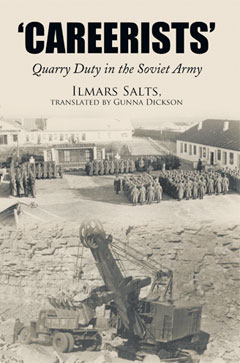
Careerists

Ilmārs Šalts’s story continues in ‘Careerists’: Quarry Duty in the Soviet Army, published in November.

Where to buy

Purchase from Amazon.com.

Note: Latvians Online receives a commission on purchases.

Andris Straumanis is a special correspondent for and a co-founder of Latvians Online. From 2000–2012 he was editor of the website.