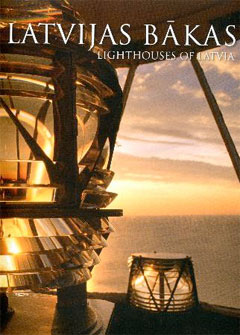
Latvijas bākas follows the Latvian coastline from Lithuania to Estonia as it tells the story of lighthouses.
What could be quainter than the lowly lighthouse? Its simple purpose has always been to shine a light out over the coastline to guide ships.
One might think that such a simple construct would not have much scope to be beautiful or to be a work of art—just a basic tower with a light at the top. In this modern era, with radar, sonar, GPS, satellite and many other navigation tools, shining a light over the water would be a relic of a bygone age.
As it turns out, the lighthouse can be a work of art. Realizing this, Ivars Putniņš, president of the Latvian computer services firm Capital, was inspired to publish a book about Latvian lighthouses. Latvijas bākas (Lighthouses of Latvia), published at the end of 2010, is a tribute to these simple yet historical buildings. The book was written by Andris Cekuls, historian of the Rīga Museum of History and Navigation, and there is also full English translation of all texts, provided by Maija Treilone.
Latvia, with a coastline that is more than 500 km long, has many distinctive and impressive lighthouses. The book follows the coastline, beginning with the Pape lighthouse near the border with Lithuania and ends with the Ainaži lighthouse near the border with Estonia.
Though full of beautiful color and black-and-white photographs, it is the detailed and thorough description of each lighthouse that is the most impressive and most valuable aspect of this book. Not only does the reader get the exact latitude and longitude of the lighthouse, but they learn about the lighthouse’s history, with many interesting facts and figures. For example, there are quite a few interesting facts about the historical Cape Kolka lighthouses (this being the northernmost point in the Kurzeme region of Latvia, where the Gulf of Rīga meets the Baltic Sea). The author notes that the origins of the name Kolka may have come from the Liv language, where ku-olka means “expect your death; be ready to die.” A Kolka lighthouse was first referenced in 1341, and there are notes about 10 Swedish ships wrecked in the storm of 1625, as the landowner at the time had not received payment for firewood, so the light had not been lit.
Also interesting is the Baltās baznīcas (White Church) lighthouse, located in the north of Rīga. Originally built in 1786 near the Daugava River, the wooden tower of the church collapsed due to the unstable ground. The church with its light beacon in its tower is unique in Latvia.
The Ģipkas lighthouse, in the Roja municipality in the Kurzeme region, was build by the Soviet Army in 1953 and has a distinct square steel structure.
The Akmeņrags lighthouse, also in Kurzeme, was officially named a historical site by the Latvian government. The lighthouse was repeatedly attacked during World War I, when 46 grenades were thrown at it, of which only 10 exploded. The lighthouse was finally destroyed by the German minesweeper Arcona. It was progressively rebuilt, and only fully renovated in 1957, at which point the Soviet government considered it a first class military lighthouse.
Particularly helpful in the book is the list of lighthouse-related terminology, explaining concepts such as nautical miles, leading light, nautophone and radio lighthouse.
The book is also full of historical photographs and historical document facsimiles, which makes for fascinating reading. What I found particularly interesting was that the lighthouses do not all look alike . They all seem to be unique in design or color or construction, as if each lighthouse has its own personality.
Though the lighthouse itself is a simple construct, this valuable book proves that lighthouses are steeped in history and are well worth reading about. The detailed texts and lush photography in this 152-page book provide a very thorough guide to the many lighthouses of Latvia. Cekuls must be commended for what was clearly a large amount of work to prepare these texts.
Latvijas bākas is not just a historical treasure, but also a pleasure to read and view the many photographs, making clear that the lighthouse has been a valuable aspect of Latvian seafaring for hundreds of years.
Details
Latvijas bākas
Andris Cekuls
Rīga: Capital, 2010
ISBN 978-9984-49-194-3
Egils Kaljo is an American-born Latvian from the New York area . Kaljo began listening to Latvian music as soon as he was able to put a record on a record player, and still has old Bellacord 78 rpm records lying around somewhere.