Female group Latvian Voices releases album of folk, original compositions

Female a cappella vocal ensemble Latvian Voices has released its third album, Tā kā taka.

Composed of seven young Latvian singers—Laura Jēkabsone, Karīan Kaminska, Nora Vītiņa, Andra Blumberga, Elīna Šmukste, Laura Leontjeva and Zane Stafecka—Latvian Voices perform a wide variety of Latvian songs which they have themselves arranged.

Tracks on the album include folk songs such as “Ej, saulīte, drīz pie Dieva!” and “Zvejnieks mani aicināja”; original works such as “Lietus” and “Tā kā taka”; and “Pasaciņa,” an arrangement of a song with lyrics by Aspazija and music by Zigmārs Liepiņš. The song “Kuto” also features Spanish beatbox artist Lytos.

The full track listing includes:

  1. Ar dziesmiņu ciemos eju
  2. Rūtoj’ saule
  3. Es gulu, gulu
  4. Mēnestiņis nakti brauca
  5. Ej, Saulīte, drīz pie Dieva
  6. Lietus
  7. Saulīt vēlu vakarā
  8. Tā kā taka
  9. Raugies tu
  10. Dindaru dandaru
  11. Zvejnieks mani aicināja
  12. Kuito
  13. Pasaciņa

The compact disc, released on the German MusicArtEmotions label, contains detailed descriptions of each song, as well as each group member, in Latvian, English and German.

This is ensemble’s third album, after Waving World Wide (focused more on sacred and international repertoire) and Seventh Heaven (a collection of Christmas songs), both released in 2010.

The ensemble will officially present Tā kā taka with a performance at the Spīķeri Concert Hall in Rīga on March 15, where Lytos and kokles performer Laima Jansone will also appear. Latvian Voices also plans a brief tour in May of Denmark and Switzerland.

For more on Latvian Voices, visit www.latvianvoices.lv.
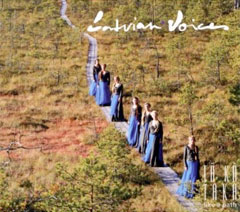
Tā kā taka

Tā kā taka is the third album by female ensemble Latvian Voices.

Where to buy

Purchase Tā kā taka from Amazon.com.

Note: Latvians Online receives a commission on purchases.

Egils Kaljo is an American-born Latvian from the New York area . Kaljo began listening to Latvian music as soon as he was able to put a record on a record player, and still has old Bellacord 78 rpm records lying around somewhere.

Citizenship agency to appeal court’s ruling in Latvian physicist’s case

A Latvian government agency will appeal a recent Supreme Court ruling that restores dual citizenship for a scientist who now lives in Sweden, a spokesman says.

Attorneys for the Office of Citizenship and Migration Affairs (Pilsonības un migrācijas lietu pārvalde, or PMLP) have reviewed the ruling in the case of physicist Uldis Bērziņš and plan to appeal it to the Senate of the Supreme Court, spokesman Andrejs Rjabcevs told Latvians Online in a Feb. 24 e-mail.

Justices of the Supreme Court’s Chamber of Civil Cases on Feb. 16 overturned a lower court’s decision that stripped Bērziņš of his Latvian citizenship. Bērziņš in 2007 became a naturalized Swedish citizen but did not relinquish his Latvian citizenship. However, under Latvian law, dual citizenship is not allowed and so the PMLP sought to revoke Bērziņš‘s Latvian citizenship.

From 1991-1995, a transitional rule in the Citizenship Law allowed more than 30,000 exiles and their descendants to reclaim their Latvian citizenship without giving up the citizenship of their home country. Several attempts to lift the restriction have failed, although proposed amendments to the Citizenship Law now before the Saeima appear to have broad support, especially as the emigration of tens of thousands of citizens in recent years has become a major political issue.

Arguing for Berziņš before the justices, attorney Māris Jansons pointed to the proposed amendments—and the fact that they have already cleared a first reading in the Saeima—as one of the reasons his client’s dual citizenship should be allowed, according to a Supreme Court press release.

Jansons also noted that his client’s ties to Latvia are strong and that he has contributed to the development of physics in his homeland. Many people in recent years have moved abroad in search of work, but maintain strong ties to Latvia, even participating in homeland elections, Jansons added.

From the PMLP’s perspective, lawmakers in crafting the Citizenship Law did not foresee special circumstances or criteria that would prevent revoking a person’s Latvian citizenship when that person has become a citizen of another country, Rjabcevs told Latvians Online. A decision by the Supreme Court would establish case law in how to deal with similar situations in the future, Rjabcevs said.

This is not the first the Supreme Court has dealt with the dual citizenship question. In 2010, for example, the court upheld a decision by the PMLP to deny Latvian citizenship to the daughter of Baiba Lapiņa-Strunska and Viktors Strunskis, a couple living in Germany. Ironically, the Supreme Court in the same case in 2009 called into question the fairness of the ban on dual citizenship, but the Constitutional Court in 2010 upheld the restriction.

At least one exception to the dual citizenship restriction has been allowed. In 2010, by a unanimous vote of the Saeima, Canadian citizen Agra Vāgnere was recognized as a Latvian citizen for her contributions to the diaspora community. Vāgnere moved from Latvia to Canada in 1989 and became a Canadian citizen, but missed the July 2005 deadline for reclaiming her Latvian citizenship.

Andris Straumanis is a special correspondent for and a co-founder of Latvians Online. From 2000–2012 he was editor of the website.

Jazz album highlights Latvian artists

A new Latvian jazz compilation, entitled Jazz in Latvia 2012, has been released by Mūsdienu mūzikas centrs (Contemporary Music Centre), which also organizes the yearly Rīgas ritmi jazz festival.

Featuring a number of well-known Latvian jazz musicians, the compilation collects nine performances ranging from jazz standards such as Thelonious Monk’s “Rhythm-a-ning” performed by 3Stick, to “Valse Melanholique” performed by the Māris Briežkalns Quintet. The latter, an arrangement of Latvian classical composer Emils Dārziņš‘s “Melanholiskais valsis,” was recorded at the world renowned Blue Note Jazz Club in New York.

Tracks on the album include:

  1. “Valse Melanholique” performed by Māris Briežkalns Quintet, featuring Chris Potter and Brian Lynch
  2. “Dancer” performed by North by Northeast
  3. “Goodbye Pork Pie Hat” performed by the Evilena Protektore Group
  4. “Life Changes” performed by Silvesteri Orkesteri
  5. “Room” performed by DPTrio
  6. “Before” performed by Add Libitum
  7. “Lyshuskvaedi” performed by Mirage Octet
  8. “Rhythm-a-ning” performed by 3Stick
  9. “Summer and Winter” performed by City Jazz Big Band

This year, the Rīgas ritmi festival will take place from July 3-7 and will feature some of the ensembles performing on the album.

For further information about MMS, visit www.mmc.lv. For details about the Rīgas ritmi festival, visit www.rigasritmi.lv.

Jazz in Latvia 2012

The album Jazz in Latvia 2012 is a compilation of nine Latvian groups performing jazz standards and unfamiliar compositions.

Egils Kaljo is an American-born Latvian from the New York area . Kaljo began listening to Latvian music as soon as he was able to put a record on a record player, and still has old Bellacord 78 rpm records lying around somewhere.