Although the ground is typically still snow-covered and frozen, the spring equinox, called Lielā diena or Lieldienas (The Great Day or Days), marks the middle of spring in Latvian folklore. On this day, March 21, night and day are of equal length.
Despite the empty cupboards at the end of winter, this is a happy holiday. The sun plays a large role at Lieldienas. Everyone celebrates its return and the lengthening days, marking the sun’s victory over darkness. At Lieldienas Latvians eat all kinds of round foods to signify the sun. Breads and sweets are baked in round shapes; puddings and head cheese are made in round molds.
And just as at the Christian Easter feast, Latvians eat hard-boiled eggs at Lieldienas. In many cultures, the egg symbolizes the beginning of life, of the world, and in this case, of a new year.
Ask anyone of Latvian descent, and you’ll hear about eggs wrapped and boiled in onion skins. The result is an array of absolutely beautiful brown, yellow and orange marbled tones. But red cabbage, turmeric, birch leaves, bark, moss and other natural dyes are also used. The dyed eggs tend to have earthy colors. Some people scratch designs into dark colored eggs, but they traditionally do not create intricately colored and decorated eggs like the Ukrainians.
Before you eat an egg, you should find another person with whom to “hit eggs.” Hit the ends together, and usually the person whose egg breaks gives it to the other person to eat. Some families play the other way around: the person with the unbroken egg keeps playing the game until his or her egg breaks, and only then can they eat it.
Spring really is in the air, and people cannot resist anything green. They like to bring lilac branches into the house a week to 10 days before the celebration to force leaves or to sprout oats or wheat berries in shallow dishes. And of course, what would a Lieldienas celebration (or Easter, for that matter) be without pussy willows—pūpoli—in a vase? (Hence, Pūpolu svētdiena, the Latvian name for Palm Sunday. Many of the pre-Christian Lieldienas traditions have been transferred to Christian Easter celebrations.)
Other outdoor traditions should be noted, too. One is supposed to wake up before dawn and wash one’s face in running water, such as a spring or stream. Unfortunately, often the ice has to be broken first and the water is really cold. This is to ensure that you will not be sleepy the coming summer. Also, water is said to have special healing qualities on the morning of Lieldienas. Then, climb the nearest hill and, as the sun peeks over the horizon, greet it with songs. If the sky is clear, this is truly a wonderful sight!
On your way back home make lots of noise to chase all of the birds away. This tradition finds very ancient roots in the belief that birds are the bringers of illness and misfortune. Those who did not wake up early receive spankings with switches and pussy willows. But these spankings are not meant to hurt; instead, they are supposed to bring health and alertness.
Perhaps the most widely practiced tradition associated with Lieldienas is swinging. Much attention is paid to where the swing is hung, as well as to who pushes the swing. The swings are often so huge, that two people at a time climb on and swing while standing up. Everyone is supposed to swing, even if it’s just a couple of slow swings back and forth, to ensure fertility in the coming season, but also so that the mosquitoes won’t bite all summer. The onlookers sing constantly: “Iešūpoja, ielīgoja, kas iekāpa šūpolēs?” (Swing, swing, who climbed onto the swing?). They make up the next verses describing the person on the swing, sometimes praising him or her, sometimes poking fun at or chiding the person. It is a good idea to have a few hard-boiled dyed eggs in your pocket, so that you can “pay” the person who pushes you. This is also a time for young people to flirt.
It’s also worth noting that for the die-hard folklorists in Latvia, the exact date the spring equinox is celebrated changes from year to year. For example, this year – 2012 – the folkorists will be celebrating the pre-Christian Easter celebration on 8th April, the same date this event will be marked on the Christian calendar. This could be for practical reasons, as the 21st March, the date of the spring equinox falls in the heart of winter.
Lieldienas is for the most part a morning festival, although the holiday used to be celebrated for three or four days, as was customary for big celebrations. The day gets off to a very early start, and by the time the meal is finished, it’s not even close to noon.
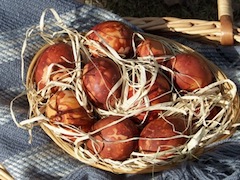
Basket of Latvian traditional Easter eggs boiled in onion skins. Photo: Amanda Jātniece
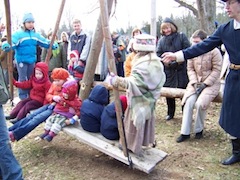
Folklore group “Savieši” celebrating Easter. Photo: Amanda Jātniece