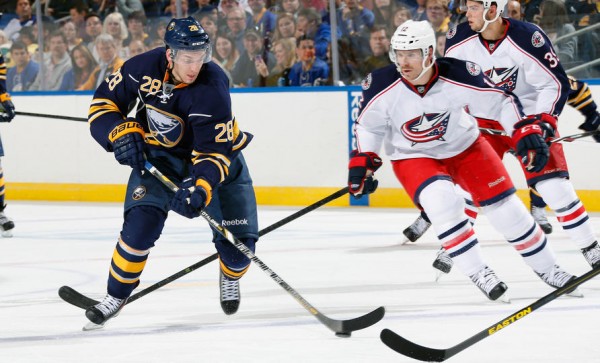
Forward Zemgus Girgensons (#28). Photo courtesy of the Buffalo Sabres
Take note of two names – Zemgus Girgensons and Kristers Gudļevskis. Just out of junior ranks, they’re making a statement. They’re here and ready for prime time.
Forward Zemgus Girgensons, the highest ever Latvian player drafted into the NHL, was only nineteen at the start of this season yet he has nailed down a position with the Buffalo Sabres. Even though Buffalo has been one of the weakest teams this year, Girgensons has shown he can play shoulder-to-shoulder against the world’s best hockey players. Coincidentally his coach Ted Nolan has also been the coach of Latvia’s national team for the past two years. Recently Nolan paid Girgensons a compliment by comparing him to retired hockey super-star Wayne Gretzky in his youth.
A year ago, lanky twenty one year old goaltender Kristers Gudļevskis was playing with the Dinamo Juniors in Riga. He was Latvia’s third string goalie at last year’s World Championships. But when the top two faltered, Nolan tapped him on the shoulder and Gudļevskis seized the opportunity and starred. A month later, the NHL’s Tampa Bay Lightning grabbed him and Gudļevskis ended up in their training camp. Gudļevskis was first sent down to the Lightning’s farm team in the ECHL two levels below the NHL, but by mid-season, he was up with the Syracuse Crunch of the AHL only one level below the NHL. He has posted excellent numbers and was even named AHL player of the week in January. It appears that the Lightning are betting on Gudļevskis maturing into a NHL goaltender. Gudļevskis will likely be Latvia’s starter at the Sochi games. Goaltending has been a hit and miss proposition for Latvia since the heyday of legendary Arturs Irbe and Gudļevskis might be the answer.
This season the last two of a promising crop of players born between 1986 and 1988 played out their NHL dreams and headed back to Europe. Even though forward Kaspars Daugaviņš spent last year’s abbreviated lock-out season with the Ottawa Senators and Boston Bruins, he was not offered a return contract. He joined Geneva Servette in the Swiss League. The pay is good, the road trips are short, the living conditions are excellent and the level of play is high. Daugaviņš is one of the team’s top forwards and over the Christmas break helped Servette win the Spengler Cup awarded to the winner of a long standing prestigious six team invitational tournament hosted by Switzerland’s Davos Hockey Club. Daugaviņš made the tournament’s all-star team.
Arturs Kulda had played a handful of games with the NHL’s Atlanta Thrashers and Winnipeg Jets but spent last season in Russia’s KHL. After his KHL season ended, the Jets signed him for the final month. He practiced with the team but never saw action and the best the Jets would offer Kulda this season was a two way contract unwilling to guarantee him a position with the big team. Kulda returned to the KHL and signed a two year deal with Ufa. He is among the team’s top defensemen and will be a stalwart for Latvia at Sochi.
Ten or fifteen years ago, there was a host of players from Latvia in North America’s minor pro leagues. These days they are few and far between. The exception this year is defenceman Ēriks Sevčenko from Daugavpils who is playing in the ECHL with the San Francisco Bulls. Unless a player has been spotted by the NHL, most players opt to play in Europe. The pay is better than North America’s minor pros and there are benefits playing close to home.
There are however a host of juniors from Latvia playing in North America hoping for the big break. At the top are five in Canada’s three major junior leagues. Nineteen year old forwards Roberts Lipsbergs of the Seattle Thunderbirds and Edgars Kulda of the Edmonton Oil Kings are playing their second year in the WHL. Forward Nikita Jevpalovs is also back north of Montreal with the Blainville-Boisbriand Armada of the QMJHL. Eighteen year old forward Rihards Bukarts is with the Brandon Wheat Kings of the WHL as is Georgs Golovkovs with Quebec’s Drummondville Voltigeurs. All five are among the top players on their teams.
Forward Haralds Egle is playing in the USHL with Michigan’s Muskegon Lumberjacks but has not been able to put up the numbers. The USHL is the top junior league in the USA but a notch below Canada’s major junior leagues. The NAHL is a level below the USHL and three players from Latvia are on the Soo Eagles in Northern Michigan. They are defenceman Kristofers Bindulis and forwards Bruno Birzītis and Sandis Zolmanis. Kristaps Bažēvics is with the Wichita Wildcats also of the NAHL.
Among the juniors, Jevpalovs and Bindulis have attracted attention and are on the list of prospects prepared by the NHL’s Central Scouting Bureau. That doesn’t mean other players don’t have a chance but the odds are against them.
There are probably at least a dozen younger players from Latvia scattered from coast to coast playing high school and lower level junior hockey in the USA. Canada restricts imports from Europe to just two on each major junior team while the USA also has restrictions but unlike Canada, Europeans can play at any level.
Two players are with tier-1 NCAA university teams in the USA. Teodors Blūgers, a draft pick of the NHL’s Pittsburgh Penguins, is a sophomore at Minnesota State University Mankota while Ralfs Freibergs is also in his second year with Bowling State Green. Twenty two year old Freibergs was selected for Latvia’s team at Sochi.
Lipsbergs, Kulda, Jevpalovs, Golovkos, Egle, Birzītis and Bažēvics joined Latvia’s Under 20 (U20) team at the tier two World Championships in December held in Poland. The exclusion of Bindulis was a surprise. The U20 juniors were charged with winning the tournament and returning to the elite level next year. They failed and lost in the key game against Denmark. This was disappointing particularly to Latvian fans in Eastern Canada who had hoped to come out and cheer Latvia next year when the elite championships are being hosted in Toronto and Montreal. There is still a chance that the following year Latvia could be up when the championship will also be played in the same two cities.
Latvia’s Under 18 (U18) team is also in the tier two division. Their championship will be held this April in France and like the U20 juniors, they will try to win a ticket to the elite level. Latvia’s women are stuck in tier two and unlikely to move up at their championships that will be held in Ventspils this April. With less than 100 female players, there is not enough skill and depth to make the leap.
Dinamo Riga has had a successful season so far in the KHL, the world’s strongest league after the NHL. Last year Dinamo finished out of the play-offs but took the Cup of Hope, derided by some as the Loser’s Cup, beating other also-rans. In the early part of this season they were among the league’s top teams but since then have dropped in the standings but in January still sit comfortable at 7th in the 14 team western conference. The bulk of Dinamo consists of players from Latvia although there is also a Swede, a Czech, several Canadians and Slovaks on the roster. Dinamo is a low budget team so you won’t see any big stars in its line-up. They are captained by Latvian hockey legend 41 year old Sandis Ozoliņš.
Hockey Club (HK) Riga serves both as a farm and a development team for Dinamo’s top players under 22 years. It plays in Russia’s MHL junior loop and in January was in the top six of the 20 team western conference. Dinamo Juniors is also part of the Dinamo system. Most of its players are between 17 and 19 and the role of the team is to develop young local talent. The Juniors play in the semi-professional Latvian Championship with players of various ages competing on six teams – Kurbads, Riga/Prizma, Zemgale/LLU, Dinamo Juniors, Ozolnieki/Monarch and Daugavpils. Sadly after many years there is no team from Liepaja after the sponsor steel mill Metalurgs went bankrupt.
The best players from Latvia not in North America are in the KHL, the majority with Dinamo Riga although Bārtulis, Kulda, Karsums, M. Redlihs and Sprukts went for more money with other KHL teams. Some play in other top European leagues. Veteran Vasiljevs plays in Germany’s top loop while Daugaviņš and Ķēniņš are in the top Swiss league. Others play in various mostly second tier European, Russian, Belarussian, Ukrainian and Kazakhstani leagues. Most of these players are journeymen who bounce from one league to another from one year to the next.
Twenty two year old Ronalds Ķēniņš is now the property of the NHL’s Vancouver Canucks but he was loaned out to the Zurich Lions to play out his second and last contract year with the Swiss team. Next year he will most likely be with Vancouver’s top AHL farm team the Chicago Wolves.
At the start of January, Latvia’s national team head coach Ted Nolan announced the 25 player roster for the Winter Olympic Games at Sochi. They include – Goaltenders: Kristers Gudļevskis (Syracuse „Crunch” AHL), Ervīns Muštukovs („Esbjerg” Denmark), Edgars Masaļskis („Poprad” Slovakia); Defence: Sandis Ozoliņš, Arvīds Reķis, Georgijs Pujacs, Krišjānis Rēdlihs, Kristaps Sotnieks (all from „Dinamo” Riga KHL), Oskars Bārtulis (Doņetsk „Donbass” KHL), Arturs Kulda (Ufa „Salavat Julajev” KHL), Ralfs Freibergs (Bowling Green State NCAA); Forwards: Miks Indrašis, Mārtiņš Cipulis, Vitālijs Pavlovs, Lauris Dārziņš (all from „Dinamo” Riga KHL), Mārtiņš Karsums (Moscow „Dinamo” KHL), Miķelis Rēdlihs , Jānis Sprukts (both from Jaroslav „Lokomotiv” KHL), Ronalds Ķēniņš (Zurich „ZSC Lions”), Kaspars Daugaviņš (Geneva „Servette”), Herberts Vasiļjevs (Kreifeld „Pinguine” DEL), Koba Jass (Liberec „Bili Tygri” Czech Republic), Juris Štāls („Poprad” Slovakia), Armands Bērziņš (Atyrau „Beybaris” Kazakhstan), Zemgus Girgensons (Buffalo „Sabres” NHL).
As a coach, Nolan had NHL, AHL and Canadian major junior coaching experience before being named as Buffalo’s head coach in November. During his tenure with the Latvian team, he has made it clear that no one has a guaranteed spot on the team. Everyone, veterans and rookies alike, need to earn a position. It’s not just about skill and performance but also about character and having the right attitude. Nolan won’t take a player who will sulk if assigned to the third or fourth line with less ice time. He wants someone who knows his role and what’s expected.
Unlike Latvia’s bobsleigh, luge and especially skeleton athletes who expect a medal or two at Sochi, Latvia’s hockey team is just happy to be there. The Winter Games run from February 7-23. Twelve countries have qualified in hockey. They have been divided into three groups. Latvia will play Switzerland on February 7, the Czech Republic on February 14 and a day later Sweden. Further play will depend on results. The first four teams will automatically advance to the quarterfinals. The remaining four will be the winners of the 5th vs 12th place, 6th vs 11th, etc. games. For Latvia to advance, it will need an upset against a stronger team. That will be tough but Latvian sports fans should remember that it’s an accomplishment just to qualify for the Games. These will be the fourth consecutive Winter Olympic Games for Latvia’s hockey team.
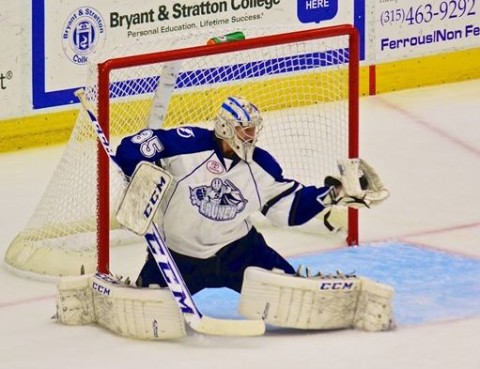
Goaltender Kristers Gudļevskis. Photo courtesy of the Syracuse Crunch