An Easter parade of Latvian Web sites

The Christian celebration of Easter—Lieldienas, in Latvian—is almost here. For many Latvians around the world, it will mean early morning church services, followed by a feast with family and friends. Among the food items sure to be found on the table will be eggs colored with onion skins.

For those who follow the Latvian folk religion dievturība, the marking of the first day of spring on the vernal equinox (saulgrieži) is already complete. The dievturi no doubt got up before sunrise to wash their faces with the cold water from a nearby stream. Then, after greeting the dawn with song, they, too, participated in a feast.

If you’d like a bit more information about how Latvians celebrate Easter, we’ve searched the Web to find a few sites that might be useful.

Easter Postage Stamps

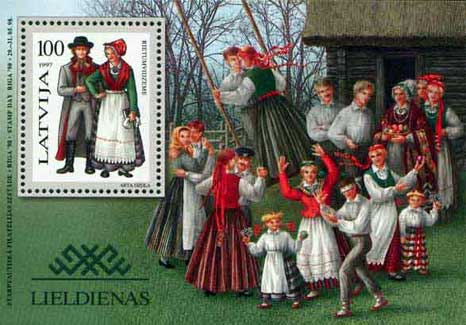
In its series of postage stamps commemmorating traditional Latvian folk costumes and celebrations, the Latvian Post Office in 1997 issued a 10-santīmi stamp and a 1-lat souvenir sheet depicting the costumes of western Vidzeme and the Latvian Easter tradition of swinging in a swing. EN

Fisherman’s Work And the Sea In the Livonian Folk Calendar

Kristi Salve’s article from the June 1996 issue of Folklore contains quite a bit of information about how the Livonian people—who still are found in small numbers in Latvia and Estonia—would traditionally celebrate the Easter season, particularly because Easter for the sea-faring Livs also marked the beginning of the fishing season. The page is part of the Estonian Folklore Web site. EN

folklora.lv

Ansis Ataols Bērziņš’ rich site devoted to Latvian traditional culture has a section devoted to folklore eduction, including pages on Lieldienas, eggs and the vernal equinox. LV

Latviešu folklora

A site about Latvian folklore, part of Latvijas Izglītības informatizācijas sistāma, includes background on Easter traditions. LV

Lieldienas

A 1993 article about Latvian Easter traditions, part of a series from Dienvidkalifornijas latviešu informācijas biļetens. LV

Tautas dziesmu izlase

The University of Latvia’s Artificial Intelligence laboratory’s online collection of folk song texts, or dainas, includes a section on Lieldienas. LV

Souvenir sheet

A 1997 Latvian postal souvenir sheet depicts a traditional Easter celebration and highlights the folk costumes of Vidzeme.

Andris Straumanis is a special correspondent for and a co-founder of Latvians Online. From 2000–2012 he was editor of the website.

An introduction to Draudzīgais aicinājums

Begun in 1935 as a way to help rural Latvian schools and libraries enrich their book collections, the tradition of Draudzīgais aicinājums continues today in North America. Literally meaning “friendly invitation,” the event is usually commemorated in late January as close to the 28th as possible. That date is the names day for Kārlis, as in Kārlis Ulmanis, the last pre-World War II leader of independent Latvia.

This is grassroots alumni development. In Latvian churches, schools and community centers in the U.S. and Canada, the event often is marked with speeches, concerts and—central to the tradition—presentation of books and other gifts to schools and libraries.

It was Ulmanis who issued the first Draudzīgais aicinājums call on Jan. 28, 1935. In the invitation to the people of Latvia, he wrote: “Let us give them books, paintings, artworks. Let us each help our old schools to receive good musical instruments. Many schools, many community centers are still without their own radios. Our church walls are bare and cold, country church bells with their old sounds find it difficult to warm hearts and bring them together. Therefore, only rarely do we hear those ringing. Whoever at home has many books, many paintings or other beautiful artwork, let us donate, let us give a portion of those to our county community organizations, and to our county schools.”

Latvia at the time had a government-run Culture Fund that had collected and distributed books nationwide, but demand was greater than the fund could meet. According to historian Adolfs Šilde’s Latvijas vesture: 1914-1940 (Stockholm: Daugava, 1976), Ulmanis believed culture could not be left only in the hands of a government organization. Ulmanis, Šilde wrote, “wanted to motivate people towards the interests of the spirit and open a path for thoughts on social ethics.”

Ulmanis had always loved books himself and therefore asked that first of all the empty library shelves of country schools be filled. He himself gave books and materials to his first school and other Latvian schools, and many followed his example.

Two years after it was started, Jānis Celms noted, “Draudzīgais aicinājums is not just a single fundraiser, but it is the beginning of a continuing Latvian tradition whose foundation is based within a sense of responsibility, a burning love for the homeland and a united spirit whose goal is to cultivate to the fullest the pillars of our culture—school, church, and Latvian society.”

By March 1939, more than 1.6 million books had been donated in response to Draudzīgais aicinājums. In addition, the Culture Fund had received donations for the purchase of school curricular materials, radio receivers, and musical instruments valued at LVL 501,506. Also donated were 4,300 paintings, art reproductions and portraits, 90 busts and sculptures, as well as other valuables. So that the Draudzigais aicinajums would not lose momentum, teachers, local politicians, and ministers were involved in the process.

Today, however, the Draudzīgais aicinājums tradition often goes unnoticed in Latvia. Some have criticized the event as an extension of the political and cultural policies of Ulmanis, who in 1934 disbanded Parliament and made himself a dictator, albeit one who is remembered fondly by many first generation exiles as well as older Latvians in the homeland.

The well-known writer Jānis Jaunsudrabiņš credited Draudzīgais aicinājums for developing in Latvian culture a high regard for books.

(Editor’s note: Andris Straumanis contributed to this article, which originally appeared on the SVEIKS.com site.)

CD-ROM features snapshot of Latvia

Latvia 98

Good photography and design help make the CD-ROM fun to watch. Captions for some images, however, would be helpful.

Latvia’s image in the West is a constant struggle. As a small country, it battles for recognition on the international stage. And sometimes the recognition Latvia gets is not favorable. So when something like the CD-ROM Latvia 98: An Interactive Guide comes along, we can be thankful that it presents the country in a clear, creative and professional manner.

I have to admit I was a bit worried when I opened the CD-ROM and read the liner notes, which offered installation instructions in faulty English. Fortunately, the text, audio and video on the CD-ROM itself are well produced.

Latvia 98: An Interactive Guide was created by Rīga-based R & I Demo and released shortly before Independence Day in November. Designed for fast computers running Windows 95, Windows 98 or Windows NT, the CD-ROM presents a survey of Latvia’s history, geopolitical situation, environment, future events, culture and social life, tourism, economy, and education. Readers are guided through the presentation by a menu that uses traditional Latvian symbols as metaphors. Unfortunately, nowhere are the symbols themselves explained. Voiceovers in English are by Kārlis Streips, the Chicago-born Latvian who has made a name for himself in Rīga’s television market.

Aside from a few gaffes (such as disagreement about whether Latvia’s first international recognition came in 1920 or 1921), the CD-ROM is well done. However, I am left with a few questions and suggestions for a future project.

In the “Latvia 80” section, Latvia’s early history is covered quickly, perhaps almost too quickly. On the other hand, too much history might keep the reader from the purpose of the CD-ROM, which is to present Latvia today. In this section, as well as throughout the CD-ROM, captions on many of the photographs would be appreciated. Was that Kārlis Ulmanis we saw in one picture? Hey, wasn’t that Anatolijs Gorbunovs in another? Because this CD-ROM is meant more for a non-Latvian audience, brief explanations of these people and their roles in Latvia’s history would be helpful.

The geopolitical section presents basic information on government, geography, major cities, currency and religion.

The section on environment looks at flora, fauna, national parks, and climate. Here again, captions would be encouraged to let the reader know what animal or plant is pictured. In addition, the climate section needs to go into more detail than just showing the range of temperatures during the four seasons. Is Latvia a wet or dry place? How much rain or snow does it receive in an average year?

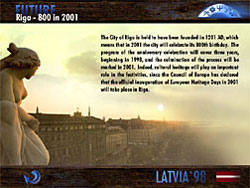
Perhaps the weakest section of the CD-ROM is the one devoted to the future. All we get here is brief mention of three major upcoming events: the European Reconstruction and Development Bank Summit in 2000, Rīga’s 800th anniversary in 2001, and the World Bank Summit in 2002. What about other items on the agenda in Latvia’s future, such as the possibility of joining NATO or the European Union?

The richest section, I was pleased to see, was the one focused on Latvian culture and society, presenting the reader with background on such broad topics as architecture, music and dance, the visual arts, and ethnography. A surprising section under the rubric of architecture was the one focused on memorial art found in Latvian cemeteries. Under music, we are treated to a video of Laima Vaikule in concert (of course, we don’t know that, because nowhere does it say it’s her!). One trouble spot was the section on the mass media. While several major Latvian newspapers are noted, none of the Russian-language press is mentioned. No doubt the producers of Latvia 98 wanted to tread carefully around some touchy issues such as the questions of language and citizenship.

In the section on tourism, potential visitors to Latvia are given some good reasons to visit the country as well as some practical information. Similarly, the section on Latvia’s economy encourages investment in the country. I was pleased to see that in this section, at least, Latvia 98 extended the notion of interactivity by adding a Web link to the Latvian Development Agency. More such links throughout the CD-ROM would be encouraged.

Finally, the education section gives us a quick look at the schools and universities of Latvia.

If you speak Latvian and follow current events, this CD-ROM probably won’t teach you anything. But you might want to consider purchasing a copy for your local school or public library’s multimedia collection.

(Editor’s note: This article originally appeared on SVEIKS.com.)

Details

Latvia 98

Viesturs Šutko et al.

Rīga:  R&I Demo,  1998

Notes: Minimum requirements are Windows 95 running on computer running at 133 MHz, 16 MB of RAM and 1 MB video RAM.

On the Web

R & I Demo

The Rīga-based publisher of the Latvia 98 CD-ROM is R& I Demo. EN LV

Andris Straumanis is a special correspondent for and a co-founder of Latvians Online. From 2000–2012 he was editor of the website.