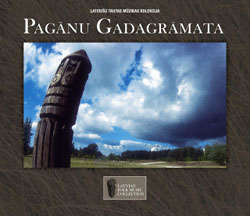
First of folk series celebrates pagan year

Pagānu gadagrāmata

UPE Recording, the Rīga-based music production company run by singer and disc jockey Ainars Mielavs, in February released the first of what it promises will be a series of recordings chronicling the vast catalog of Latvian folk songs. Pagānu gadagrāmata (Pagan Yearbook), the brainchild of Uģis Prauliņš, is not, however, the typical collection of folk songs.

In fact, Latvian audiences unaccustomed to what’s been happening in the field of "world music" might be taken aback by the cycle of songs on this album. Pagānu gadagrāmata is not an introductory library of folk tunes. Rather, it is a concept album tied to the theme of the passing of the seasons. During the course of 15 tracks, the listener is carried from the atkūsnis (thaw) that occurs around Easter time, forward through spring, summer, autumn and winter.

This also is an album about the Latvian countryside, home of the Latvian soul. That helps explain the various "nature" sound effects scattered through the album, a somewhat trite addition to an otherwise fine recording.

Pagānu gadagrāmata is not a singalong album that lends itself well to air play, even though tracks have been featured on Radio Latvia and some commercial stations. Instead, the album is better listened to in a single sitting, maybe even with the "repeat" function of your CD player activated, so you can experience several "years" in row.

"I wouldn’t like these songs to climb the Latvian pop charts and go down as swiftly afterwards," Prauliņš writes in the liner notes. "These songs are meant to be a retrospection of a whole year for the inner self of an urban man—at places we hardly ever visit these days."

Familiar voices, such as that of Latvian folk diva Ilga Reizniece, sing traditional lyrics (dainas) but often to the accompaniment of nontraditional instruments, such as the West African xylophone, the balafon, and the hand drum, the djembe. Thus, we find Prauliņš singing "Meitas gula ābolajē"—with Prauliņš himself handling voice, keyboards, and recorder—ending with bongos that segue into Reizniece and Māris Muktupāvels singing a percussive "Ganiņš biju" on a track punctuated by the djembe and the balafon.

The arrangements are a sign that "folk" culture does not have to be restricted to a specific time in the past to be considered genuine. Consider as an example "Baladīte," a tragic ballad composed by Prauliņš with lyrics drawn from the work of poet Ojārs Vācietis (1933-1983).

Featured performers on the album are Reizniece and Muktupāvels, both of the post-folk group Ilgi; guitarist Gints Sola of Jauns Mēness; and bassist Andris Alviķis, percussionist Nils Īle, and Prauliņš. In a recent interview in the Rīga daily newspaper Diena, Prauliņš told journalist Uldis Rudaks that the idea for Pagānu gadagrāmata came to him in 1995. For some tracks on the album, Prauliņš arranged the music around the traditional songs transcribed by the Latvian folklorist, composer, and critic Emilis Melngailis (1874-1954). Other tracks, such as the instrumental “Pirmais pērkons,” are new compositions.

We hope UPE does well with this series. Latvian folk music, important though it is to Latvian ethnic identity, has received scant recent attention from recording companies in Latvia. Mielavs tells SVEIKS.com that the second album in the series, Latviešu danči (Latvian Dances), is nearing completion, and that at least one additional album is expected this year.

(Editor’s note: This review originally appeared on SVEIKS.com.)

Details

Pagānu gadagrāmata

Latviešu tautas mūzikas kolekcija

UPE Recording Co.,  1999

UPE CD 009
Andris Straumanis is a special correspondent for and a co-founder of Latvians Online. From 2000–2012 he was editor of the website.

An Easter parade of Latvian Web sites

The Christian celebration of Easter—Lieldienas, in Latvian—is almost here. For many Latvians around the world, it will mean early morning church services, followed by a feast with family and friends. Among the food items sure to be found on the table will be eggs colored with onion skins.

For those who follow the Latvian folk religion dievturība, the marking of the first day of spring on the vernal equinox (saulgrieži) is already complete. The dievturi no doubt got up before sunrise to wash their faces with the cold water from a nearby stream. Then, after greeting the dawn with song, they, too, participated in a feast.

If you’d like a bit more information about how Latvians celebrate Easter, we’ve searched the Web to find a few sites that might be useful.

Easter Postage Stamps

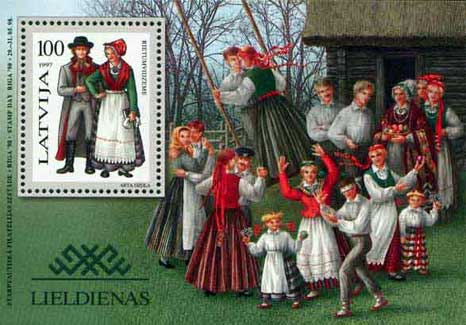
In its series of postage stamps commemmorating traditional Latvian folk costumes and celebrations, the Latvian Post Office in 1997 issued a 10-santīmi stamp and a 1-lat souvenir sheet depicting the costumes of western Vidzeme and the Latvian Easter tradition of swinging in a swing. EN

Fisherman’s Work And the Sea In the Livonian Folk Calendar

Kristi Salve’s article from the June 1996 issue of Folklore contains quite a bit of information about how the Livonian people—who still are found in small numbers in Latvia and Estonia—would traditionally celebrate the Easter season, particularly because Easter for the sea-faring Livs also marked the beginning of the fishing season. The page is part of the Estonian Folklore Web site. EN

folklora.lv

Ansis Ataols Bērziņš’ rich site devoted to Latvian traditional culture has a section devoted to folklore eduction, including pages on Lieldienas, eggs and the vernal equinox. LV

Latviešu folklora

A site about Latvian folklore, part of Latvijas Izglītības informatizācijas sistāma, includes background on Easter traditions. LV

Lieldienas

A 1993 article about Latvian Easter traditions, part of a series from Dienvidkalifornijas latviešu informācijas biļetens. LV

Tautas dziesmu izlase

The University of Latvia’s Artificial Intelligence laboratory’s online collection of folk song texts, or dainas, includes a section on Lieldienas. LV

Souvenir sheet

A 1997 Latvian postal souvenir sheet depicts a traditional Easter celebration and highlights the folk costumes of Vidzeme.

Andris Straumanis is a special correspondent for and a co-founder of Latvians Online. From 2000–2012 he was editor of the website.

An introduction to Draudzīgais aicinājums

Begun in 1935 as a way to help rural Latvian schools and libraries enrich their book collections, the tradition of Draudzīgais aicinājums continues today in North America. Literally meaning “friendly invitation,” the event is usually commemorated in late January as close to the 28th as possible. That date is the names day for Kārlis, as in Kārlis Ulmanis, the last pre-World War II leader of independent Latvia.

This is grassroots alumni development. In Latvian churches, schools and community centers in the U.S. and Canada, the event often is marked with speeches, concerts and—central to the tradition—presentation of books and other gifts to schools and libraries.

It was Ulmanis who issued the first Draudzīgais aicinājums call on Jan. 28, 1935. In the invitation to the people of Latvia, he wrote: “Let us give them books, paintings, artworks. Let us each help our old schools to receive good musical instruments. Many schools, many community centers are still without their own radios. Our church walls are bare and cold, country church bells with their old sounds find it difficult to warm hearts and bring them together. Therefore, only rarely do we hear those ringing. Whoever at home has many books, many paintings or other beautiful artwork, let us donate, let us give a portion of those to our county community organizations, and to our county schools.”

Latvia at the time had a government-run Culture Fund that had collected and distributed books nationwide, but demand was greater than the fund could meet. According to historian Adolfs Šilde’s Latvijas vesture: 1914-1940 (Stockholm: Daugava, 1976), Ulmanis believed culture could not be left only in the hands of a government organization. Ulmanis, Šilde wrote, “wanted to motivate people towards the interests of the spirit and open a path for thoughts on social ethics.”

Ulmanis had always loved books himself and therefore asked that first of all the empty library shelves of country schools be filled. He himself gave books and materials to his first school and other Latvian schools, and many followed his example.

Two years after it was started, Jānis Celms noted, “Draudzīgais aicinājums is not just a single fundraiser, but it is the beginning of a continuing Latvian tradition whose foundation is based within a sense of responsibility, a burning love for the homeland and a united spirit whose goal is to cultivate to the fullest the pillars of our culture—school, church, and Latvian society.”

By March 1939, more than 1.6 million books had been donated in response to Draudzīgais aicinājums. In addition, the Culture Fund had received donations for the purchase of school curricular materials, radio receivers, and musical instruments valued at LVL 501,506. Also donated were 4,300 paintings, art reproductions and portraits, 90 busts and sculptures, as well as other valuables. So that the Draudzigais aicinajums would not lose momentum, teachers, local politicians, and ministers were involved in the process.

Today, however, the Draudzīgais aicinājums tradition often goes unnoticed in Latvia. Some have criticized the event as an extension of the political and cultural policies of Ulmanis, who in 1934 disbanded Parliament and made himself a dictator, albeit one who is remembered fondly by many first generation exiles as well as older Latvians in the homeland.

The well-known writer Jānis Jaunsudrabiņš credited Draudzīgais aicinājums for developing in Latvian culture a high regard for books.

(Editor’s note: Andris Straumanis contributed to this article, which originally appeared on the SVEIKS.com site.)