Melbourne among top émigré communities

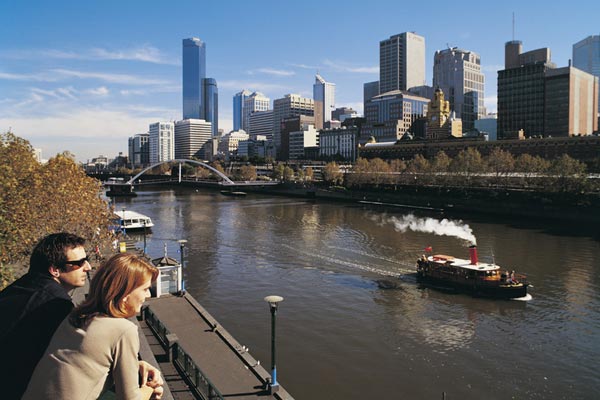
Melbourne skyline and Yarra River

The Yarra River flows past the downtown Melbourne skyline. (Photo by David Hannah courtesy of Tourism Victoria)

Melbourne with its approximately 3 million inhabitants is Australia’s second largest city and, many would claim, its most cosmopolitan one. While white Australians of English and Irish origin form the bulk of the population, among the most noticeable minorities one would certainly have to include Greeks, Italians and, since relatively recent times, Vietnamese.

The Latvians arrive

The main wave of Latvian immigration into Melbourne occurred in 1947-1952, at the very beginning of Australia’s ambitious post-World War II immigration program. Those Latvians were drawn from among a multitude of refugees from East European communism, dwelling since war’s end in Displaced Persons’ camps in the Western occupation zones of Germany, in Austria and in Denmark. The Australian Federal Government’s desire was to beef up Australia’s labour forcewhere at the time there were many unfilled vacancies, especially in the manual labour area. The refugees were looking for a country to go to because of their unwillingness to return, for the time being, to their homeland because it was now dominated by a foreign power, the Soviet Union.

It is estimated that in the 1947-1952 period about 26,000 Latvians came to Australia, with at least one quarter of those ultimately settling in Melbourne. Before this period there were only about 200 Latvians living in the whole of Australia, and only a handful of them lived in Melbourne. In the 1950s Melbourne became the third largest Latvian settlement in what was then known as the Free World, after Toronto and New York. An active social and community life developed.

Although assimilation during the intervening fifty years (largely brought about by ethnically mixed marriages and by many Latvians’ preference not to participate in community activities) has certainly taken its toll, many of the structures developed around the middle of the 20th century still exist, though the actual level of activity within most of them has declined considerably.

Most secular activities are centred at the Latvian House at 3 Dickens St., Elwood, and at the Latvian Relief Society’s “Daugavas Vanagi” quarters at 87 Chetwynd St., North Melbourne. The Latvian House is run by a cooperative committee of the Melbourne Latvian Association, founded in 1949. Both Daugavas Vanagi and the Melbourne Latvian Association have been the backbone of Melbourne Latvian cultural activity and many organisations began their activities under their wing. The cultural activity of the Latvians in the decades following their arrival in Melbourne was quite astounding. Numerous organisations with diverse interests flourished in the 1950s, ‘60s and ‘70s and are still relatively active today: academic organisations, choirs, theatre troupes, schools, folk dancing ensembles, sports associations, scout and guide groups, ski clubs, an arts and crafts federation, various musical ensembles, a press society and many others.

One part of the Latvian House is particularly worthy of mention—the Latvian Library on the second floor. It is the biggest library that houses Latvian books outside Latvia, with a grand total of 17,000 volumes. Its goal has been to collect all Latvian publications published outside Latvia as well as all those publications that mention Latvia and the Latvians. For 50 years the main person behind this mammoth task of collating and cataloging was Lilija Dunsdorfa with a long list of diligent helpers.

Two Lutheran congregations

Two Latvian Evangelical Lutheran church congregations are found in Melbourne, the larger of them, the Church of the Holy Cross, owning its own church building at 40 Warrigal Road, Surrey Hills. Over the past 50 years, the congregation has been a great supporter of Latvian social activity, particularly that of the Latvian youth, even going as far as purchasing a property, Sprīdīši, in Daylesford approximately 100 km outside Melbourne, where annual summer camps were held for Latvian children for 25 years before the property was sold in the late 1980s. The Rev. Dean Arnolds Grosbachs was the minister of this congregation for 36 years, while the current shepherd, Pastor Aldis Elberts, has been at the helm since 1987.

The other active Latvian congregation is the First Latvian Ev. Lutheran Congregation in Melbourne, with services conducted by Deacon Māra Saulīte. This congregation recently merged with the Melbourne Latvian Ev. Lutheran Congregation which was led by the Rev. Dr. Elmārs Kociņš before his death a few years ago. Services are conducted in the German Trinity Church in Parliament Place, Melbourne. A Latvian Roman Catholic Congregation operated until mid-2000 when it had to suspend regular Masses because of the advanced age and ill health of its priest.

The Latvian young are schooled on Saturday afternoons throughout the year at the Ethnic School “Daugava” at 51 Brighton Road, Elwood. The principal of the school is Ivete Lainis. The school is proud to still have an average of 50 pupils attending, a number that has remained constant for the past few years. The Latvian language and the rudiments of Latvian culture can be studied by students of any nationality of secondary school age and adults on the same premises on Saturday mornings, as part of the Victorian Education Department’s School of Modern Languages program. For those who are interested in furthering their studies of the Latvian language it is also possible to study Latvian as a single tertiary-level cross-institutional subject of the Flinders University of South Australia Bachelors Degree Program.

The Melbourne Latvian community also caters for its youngest members: pre-school activities take place on Tuesday mornings in the Church of the Holy Cross hall where currently approximately 30 young Latvian children play and learn together.

A very important role in the educating of Latvian youth in Melbourne has been played by the scout and guide movement. The Riga 102nd Scout Group, currently led by Arnis Vējiņš and Riga 1st Guide Group, led by Rasma Celms, have taught invaluable life skills in Latvian to dozens of children on a regular basis throughout the year in the form of organised activities as well as camps conducted in various locations, including the Scout and Guide country property, purchased in 1973 and located just outside Kilmore, approximately 80 km from Melbourne.

Keeping the culture alive

Of cultural groups, the most prominent are the Australian Latvian Theatre company, currently staging at least two plays a year, and the mixed choir Rota, giving an annual concert of its own and adorning with its singing many a festive occasion. A youth choir, Daina, also exists, though suffering from a somewhat fluctuating membership. This choir, however, has the remarkable ability to muster an impressive number of singers with good singing voices when a major Latvian event is about to take place in Melbourne and then manages to wow the audience with the quality of its singing. Folk dancing is another activity favoured by the young. In their heyday, the three folk dancing groups Daugavieši-Sakta, Sprīdītis and Ritenītis had up to 50 members. Currently, two of these groups—Sprīdītis and Ritenītis—still are active.

A positive event in mid-2004 was the founding of a new folk dance group, Piektais ritenis, which is meant for the 30- and 40-year-olds who are too young to dance in Sprīditis and too old for Ritenītis. The group’s debut came during the 50th Australian Latvian Arts Festival in Melbourne in December 2004. The group still rehearses weekly and performs at Melbourne Latvian events.

With many of the first generation arrivals now moving toward an advanced age, an important development of the 1980s was the founding of a Latvian Retirement Village at 60 Fraser Crescent, Wantirna South 3152. The retirement village is constantly expanding with more and more Latvians choosing to spend their later years in close proximity to their countrymen.

For those who have any consular enquiries regarding travel to and from Latvia from Australia, the Latvian Consulate-General (the Honorary Consul-General being Jānis Dēliņš) at 28 Longstaff St., East Ivanhoe, can be suggested as a first point of contact in Melbourne.

A Melbourne city-based Latvian commercial group is the Latvian Australian Credit Cooperative Society at Level 8, 313 Little Collins St. The director of the credit union is Pēteris Delvers. A shop selling Latvian crafts and books existed for many years at 94 Elizabeth St. but it recently closed down.

A Latvian newspaper, Austrālijas Latvietis, an eight-page weekly with a readership throughout Australia and a circulation of 800, is published by Latvian Publishing Pty. Ltd., P.O. Box 1320, Box Hill, VIC 3128. The current editor is Brigita Liepiņa. Emīls Dēliņš was the editor for more than 50 years, followed by Ēvalds Paeglis.

Broadcasts in the Latvian language are heard on Melbourne’s 3ZZZ Ethnic Community radio station (92.3 MHz FM) from 9-10 a.m. Thursdays and on the multicultural Special Broadcasting Service (93.1 MHz FM) from 4-5 p.m.Wednesdays and from 5-6 pm. Saturdays.

One annual event that the Melbourne Latvian community has been actively involved in is the annual Cultural Festival hosted alternately by the capital cities of each state. In recent years the three larger Latvian communities—Melbourne, Sydney and Adelaide—host the festival every second year. Whenever it is Melbourne’s turn to host this major Australian Latvian event the community truly rallies and puts together a quality program (with the participation of Latvians from other cities). The last, 50th Latvian Arts Festival, was held in Melbourne in 2004.

From this brief overview one can sense that the Melbourne Latvian community in its prime was a most active community. In a study conducted by Biruta Flood and Antra Kulniece in 1982-83, published in Archīvs, the Melbourne Latvian community was the most active in Australia in terms of frequency of events and third in rank among all émigré Latvian communities, after Toronto and New York. And even now, although the members of the community are strongly advancing in age and with minimal new blood taking the reins from the older generation, the community is still quite active and can still draw in a substantial crowd for the major functions and events.

(Editor’s note: Eduards Silkalns contributed to this article. He is a retired teacher’s college lecturer and active member of the Melbourne Latvian community, especially the Melbourne Latvian Press Society.)
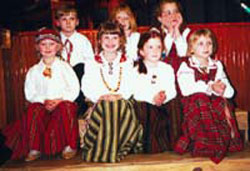
Melbourne Latvian Saturday School

Some of the youngest members of the Melbourne Latvian Saturday School “Daugava” pose for a photographer.
Daina Gross is editor of Latvians Online. An Australian-Latvian she is also a migration researcher at the University of Latvia, PhD from the University of Sussex, formerly a member of the board of the World Federation of Free Latvians, author and translator/ editor/ proofreader from Latvian into English of an eclectic mix of publications of different genres.

Sampler is primer on Latvian classical music

Latvian Millenium Classics

In my library of recordings, I have a substantial classical music collection. Composers such as Beethoven, Chopin, Bizet, Rachmaninov and Gershwin are found there, representing diverse nations such as Germany, Poland, France, Russia and the United States. However, up until this year, if you asked me to show you my Latvian classical compact discs, I would have been unable to do so. As for why there were no Latvian classical artists, there were a few reasons. I would plead ignorance, because Latvian classical music almost never gets played in the United States and recordings were also fairly scarce. And even though I knew of the existence of Latvian classical music, it never occurred to me to pursue learning about it, because I knew absolutely nothing about the composers.

This all changed over the course of the past year. Through a very strange set of coincidences, I was able to participate in the Latvian music camp in Ogre this summer. At the camp, I was exposed to a world of music that I never knew existed. Every night there was a concert, and many of the works were Latvian compositions. Such previously unfamiliar names such as Ivanovs, Vasks, Vītols and Einfelde became known to me.

Latvian Millennium Classics is a compilation of 20th century classical pieces by many different Latvian composers, covering all types of styles and genres, with both instrumental and choral works. It is meant to be an introduction to the many great works that were composed in Latvia over that time, and is as good as any introduction to Latvian classical music and performers.

National pride is a theme that is found in many a composer’s music and Alfrēds Kalniņš is no exception. One of my favorite works on the CD, "Mana dzimtene" (My Homeland), reflects that in a symphonic style that reminded me of composers such as Dvorak and Smetana.

The Latvian celebration of Midsummer, Jāni, also is featured in the track from Emīlis Melngailis, "Jāņuvakars" (Midsummer Eve). This is one of the choral pieces on the CD, and probably the one I like the most. The lyrics are all taken from traditional Jāņi songs—it seems like every line comes from a different song. But they all come together to form a very beautiful choral arrangement.

The liner notes (written by Inese Lūsiņa) mention that the "Melanholiskais valsis" (Melancholy Waltz) by Emīls Dārziņš is the most popular symphonic piece of all time in Latvia, and it easy to see why, as it is a simple waltz full of emotion and beauty.

"Bakarola" (Bacarole) by Andrejs Jurjāns, is another memorable symphonic piece, especially for the gorgeous french horn solo by Arvīds Klišāns.

The more modern selections on the CD start with Juris Karlsons’ "Neslēgtais gredzens" (The Open Ring) with lyrics by Rainis. This is another choir piece, performed by the famous Ave Sol chamber choir. However, modern choir music is not something I’ve learned to appreciate yet. The song starts out normally, but soon becomes discordant. Eventually the singing stops and is replaced briefly by chattering of some kind. Interesting, but not really my cup of tea.

Pēteris Vasks, probably the most famous Latvian composer outside of Latvia, gets represented by two works in this collection. Even though he gets two, they are two completely different compositions. The first is "Ainava ar putniem" (Landscape With Birds), a solo flute piece performed by Dita Krenberga. Through the flute, Vasks is able to paint a detailed picture of a field of birds, which I could imagine when I closed my eyes. And at the end, all the birds fly away!

The second piece is the "Cantabile per archi," described in the liner notes as a work of "concentrated spiritual power." This somber string work also expresses great sadness, a common theme throughout many of Vasks’ works.

The "Maija balāde" (May Ballad) by Maija Einfelde, with lyrics by Aspazija, is another modern choral piece, and again, though unique and innovative, is not something I could find myself listening to for an extended amount of time. As the liner notes indicate, Einfelde "works with human voice in the most creative way," something that is clear when listening to this piece.

The organ work "Lauks" (Field) by Imants Zemzaris is best described in the notes as a "meditative" work. I guess it can also be called minimalistic, since it is pretty much the same theme repeated over and over again the entire work. Meditative is an appropriate description, because is does seem that listening to this is like meditation—repeating a mantra over and over again until enlightenment is achieved. Though deceptively simple, listening to this put me into a trance-like state.

The final work on the CD is the fifth and sixth part to the "Kāzu dziesmas" (Wedding Songs) by Romualds Kalsons, a fitting celebratory end to this compilation. This piece reminded me a bit of Prokofiev, but with a unique Latvian flavor to it.

For those who were like me and knew nothing about Latvian classical music, this CD is a great introduction to it. Not only for the composers, but for the performers as well, including conductors such as Leonids Vigners and Vaisily Sinaisky, the Latvian National Symphonic Orchestra, and organist Tālivaldis Deksnis (who is also a fascinating lecturer on the topic of organs), among many others.

I only have very minor complaints about this recording. The liner notes are too brief, with barely a sentence about each composition. Very little history is given, and I would have appreciated knowing when each work was composed, and a bit more biographical information about some of the composers. Also, conspicuous by their absence are Latvian composers Imants Kalniņš and Jānis Ivanovs (probably my favorite Latvian composer). But because this is meant to be an introduction to Latvian classical music, it would have been unrealistic that they could have covered the entire spectrum of classical music in Latvia.

Whether you are a devoted classical music listener, a casual listener, or even if you only know the first few notes in Beethoven’s "Fifth Symphony," Latvian Millennium Classics is a worthy addition to any collection, and will hopefully introduce many people to the world of Latvian classical music.

Details

Latvian Millenium Classics

Various artists

UPE Recording Co.,  2000

Egils Kaljo is an American-born Latvian from the New York area . Kaljo began listening to Latvian music as soon as he was able to put a record on a record player, and still has old Bellacord 78 rpm records lying around somewhere.

Child’s story reveals humanity’s disgrace

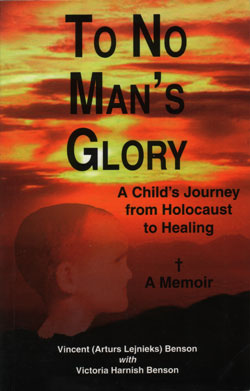
To No Man's Glory

One of our dogs had worms when she was a puppy. I still recoil at the memory of the long, white worms mixed in with her excrement—and at having to gather up some for a veterinarian’s analysis.

Arturs, the little boy who is the subject of Vincent and Victoria Benson’s To No Man’s Glory, also had worms. He had to pull them from his rectum with his fingers.

This is just one of many disgraces Arturs Lejnieks, a young Jewish orphan, had to face as he and his group of refugees wandered around Latvia during World War II in an attempt to escape death at the hands of the enemy, whoever that might be at any given moment. Young Arturs later became Vincent Benson, the adopted son of an Iowa farm couple.

To No Man’s Glory takes the reader along with Arturs as he in 1941 leaves an orphanage in Majori with his beloved Auntie and embarks on several years of constant running from those who would wish them dead. The child doesn’t understand his Jewishness, nor does he understand why people would want to kill him because he is a Jew. But he learns there are many who cannot be trusted: Germans, Russians, Latvians. As the bumper sticker says: "Mean people suck."

After he and his Auntie survive several close calls in Latvia, they wind up in Germany as Displaced Persons. From there, Arturs is shipped off to America where he is placed in Iowa with an ungrateful adoptive father but a loving adoptive mother. Only after he converts to Christianity does Arturs, now known as Vincent Benson, find the strength to forgive all those who have hurt or betrayed him in Latvia, in Germany, in America.

This is, obviously, a story of survival. It is not a happy book, even with an ending that sees Vincent Benson finally have some normalcy in his life. It is a matter-of-fact book, with horrid wartime scenes that require little embellishment to paint powerful images. It also is a revealing book: Vincent Benson doesn’t shield himself or the reader from the nastiness of everyday life, even in the relative security of postbellum, midwestern America.

What is especially troubling about the story is that despite being a Jew—and being persecuted for being one—Vincent Benson never really had the chance to be one. German soldiers wanted to kill him for being a Jew before he even knew what being Jewish meant. As a Displaced Person there was precious little time to learn about his heritage. In Iowa, his adoptive father pushed him to forget his past and become a good Lutheran. Taken together, that is perhaps the greatest disgrace experienced by Vincent Benson.

Although it has the markings of a self-published book, To No Man’s Glory is well done. Victoria Benson presents herself as a competent writer who has taken her husband’s story and shaped it into prose.

Illustrations are few, mostly some small snapshots of the Lejnieks family taken during better times in prewar Latvia. But one group of pictures, taken from an assignment book Arturs used while a student in a DP school, deserved to be displayed much larger. These include drawings by the child, depicting war and other scenes that were etched into his memory.

The Bensons obviously researched events beyond simply relying on the decades-old memories of Vincent. In the first part of the book, brief introductions to some chapters provide historical context in terms of Nazi Germany’s plans for the "Final Solution." But what is lacking is a clear understanding of where in Latvia many of the events unfold. Yes, we know where Rīga is, but where are the roads young Arturs and Auntie travelled? Where are the forests in which they hid? Where are the mass graves they saw? Of course, it may be difficult to resurrect geographical context from childhood memories, but even a general fix on where events occurred would be of great benefit to the reader.

To No Man’s Glory joins the still small but growing literature on the Latvian experience during and after World War II (see Aurora and A Woman in Amber for other examples). Call it victim literature, call it refugee literature. Whatever its name, it’s an important story that must be told.

Details

To No Man’s Glory: A Child’s Journey From Holocaust to Healing

Vincent (Arturs Lejnieks) Benson with Victoria Harnish Benson

Medford, Oregon:  Silver Dove Publishing,  2000

ISBN 0967656605

Andris Straumanis is a special correspondent for and a co-founder of Latvians Online. From 2000–2012 he was editor of the website.