DVD highlights unusual Latvian skills and crafts

8 brīnumlietas

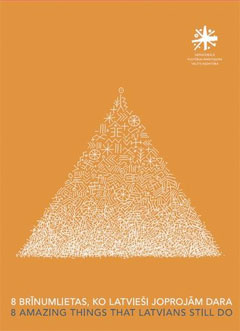
Latvians have some unique skills that have been handed down from one generation to the next. These are worth highlighting and feeling proud of, as revealed in the DVD 8 brīnumlietas, ko latvieši joprojām dara (8 Amazing Things That Latvians Still Do), which can serve as an indirect ambassador of these crafts and skills to the rest of the world.

The publisher of the DVD, the State Agency of Intangible Cultural Heritage (Nemateriālā kultūras mantojuma valsts aģentūra), has been tasked with promoting Latvian cultural heritage within Latvia for many years now. The government body has been responsible for the world-renowned and spectacular song festivals. One of the more recent campaigns has been a two-month long event in March and April called “Tradicionālo prasmju skola 2010” (Traditional Skills School 2010), where artisans from various regions of Latvia opened their doors to anyone interested to teach their traditional folk skills .

The DVD is also part of this campaign. As the artisans’ commentary also has English subtitles the DVD lends itself to various audiences. Not only can it be used in Latvia but it can also be viewed by tourists and anyone interested in Latvian cultural heritage. The quality of the subtitles is excellent—always a good indicator of professionalism.

The DVD is also a marvelous educational resource for those learning about Latvia and its heritage. Latvian folklore lessons can be supplemented with this DVD, with discussion after the viewing an integral part of the lesson. Imagine the conversation you could end up having with a group of pre-pubescent youths of Latvian descent in your part of the world after they have watched this DVD. After the standard whys and wherefores that can be expected from an audience of this age group, you may well end up discussing the meaning behind traditional Latvian beliefs, the health benefits of home-baked bread or simply the reason why ancient Latvians had so much time on their hands to spend weeks weaving shawls and knitting complex mittens.

What, then, are these so-called “amazing” things? They include odd assortment of skills and crafts: the art of making wood carvings from single pieces of wood, ancient folk musical instruments, mobiles made of straw, the baking of bread the traditional way, knitting of mittens in Rucava, lamprey fishing, the weaving of woolen shawls in Piebalga and the weaving of cord shoes in Latgale. They are all skills requiring detailed instruction by an artisan, followed by hours of practice and loads of patience.

The DVD is not only a look into some quaint skills of days gone by, but also an audio-visual “how-to” manual. The second part of each film clip features the artisans talking through the steps and giving advice on how to make the items in question. For instance, one of the knitters from Rucava, Mirdza Ārenta, explains in detail how to knit mittens with the specific patterns associated with the region. Expert puzuri-maker Ausma Spalviņa shares her philosophy on the ancient ornaments that also served as protective charms, similar to the dreamcatchers of the American Indians. The lamprey fisherman, Aleksandrs Rozenšteins, goes through the process of grilling lamprey in a wood-burning oven. It’s heartening to know that each of these tautas daiļamatmeistari (experts in folk crafts) can now reach a much wider audience via this DVD.

The overall pace of this DVD is very relaxed and friendly. The interviewees feel so comfortable, leaving the impression they are sharing their knowledge and world-view with an old friend. They appear to have all the time in the world to slowly talk about their “hobby,” which is more than just a hobby. For some it’s just a way of life, complete with the philosophy that goes with it. This makes one think about priorities, values and the old saying, “The simple things in life are often the best.” A big thank you to Vides Filmu Studija for filming such a simple yet educational DVD. Our 21st century world-view needs a bit of adjustment and seeing these artisans in their home environment certainly makes one wonder if they still have a sense of something that we have long forgotten.

Details

8 brīnumlietas, ko latvieši joprojām dara

Nemateriālā kultūras mantojuma valsts aģentūra,  2010

Notes: In Latvian with English subtitles.
Daina Gross is editor of Latvians Online. An Australian-Latvian she is also a migration researcher at the University of Latvia, PhD from the University of Sussex, formerly a member of the board of the World Federation of Free Latvians, author and translator/ editor/ proofreader from Latvian into English of an eclectic mix of publications of different genres.

DVD does not reveal why all the fuss about choir wars

Labākais no labākā

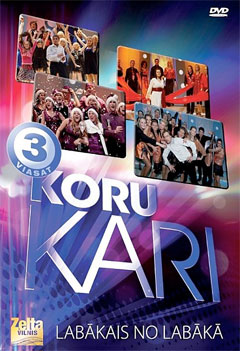
With choir music and choir performance being so popular in Latvia, not to mention a part of the national heritage, it was inevitable that a reality series based around choir singing would appear. The show “Koru kari” (Choir Wars), produced by television channel TV3, was quite a sensation in Latvia. Seven choirs—each from a different city in Latvia, each led by a popular singer, and each given a unique color to identify themselves—competed for victory.

As on other performance-based reality shows, judges would give their opinions on the choirs’ performances, viewers could call in and vote for their favorite choir, and periodically one of the choirs would be voted off until only one choir was left and was declared the winner. The highlights of the first season of the show were collected on the DVD Labākais no labākā.

The seven choirs participating were Ieva Akuratere (solo singer and singer for the rock group Pērkons) and the White Riga Choir, Olga Rajecka (solo singer and singer with Latvian groups such as Turaidas roze and Eolika) and the Violet Lielvārde Choir, Dzintars Čīča (solo singer) and the Blue Talsi Choir, Atis Auzāns (solo singer) and the Orange Daugavpils Choir, Chilli (solo singer) and the Red Liepāja Choir, Miervaldis Jenčs (one of the Latvian Three Tenors) and the Green Sigulda Choir, and Arnis Mednis (solo singer) and the Yellow Rīga Choir.

Having not ever seen the show while it was running, but having heard much about it, I figured I should check out what all the fuss was about, since many in Latvia were captivated by the show, discussing who had the best performance, who should be eliminated, who was unfairly eliminated, and the regular discussions that accompany these types of shows.

On the DVD, the first thing that becomes obvious is that these were not choirs in the traditional Latvian sense. For the most part, the choirs perform popular songs and not Latvian choral classics. Also, the performances do not really strike me as true choir performances. They are more “star and a bunch of backing vocalists” performances. Four-part harmonies are minimal. Of course, with this being a television show, the visual aspect is also important. In addition to singing, we get choreography and the occasional costume.

The songs performed are pretty much as one would expect, with not much deviation from the original. This is a bit of a shame, as the highlights of the DVD are the songs that give a new spin to existing songs and manage to surprise you. Unfortunately, there are too few of those kinds of performances. Rajecka and the Lievārde Violet Choir, the eventual second-place finishers, provide two of the better moments of the show. One is their hip-hop reinterpretation of the Latvian folk song “Rikšiem bērīt es palaidu” (goofy dancing notwithstanding). The other is their rearrangement of a slightly more obscure Čikāgas piecīši tune “Bitītes,” which makes a rather surprising segue into the Mission: Impossible theme.

The winners, the Daugavpils Orange Choir led by Auzāns, provide a memorable moment with their performance of the Latgallian folk song “Kur gaismeņa.” Čīča, himself of Roma descent, and his choir perform the Roma song “Jelem, jelem.” Perhaps one of the only actual choir songs to get a performance is Song Festival favorite “Saule, Pērkons, Daugava” (composer Mārtiņš Brauns, lyrics by Rainis), performed by Akuratere and the White Riga Choir.

The DVD also has occasional “pop up” notes on the show, such as the fact that an impressive 1.39 million viewers watched the first season. While interesting, there are too few of them, and they get repeated over and over again. Additionally, it would have been helpful to maybe have a brief documentary about the show and how it works. No mention is made of the judges, for example. Also potentially interesting would have been to find out how the choirs chose their songs, or maybe comments from the leaders of the choirs on the whole ordeal and their thoughts on it.

For those interested in further exploration, both Auzans and Rajecka and their respective choirs have released compact discs of their choir performances

I guess I was expecting more than just the slightly rearranged pop songs that make up the bulk of this collection, and not many surprises along the way. Of course, since this is television, the visual element becomes almost more important than the musical element. The choirs all sing great, and there are a few interesting tunes in the set, but the choirs could have been utilized in a better way, rather than simply being used as backing vocalists. The show was still a big hit. The second season, from what I have heard, was even more of a spectacle than the first season. But in the end, I could not quite figure out what all the fuss was about.

Details

Labākais no labākā

Koru kari

MICREC,  2009

MRDVD017

Notes: Region 0 encoded.

Egils Kaljo is an American-born Latvian from the New York area . Kaljo began listening to Latvian music as soon as he was able to put a record on a record player, and still has old Bellacord 78 rpm records lying around somewhere.

Folk song golden oldies compilation a winner

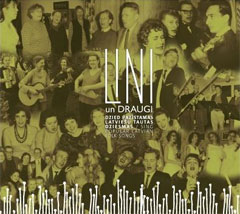
Lini un draugi Dzied pazīstamas latviešu tautas dziesmas

The “oldies but goodies” of Latvian folk songs on one compact disc has for a long time been an elusive compilation to track down. We’re talking the basic songs and rotaļas, the staple of all Latvian gatherings the world over, such as “Nu ardievu, Vidzemīte,” “Div’ dūjiņas gaisā skrēja,” ” Kas dārzā,” “Skaisti dziedi, lakstīgala,” “Līgo laiva uz ūdeņa,” “Rīga dimd” and many others that have been sung for decades. And, more importantly, without all the bells and whistles of fancy musical arrangements and modern interpretations—just the good old songs that are always in the repertoire when the chance to get together and sing arises.

The two-disc Lini un draugi Dzied pazīstamas latviešu tautas dziesmas is exactly this.

Lini is a Latvian folk ensemble, established in 1994 by four second-generation Latvian-Americans, based in Minneapolis: Ingrīda Erdmanis, Gunta Pone (now Herron), Amanda Zaeska (now Jātniece) and Zinta Pone. The folk singers say of themselves, “When our parents and grandparents were forced to leave Latvia during World War II, among the few things they could take with them were their folk songs. During the early years of exile in the Displaced Persons camps and later in their adopted homelands, not a single celebration, party, or gathering took place without singing. Latvians continue to sing these well-known songs and pass them on to their children and grandchildren.”

All the singers have grown up immersed in Latvian music in their childhood (some of their parents are part of the long-standing Minneapolis folk group Teiksma) and have innate musical talent. Their voices are not specially trained to perform choral works: these are the voices of four wholesome Latvian women, melodic and still sounding youthful. The accompaniment is simple and at the same time effective: an accordion in one song, the sweet sounds of the Latvian kokles, or the guitar in another, with a tambourine adding rhythm to the song. Quite a few of the songs are sung a capella and performed so well that an instrument would only have interfered and “stolen the show” and detracted from the pure vocals.

Some songs are sung with a larger group—the “friends” of Lini—invited to join in and help create the atmosphere of get-togethers in the exile Latvian communities of the 1950s and 60s. According to Jātniece, “W@e wanted to recreate the mood experienced by our parents and their friends back in their youth in the early years in the U.S. We were actually surprised how much we enjoyed the process of recording these songs, that had been sung ad nauseum in our childhood. It was a real thrill to explore them as an adult.”

This compilation of “the best of” Latvian folk songs is a good resource for various reasons. For one, it is a fantastic educational resource. It can be used by Latvian schools, both in Latvia and outside, for the words and tunes to classic folk songs and rotaļas (dancing games). These are the building blocks for the repertoire of every young Latvian. Start with these songs, teach them so he or she knows them by heart, and your child or pupil will be well on their way.

Then there’s a few other scenarios, such as the adult who learned these songs in their childhood, many moons ago, and now only remembers brief snippets, or the tune and not the name of the song, or maybe a few words but not the tune. This CD can help piece together the missing links and provide answers to these musical riddles. The CD is also perfect for the non-Latvian learning about Latvia and its language, culture and history, or the second- or third-generation Latvian who never learnt the language and culture in their childhood and is now on the journey of finding their roots. And last, but not least, there’s the Latvian who simply wants a handy CD with all the standard folk songs in one place.

The CD was produced in the U.S. with the financial support of the American Latvian Association Cultural Foundation.

More information about the CD can be provided by Zinta Pone in Minneapolis, zintapone@yahoo.com.

Details

Lini un draugi Dzied pazīstamas latviešu tautas dziesmas

Lini

Lini,  2009

Where to buy

Purchase Lini un draugi Dzied pazīstamas latviešu tautas dziesmas from BalticShop.

Note: Latvians Online receives a commission on purchases.

Daina Gross is editor of Latvians Online. An Australian-Latvian she is also a migration researcher at the University of Latvia, PhD from the University of Sussex, formerly a member of the board of the World Federation of Free Latvians, author and translator/ editor/ proofreader from Latvian into English of an eclectic mix of publications of different genres.