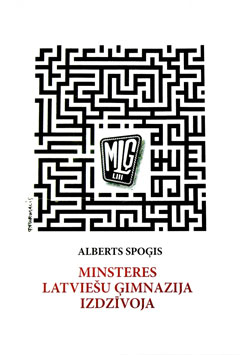
Story of Minstere documented in detailed book

Minsteres latviešu ģimnāzija izdzīvoja

About a decade after Minsteres latviešu ģimnazija (MLĢ) closed its doors, Alberts Spoģis has complied a history of the alma mater of exiled Latvians from around the globe. Minsteres latviešu ģimnāzija izdzīvoja, published in October 2009, tells the story of a one-of-a-kind institution and the only full-time Latvian-language secondary school outside of Latvia.

MLĢ was, in fact, a relic of the Displaced Persons camps in Germany during and after World War II. For a few years almost every camp had a school of its own. One by one they closed down as the Latvian refugees began emigrating to other countries in the late 1940s. The remaining resources were consolidated into one school in Detmold-Augustdorf, and in 1957 that school moved to Münster, or Minstere in Latvian. MLĢ suffered from a lack of facilities, a lack of supplies, a lack of money, and sometimes also a lack of students. But, as the title of the book says, it survived—often on determination and idealism alone.

In 1964 the first student from another continent began attending MLĢ, and by the end of that decade the growing number of students from the United States, Canada, England, Sweden and Australia seeking a super-Latvian education had transformed MLĢ from a school designed primarily for Latvians living in Germany to a school belonging to the whole global community of Latvian exiles. Some say MLĢ provided only a mediocre education, but no one disagrees that what it ended up doing best was to cultivate national pride and keep alive the hopes of an exile community. If MLĢ was often “just school” for the students from Germany, for the community abroad it became the pinnacle of Latvian exile education. Many illustrious individuals and future leaders of Latvian exile society, not to mention just plain colorful characters, graduated from MLĢ, and a disproportionately large number of its former students and employees now live in Latvia.

So much for a summary of the school’s history and mission. Readers who wish to know all the ups and downs and ins and outs will have plenty of reading material in this book written and compiled by Spoģis, a long-time teacher and board member at MLĢ, as well as a poet and the father of several graduates.

Spoģis’ writing style is modest and matter-of-fact. After a very detailed first section (which includes comments about curriculum, tuition rates and even teachers’ salaries during the school’s first years), it seems as if he steps completely into the background and hands the narration of the school’s story over to the press of the day. The bulk of the book consists of articles from newspapers and newsletters, summaries of meetings, and pieces by teachers, students, and the school administration. However, readers may instinctively begin looking at the lists at the end of the book of graduates, teachers, administration, dorm counselors and even kitchen help —and, of course, the pictures. The pictures show all possible graduating classes and school boards, as well as sports teams, concerts, theaters productions, and other activities. They are all black-and-white and some are much too grainy, but an author works with what’s available.

Minsteres latviešu ģimnāzija izdzīvoja is laid out chronologically, with accounts of programs, seminars, concerts, theaters, festivals, graduates, scholarships, speeches, meetings, sports events (even chess tournaments), finances, changes in the school and staff, its relationship to and support from the German government, and other significant events. It seems as if every article that ever appeared in the Latvian press about MLĢ has been reprinted in this book. That said, the book does not pretend to be a complete history but rather a wide-ranging testimony. Most readers, however, will probably not read the book cover to cover. Instead, they’ll jump around and read those articles that pertain to them in whatever way. Here and there they’ll find a gem of an article. The memorials to deceased students and teachers are particularly touching, but so are the quirky reminders that, for example, in November 1980 a group of MLĢ students traveled to Mainz to see and meet Pope John Paul II, in 1989 four students wrote and performed the darkly philosophical play “Jezidija,” and much thought went into deciding on a style for the furnishings in the bar (yes, a bar that served alcohol) on the lower level of the school building.

Beyond the accounts of staff and organizational meetings, the retrospects written by former directors of the school, such as Eduards Silkalns and Ilga Grava, give a more personal glimpse into the school. Grava also dares to touch on the complications, negative attitudes and internal politics that are inevitable in tight-knit communities, as well as the difficulty in mixing and merging students from different countries and backgrounds.

This miracle of a school—it’s a miracle it survived, both financially and ideologically—graduated 53 groups of students and finally closed its doors for good on June 20, 1998. By that time it was no longer catering to the exile community, but rather to teenagers straight from Latvia. Ironically (and very appropriately), it was the fulfillment of MLĢ‘s ideological goal—Latvia regaining its independence—that ultimately forced it to close. Despite the 527-page length and sometimes tedious reading, Minsteres latviešu ģimnāzija izdzīvoja provides good documentation of a legend. I’m happy Spoģis wrote it and I’m glad I have a copy.

Details

Minsteres latviešu ģimnāzija izdzīvoja

Alberts Spoģis

Rīga:  Valters un Rapa,  2009

ISBN 978-9984-805-68-9
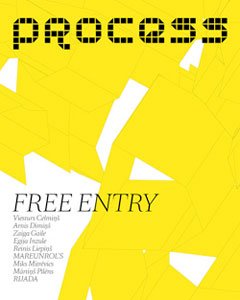
Second book in series examines innovative design in Latvia

Process 2

What do the Day-Care Centre for the Homeless and Underprivileged on Rīga’s Katoļu iela, the artists’ quarter at Andrejsala, the Majori Primary School Sports Ground and the Pārventa Library have in common? They are all featured in Process, a recently released book on contemporary architecture as examples of innovative design that can be found in Latvia today.

The book is the second in a series of two so far. The first book, Kā rodas laba arhitektūra?, was released in 2008. The aim of both is to give architects and designers a platform to express views on Latvian design trends and their place in the world today.

Process is a very apt title for this book. It doesn’t aim to boast the achievements of the young and talented players in the field. Emphasis is on the thought process involved in designing a project. This is the internal dialogue of the architect or designer trying to fuse their own aesthetic taste with their interpretation of a Latvian style and the functionality of the building, bearing in mind the building regulations governing the object.

Interviews with various high-profile architects—such as Arnis Dimiņš (involved in designing the Dzintari Forest Park in Jūrmala), Zaiga Gaile (renowned for the transformation of the old wooden buildings in Ķīpsala), and Roland Pēterkops and Mārīte Mastiņa (the fashion designers that make up the firm Mareunrols)—are a brave and successful attempt to delve into the designers’ psyche. By discovering the sources of inspiration for the works of these designers and their view of Latvia’s place in the design world, the book has also prompted an analysis of the direction design is heading. Reflection on the concept of a uniquely Latvian style of design—and whether such a concept actually exists—makes this book a serious and critical, but at the same time easily digestible, look at contemporary design trends in Latvia in the past decade.

The showcased designers are mostly young and energetic professionals who have completed some of their studies abroad and, therefore, have had much more interaction with their contemporaries in other countries than architects and other designers had in the first decade since the fall of the Soviet Union. They have set up their own firms with their own unique sense of style. One obstacle stressed in interviews in both books is the corruption in the government tender process that should be addressed sooner rather than later.

The book also illustrates the effects the economic crisis has had on small businesses, which has resulted in the trend to cooperate with others and to form creative “enclaves” in various places throughout the city. Andrejsala, which has for a few years been the up-and-coming artists’ quarter in Rīga, has now been joined by the Spīķeri area next to the Central Market, Kalnciema kvartāls, and the artists’ territory now slowly finding its place in the grounds of the former VEF electronics factory complex. The appearance of these areas and events organised at these quarters are no longer merely individual attempts at being original in a world of franchises and copy-cat styles, but a collaborative effort by like-minded energetic and creative professionals to find a common physical space to give the fruits of their imagination a home.

A noteworthy section for the budding young designer are the last two pages of the book, featuring interviews with students at internationally acclaimed design schools. This kind of first-hand insight is always good to find.

One shortcoming, however, is the lack of an English translation in full. While some articles are briefly summarized, a full translation of the book would take this excellent showcasing of design talent in Latvia past its borders.

Books such as this are essential in applauding the efforts and achievements of our architects and designers and showing that Latvian artists are an extremely talented bunch. They have the education and often the contacts (the result of studies abroad and many other opportunities for regular interaction), they just need to think outside the square, take a risk, work together with others and not compromise on their vision. The rest will come, once the wheels are set in motion.

Details

Process

Ieva Zībārte, editor

Rīga:  Arhitektūras veicināšanas fonds,  2009

ISBN 978-9984-39-902-7

Daina Gross is editor of Latvians Online. An Australian-Latvian she is also a migration researcher at the University of Latvia, PhD from the University of Sussex, formerly a member of the board of the World Federation of Free Latvians, author and translator/ editor/ proofreader from Latvian into English of an eclectic mix of publications of different genres.

Countertenor, electronica artist take on Latvian folk songs

Dziesmiņās remdējos

The folk song, though it may have a simple melody and lyrics, has been a source of inspiration not just for listeners, but for musicians as well. Most every Latvian composer has written a folk song arrangement for choir, orchestra, solo instrument or for some sort of ensemble. Although the songs may be hundreds of years old, these arrangements more often than not sound fresh and compelling.

A case in point is the compact disc Dziesmiņās remdējos (Soothed by Songs). It is a collaborative effort among some of the most prominent Latvian musicians. The recording gathers countertenor Sergejs Jēgers, composer Raimonds Tiguls and the orchestra Sinfonietta Rīga, conducted by Māris Sirmais. The album features orchestral versions of Latvian folk songs, arranged by Tiguls. Also participating on the disc are pipe player Andis Klučenieks, Ieva Šablovska and Valdis Muktupāvels playing the kokle, and bagpipe and drum ensemble Auļi.

When I first heard about this CD and that it would feature arrangements by Tiguls, I was slightly apprehensive. Tiguls is best known for his slightly New Age and ambient instrumental arrangements. The albums Moonlight Sound Design and Bay Lounge were heavy on the keyboards and neither was particularly my cup of tea. However, my assumption was incorrect. These are beautiful arrangements that stay very close to the spirit of the original melodies, and the Sinfonietta Rīga orchestra is very prominent in the music.

Credit must go to Jēgers for being the key element of this project, as his soaring voice brings a poignant beauty to many of the songs, and a celebratory exultation to others. For example, in the folk song “Trīcēj’ kalni, skanēj’ meži,” the joyous vocals of Jēgers—with the swelling power of the orchestra alongside—bring a vibrancy to this Latvian ode to singing.

Jēgers also brings a deep tenderness to songs such as “Tumsa, tumsa, kas par tumsu,” a particularly delicate song about a man who is not worried about riding on a particularly dark night, as his bride has made him a blanket of stars. This is also exhibited in what is perhaps the most heartbreaking of Latvian folk songs, the orphan’s song “Tek saulīte tecēdama.” Jēgers emotionally sings the words, pleading with the sun to send warm wishes to the orphan’s recently departed mother.

That the arrangements are by Tiguls is still very much clear from the music, particularly in the arrangement of beloved folk song “Tumša nakte, zaļa zāle,” as well as “Aiz ezera augsti kalni,” which begins with an ambient musical introduction, and ends with an extended outro featuring an electric guitar solo.

A number of popular folk songs are performed here, including old favorites like “Rīga dimd” and “Aiz kalniņa dūmi kūpa,” with its interplaying trumpets, clarinets and drums, with the brass sound in particular giving the song an almost march-like feel. “Rīga dimd” also features slightly different lyrics than traditionally sung. Usually the song is about three brothers making a frightful racket in Rīga when forging a dowry chest for their sister, but now there are five brothers, so the din must be even louder! However, one moment in the song sounds slightly out of place: the brief bassoon burst at about the 3:07 mark is rather jarring.

Conductor Sirmais is also an integral part of the success of this CD. Though normally a choir conductor (conducting both the professional Latvian State Choir Latvija and the amateur choir Kamēr…) his talents for conducting, not too surprisingly, extend to orchestral conducting. This can be heard in the performance of the tender folk song “Pie Dieviņa gari galdi,” with its beautiful string performance in the introduction. Sirmais and Sinfonietta Rīga give Jēgers a foundation to make this song a particularly memorable one on the album.

The CD contains pictures of the musicians, and a very brief essay by Nora Ikstena. All text is also translated to English. However, it would have been nice to have the lyrics to the folk songs as well.

Jēgers, Tiguls, Sinfonietta Rīga and Sirmais have come together to create a memorable recording—one of the best collections of Latvian folk songs to be released. Unlike some other arrangements, which at times dilute their original beauty and simplicity, these celebrate and praise the folk songs. The album also gives these timeless melodies a modern sound, making this CD a joy to listen to and one of my favorites of 2009.

Details

Dziesmiņās remdējos

Sergejs Jēgers, Raimonds Tiguls, Sinfonietta Rīga, Māris Sirmais

Upe tuviem un tāliem,  2009

UPETT CD042

Track listing:

Trīcēj’ kalni, skanēj’ meži

Mēnestiņis naktī brauca

Pie Dieviņa gari galdi

Tek saulīte tecēdama

Rīga dimd

Tumsa, tumsa, kas par tumsu

Silta, jauka istabiņa

Aiz kalniņa dūmi kūpa

Upe nesa ozoliņu

Tumša nakte

Aiz ezera augsti kalni

Where to buy

Purchase Dziesmiņās remdējos from BalticShop.

Note: Latvians Online receives a commission on purchases.

Egils Kaljo is an American-born Latvian from the New York area . Kaljo began listening to Latvian music as soon as he was able to put a record on a record player, and still has old Bellacord 78 rpm records lying around somewhere.