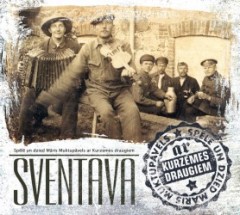
New CD a showcase of music from southern Kurzeme

The new folk music CD, Sventava, features Māris Muktupāvels, kokle player and member of the post-folk ensemble Iļgi, along with many friends, performing songs from the Kurzeme region of Latvia. The album, released by MGM Projekti (MGM 001), brings together a wide variety of Latvian musicians to perform these songs.

According to the liner notes, many of these songs are sung by Latvians in the village of Sventāja, which is actually in Lithuania (between Liepāja in Latvia and Klaipėda in Lithuania). The songs were compiled during a folklore ‘expedition’ to the village by Ilmārs Mežs in the 1980s, and these are new arrangements by Muktupāvels.

Joining Muktupāvels are other Iļģi members like Gatis Gaujenieks, Ilga Reizniece, Egons Kronbergs, as well as other well-known musicians such as Ainars Mielavs, Uģis Prauliņš, and Valdis Muktupāvels.

image

Egils Kaljo is an American-born Latvian from the New York area . Kaljo began listening to Latvian music as soon as he was able to put a record on a record player, and still has old Bellacord 78 rpm records lying around somewhere.

North American writer Berzins to release memoir

Writer Ilze Berzins is set to release her latest book titled A True Love Story on Nov. 1. The book is an autobiographical account of Berzins’ life.

According to a press release from Berzins: “Journey with her from Latvia to Germany to Canada to Paris and back, and finally – after romantic mishaps, outrageous escapades, and tragic loss – to Maine where she finally finds her true home with her true love. Berzins’ narrative is at times acerbic, humorous, and evocative, but it is always engaging. If you don’t believe in happy endings, this delightful memoir may change your mind.”

Berzins previous mystery titled The Blood Red Teardrop was released in 2011. Some of Berzins’ previous books include Aluksne, set in the Latvian town of Alūksne and Riga Blanca, a thriller about the criminal underworld of post-Soviet Riga. Berzins’ first mystery was Death in the Glebe, published in 1999 and set in Ottawa, Canada. Happy Girl, published in 1997 was a memoir of Berzins’ attempt to repatriate to Latvia. In 2009, she published a biography of her mother, Ilze Henriete Bērziņš, titled Portrait of a Latvian Beauty. Berzins is the author of a total of 14 books.

A True Love Story runs 304 pages and is available for USD 20 from the author, who may be contacted by email at ilzeberzins@hotmail.com or through her website, http://www.ilzeberzins.com

image

Daina Gross is editor of Latvians Online. An Australian-Latvian she is also a migration researcher at the University of Latvia, PhD from the University of Sussex, formerly a member of the board of the World Federation of Free Latvians, author and translator/ editor/ proofreader from Latvian into English of an eclectic mix of publications of different genres.

European Commission designates sklandrausis as traditional speciality

The sklandrausis, a small, almost bite-sized pie made of rye flour with a filling of potatoes and carrots, has received a “Traditional Speciality Guaranteed” designation from the European Commission, according to the commission’s representative office in Rīga.

The designation “increases the market value of the products of economic operators, by guaranteeing that they are distinguishable from other similar products or foodstuffs,” according to the European Commission’s description.

The sklandrausis, described on one recipe website as a Latvian vegetable tart, earned the designation based on a December 2011 application (PDF, 1.1 MB) from the organization Zaļais novads from the Dundaga region.

The application explained the meaning of the word sklandrausis:

The word is a compound of skland- and rausis. The word rausis (“pie”) is derived from the verb raust (“to rake over or strew”). This suggests that the pies were baked in a primitive fashion, by raking hot hearth ash or oven coals over them. Sklanda is an ancient word derived from the Couronian language (proto-language of the ancestors of the modern-day Courlanders, inhabitants of western Latvia) which means “fence-post, wattle fence” or “slope, declivity”; in this case, it refers to the upturned edges of the pie’s crust (Karulis, K., Latviešu etimoloģijas vārdīca (“Etymological dictionary of the Latvian language”), Vol. II, 1992). There is a special type of fence in Courland known as a sklandu žogs.

While the sklandrausis is the first Latvian product to earn special designation, it may not be the last.

The European Commission also has received an application for “Traditional Speciality Guaranteed” designation for salinātā rudzu rupjmaize (sweetened rye bread).

The Latvian Bakers Association (Latvijas Maiznieku biedrība) notes in its application (PDF, 1.0 MB) that the bread is distinct because of the way it is made: Hot water is poured onto the flour to make it sweet.

Meanwhile, an application for “Protected Geographical Indication” is pending for Carnikavas nēģi (Carnikava lampreys), according to the European Commission. The town of Carnikava boasts about its lampreys and even hosts an annual festival for the eel-like fish.

Logo for Traditional Speciality Guaranteed

The sklandrausis has earned the European Commission’s “Traditional Speciality Guaranteed” designation.

Andris Straumanis is a special correspondent for and a co-founder of Latvians Online. From 2000–2012 he was editor of the website.