A Numbers Game – the future of the Latvian émigré community

Listen to the words spoken by Latvian diplomats at émigré community functions.They choose their words carefully. There is the obligatory thank you for the role that post-war exiles played in the restoration of Latvia’s independence and for their later support of Latvia’s NATO membership drive.

But that’s all history and the question what have you done for me lately begs an answer. The size of the exile, now the émigré community in North America is dwindling. Politically it is a spent force. With the mass global movement of the peoples, the émigrés have become a minority among minorities and would be unable to come close to repeating the political activity of more than twenty years ago during the collapse of the Soviet Union. The politicians in Washington and Ottawa know it. So do the politicians in Riga.

Yet the émigré community and its leaders have an aggrandized view of their role on the political stage in Latvia. The motivation may be genuine, a desire to add value and help Latvia emerge from the long tail of Soviet occupation but it is too easy and self-gratifying to pontificate from safe havens abroad.

There are those who have returned and the results are mixed. Among the most successful is popular ex-President Vaira Vīķe-Freiberga. Less fortunate are the leaders of the World Federation of Free Latvians (PBLA) who over the past twenty years have tried to use the organization as a springboard onto the Latvian political stage. In between you have around five thousand expats ranging from retirees to idealistic youths many of whom have been in Latvia since the 1990s. Those who have survived successfully have done so by tossing out their parachutes and taking Latvia on its own terms. Among them you can find lawyers, software developers, professors, media figures, bankers, restauranteurs, pilots, a few ambassadors, entrepreneurs, some politicians and civil servants.

Nevertheless, 5,000 expats from the post-war diaspora of around 150,000 is not a lot. Economic, social and psychological factors – successful careers, pension concerns, proximity to family, children and grandchildren, access to medical care, lack of language proficiency in Latvian and unfortunately in Russian. Many have grown up or lived in the West and just feel different, that they really don’t fit in. The émigré community is there and its leaders need to pay attention even though what’s happening in Latvia seems more exciting and sexier.

It’s all about numbers. Let’s stick for the most part with the United States although things are playing out no differently in Canada or Australia, the other large overseas dominions.

According to USA census data, there are approximately 80,000 Americans of Latvian descent. ALA has mailing addresses for 12,000. The Latvian Evangelical Lutheran Church in America (LELBA) reported that in 2011 it had 8,826 baptized members, down form around 15,000 in 2000 and 28,000 in 1975. American Latvian song festivals attract up to 5,000 spectators and participants. ALA reports that there are around 500 students who attend after-hours Latvian schools across the USA, about 100 who participate at the Garezers summer high school and around 30 who attend its West Coast equivalent Kursa.

Let’s work the numbers the other way. To make the math simple, let’s assume that the 80,000 Americans of Latvian descent are uniformly distributed between ages 0 and 90.

They forget that even among those arriving from Displaced Person camps after the War, many stayed on the periphery or even dropped out preferring to integrate. They would do well to consider the generational issue when they complain that “jauniebraucēji” don’t turn out. The established émigré community is old while the new immigrants are young.

In her Master’s degree thesis “Defining Boundaries Between Two Immigrant Waves from Latvia: A Study of Latvian Supplemental Schools in the US” submitted to the University of Minnesota in 2011, Ilze Garoza, herself a recent arrival, presents the definition of forced migration proposed by migration scholar Nicholas Van Hear. It is the process “when individuals or communities are compelled, obliged or induced to move when otherwise they would stay put”, further adding, that “the force involved may be direct, focused or indirect, covert and diffuse…where departure from the homeland has been inflicted by an external force”.

Given that economic conditions in Latvia rather than wanderlust are by and large the trigger for the exodus, the notion of forced migration uncovers common elements between post-war exiles and the current emigration. The example of the British Isles shows that interest among immigrants in building and sustaining a community exists. Points of engagement with the old émigré  community are possible and must be found. However expecting them to roll into the structures of the established community to play a subservient role, is not realistic. That is not partnership. And do for example any national émigré organizations provide information or advice to immigrants from Latvia?

Priority number one is Latvian language training – basic, intermediate and advanced for elementary school children, teenage youths and adults. It needs to be web-based and interactive, accessible anywhere and anytime be it in the privacy of the student’s home or in the classrom of a heritage language school. It cannot be dependent on émigré community parent-teacher volunteers who are pressed for time, have little formal pedagogical training and whose Latvian language skills are not necessarily up to snuff.

An undertaking of this sort is beyond the abilities of the émigré community. It must be a partnership with institutions in Latvia. A glossy graphic-rich well-written Latvian history book in English targeted at high school students abroad would be money well spent. A similar text on Latvian geography in English would also be a welcome addition.

Making Latvian culture accesible to all is another priority. Latvian dancers, choirs, opera singers, artists and actors regularly tour émigré outposts around the gobe. They need to be promoted, not just within the Latvian community but externally to wider audiences. Latvian films are being shown at European Union film festivals in North America and elsewhere. At a recent festival in Toronto, The Return of Sergeant Lapins was screened. While not exactly Cannes material, the film was interesting and the neat thing was that of the more than 200 in attendance, about half were non-Latvians and they did not appear to regret turning out. The result? Positive connections.

Preservation of émigré history is also a priority. LNPL set the bar with its 1995 publication Latvieši Lielbritānijā which chronicled the history of Latvians in Great Britain. Aldis Putniņš has published a number of scholarly works about Latvians in Australia. “Mutvārdu vēsture” is an oral history project that uses audio and video to document stories of the Latvian immigrant experience in North America. But beyond that, the history of the émigré community is poorly documented.

The community has recognized the need to preserve its material archives albeit in a haphazard manner. While materials have been gathered, sent to local archives, shipped to Latvia, many more sit in boxes in dusty storage rooms. The April 2012 seminar hosted in Minneapolis by ALA on understanding archival work – selection, collection, cataloguing and storage as well as setting guidelines for community archival work is timely and the content needs to be disseminated widely. The seminar dovetails nicely with the “Latvians Abroad” museum and research centre being established in Latvia by expat émigrés. ALA is investing some serious money in the archival project. Kudos!

This article appeared in Jauno LAIKS nr. 2 2012 and is to be continued.
Latvian hockey, players face season of ups and downs

Description of image

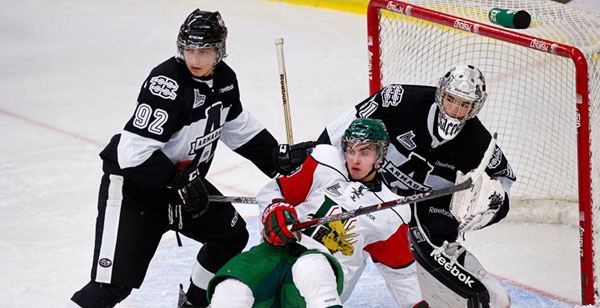
Nikita Kolešnikovs (No. 92) was traded by Canada’s Shawinigan Cataractes and now plays for the Blainville-Boisbriand Armada. (Photo courtesy of Blainville-Boisbriand Armada)

The ice hockey season started tragically for Latvia. On Sept. 7, 43 players and officials of the Kontinental Hockey League’s (KHL) Jaroslavl Lokomotiv team, as well as crew members, died when their aircraft crashed on take-off heading for the season opener in Minsk. The hockey world was in shock.

Among those who perished was Canadian coach Brad McCrimmon and players from Russia, the Czech Republic, Slovakia Sweden, Belarus and—sadly for Latvian hockey—Karlis Skrastiņš.

At age 37, Skrastiņš had just moved to the KHL after a stellar career in the National Hockey League (NHL). He held the NHL’s ironman title for defencemen having played 495 consecutive games and was the captain of the Latvian men’s national team. In a country with few high calibre hockey players, Skrastiņš will be sorely missed. The tragedy was underscored by reports that the cause of the crash was pilot error and lack of safety standards among domestic Russian air carriers.

A tough start in North America

Things did not bode well for Latvian hockey a month later. For the first time in years, no player from Latvia started the season in the NHL. Three prospects and one veteran from Latvia who had been at NHL training camps were sent down to their farm clubs in the American Hockey League (AHL).

However by late October, forward Kaspars Daugaviņš was recalled from Binghamton to the Ottawa Senators and has been playing credibly. Daugaviņš’ contract allowed him to bolt for the Europe, most likely Dinamo Rīga in the KHL, if he had not been given a set number of games with the big team by the end of 2011. He’s already exceeded that number.

Winnipeg Jets prospect defenceman Arturs Kulda was also called up in November from the St. John’s Ice Caps in Newfoundland. Hockey sources rate Kulda as ready for the NHL but the Jets have an abundance of defencemen and Kulda will need to knock someone off the roster to play regularly.

Even though defenceman Oskars Bārtulis spent most of last season with the Philadelphia Flyers albeit a healthy scratch on many nights, he started the season with the Adirondack Phantoms and is waiting his turn. He will likely get the call sometime this season.

Calgary Flames enforcer Raitis Ivanāns was also sent down to the Abbotsford Flames of the AHL. After spending four years in the NHL with the Los Angeles Kings, Ivanāns moved to the Flames last season with a two year contract. Early last year Ivanāns suffered a serious concussion from a knock-out punch in scrap with another enforcer. It took a year before he was cleared to play. Even though Ivanāns is a solid fourth-line player, he earned his pay as an enforcer, at 6 feet 4 inches and 240+ pounds (1.93 meters and 109+ kilograms) one of the heavyweights in the NHL. Concussions and head shots as well as the mental toll exacted on enforcers have lately generated a lot of discussion in hockey circles and it is difficult to say whether post concussion health concerns will prevent Ivanāns from returning to the NHL. Ivanāns and Bārtulis have one-way contracts. That means they gets paid a NHL salary even when sent down. Ivanāns earns USD 600,000 a year, roughly 10 times the amount he would get playing in the AHL on a two-way contract.

Three players started the season in Canada’s three Major Junior (under 20 years old) hockey leagues. The majority of NHL players go this route and each team can only carry two Europeans. Edmonton Oilers draft pick forward Kristiāns Pelšs returned to the Western Hockey League’s (WHL) Edmonton Oil Kings for his second season after attending the Oilers training camp. Pelšs is one of the top players on the team, he gets lots of ice time, accumulates points at a respectable pace, play on the power-play and according to his coach excels on the penalty kill. Look for him to turn professional and play in the AHL next year.

Defenceman Nikita Kolešnikovs was picked up by the Quebec Major Junior Hockey League’s (QMJHL) powerful Shawinigan Cataractes. He was later traded for a highly touted Russian prospect to the Blainville-Boisbriand Armada just north of Montreal. Unlike most European players who take a few months to adjust to the North American game, Kolešnikovs had a running start and was picking up points at a regular clip as one of the Armada’s best players. He is a big rugged defenceman who in November was suspended two games for an illegal hit from behind and in December had two fights in one game.
Things didn’t go nearly was well for defenceman Kristaps Bažēvics, who was picked up by the Prince Albert Raiders of the WHL. He didn’t make the cut and after playing only two games, he was released in October. Bažēvics is now playing Tier 2 junior hockey in the United States with the Alaska Avalanche of the North American Hockey League (NAHL).

Latvians in American junior hockey

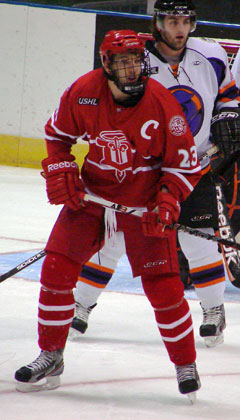
A number of players from Latvia are playing in various American high schools and junior loops. Among them is United States Hockey League (USHL) stand-out forward Zemgus Girgensons of the Dubuque Iowa Fighting Saints. The USHL is the top tier of junior hockey in the USA. Girgensons is playing his second season in the USHL and even though he only turns 18 in January, he is already the team’s captain, top forward and among the best players in the USHL. More and more players from the USHL are being drafted by the NHL and Girgensons is expected to go in the first round next summer. By comparison Daugaviņš went in the third and Kulda in the seventh rounds. If so, Girgensons will be highest-ever drafted player from Latvia. At this point, Girgensons is committed to moving on to the the University of Vermont in Tier 1 NCAA. However if he continues to shine, look for a big entry-level contract thrown his way to entice him to turn professional. Another player in the USHL is 20-year-old defenceman Ralfs Freibergs, who is likely playing out his last junior season with the Lincoln Stars.

Girgensons, Kolešnikovs and Pelšs will join the rest of the Latvian National Junior (U20) team when it plays against Russia, Sweden, Switzerland and Slovakia at this year’s World Championships in Calgary from Dec. 26 through Jan. 5. Meanwhile Canada, the U.S., Finland, the Czech Republic and Denmark will play their preliminary games in Edmonton. Unlike previous years when the bottom two teams were demoted, this year it will only be the last place team. Latvia and Denmark are the underdogs and will likely be the two trying to stave off relegation.

The bulk of Latvia’s U20 team will be made up of players from Hockey Club Rīga (HK Rīga). It plays in the MHL, the junior loop run by the KHL. Although many junior-aged players and even those younger head to other countries looking for exposure and opportunities, HK Rīga and the MHL provide a credible alternative for Latvian juniors to play at home and the team has performed reasonably well. Given that the majority of Latvia’s U20 team will have played together all season with HK Rīga, this might just be the edge that Latvia is looking for to secure a spot in the top tier for two years running. However, it would be a mistake to take the Danes lightly. Danish hockey has made strides in the last few years and the Danes are no longer push-overs.

Latvia’s U18 team was promoted earlier this year and will see action against hockey’s superpowers at the World Championships in April being held in the Czech Republic. The teams will be the same ones lining up in Calgary and Edmonton with the exception of Germany replacing Slovakia.

Meanwhile with less than 80 registered players and only three local teams, it is not surprising that Latvia is miles behind Canada and the United States in women’s hockey, both of which have thousands of girls and women who play. These two countries dominate the top tier of women’s hockey which also includes six other countries although the others rarely win a game against the big two. Latvia plays one level lower and will be hosting the Group A Tier 2 World Championships in Ventspils next March. Austria, the Czech Republic, Japan, Kazakhstan, Norway and Latvia will be participating. Another six countries will play in the parallel Group B Tier 2 championships to be held in Great Britain. American-born Sarma Pone, who now plays in Turkey, is on the Latvian team. Latvia’s women will have their hands full. Realistically their objective will be to avoid relegation to Tier 3.

Latvia in the World Championships

The senior men’s team will be competing in May at the World Championships being held in Stockholm and Helsinki. Latvia will be playing in Stockholm and its proximity to Latvia will guarantee a large contingent of noisyLatvian fans chanting in unison to their trademark bass drums. Latvia is currently ranked 12th and has been at the top level since 1997, an unprecedented run for all but hockey’s superpowers. Since 1997, Latvia has placed seventh three times, most recently in 2009. The bulk of the team will come from Dinamo Rīga but the availability of reinforcements from North America playing in the NHL and AHL is key. Their presence is always problematic and depends on how far their teams go in the playoffs that happen at the same.

The big news with the senior men’s team is that Canadian Ted Nolan has been hired as head coach after years of mostly Latvian coaches with one Swede and Russian the exceptions. Nolan is experienced having played and coached in the NHL and AHL. He has also worked with juniors. His Moncton Wildcats won the Canadian Major Junior title in 2005-2006 and took home the Memorial Cup. Latvians Oskars Bārtulis and Mārtiņš Kārsums were on that team. Nolan is a member of the Ojibwa First Nation from Northern Ontario. He is a colourful figure and is able to get the most out of his players. Nolan has already been to Rīga several times to check out players on Dinamo Rīga and has made a point of catching games with Latvian players in North America.

Over in Latvia, Dinamo Rīga, which plays in the KHL, has struggled this season under its new Finnish head coach, Pekka Rautakallio. In the previous three seasons, the team had exceeded expectations under Slovak coach Julius Suplers, who moved this season to coach rival CSKA Moscow. Recently team chairman Juris Savickis publically criticized Rautakallio, which is never a good sign. Rautakallio himself admitted that he may have moved too quickly trying to change the team’s style of play to be more defensive and positional. The team’s inconsistent play has also been noticed by the fans and attendance is down. The bulk of Latvia’s men’s team plays on Dinamo Rīga. The rest of Dinamo is composed of the so-called “leģionāri” or imports from Canada, Sweden, Finland and Slovakia. The most popular foreigner is goaltender Chris Holt from Vancouver. As a low-budget team, Dinamo Rīga does not have the money to attract top players, which is why Skrastiņš turned down an offer to play in Rīga for more money in Jaroslavl and why leading scorer Lauris Dārziņš moved to AK Bars in Kazan this season.

Then there are the journeymen—players who are too old for HK Rīga and not good enough for Dinamo Rīga or teams in top leagues. For the most part they bounce around in lower leagues throughout Europe never knowing where they will play next year. Players from Latvia can be found in Finland, Sweden, Norway, Great Britain, France, Germany, Switzerland, Austria, the Czech Republic, Belarus, Russia and Kazakhstan.

Latvia itself has a domestic league of 10 teams including one from Lithuania. The level of play is low and the teams can for the most part be considered semi-professional. The exception is Liepājas Metalurgs which fields a reserve team in the Latvian league and a professional team in the Belarus league. Liepājas Metalurgs also functions as a farm team for Dinamo Rīga where players can be sent down for conditioning and more ice time.

Latvian hockey has its ups and downs, its challenges and successes. The most interesting story-lines this year will be how many players from Latvia stick in the NHL and whether the U20 team will stay in the top tier two years running.

Description of image

Kristiāns Pelšs (No. 26), who was drafted by the Edmonton Oilers, is playing this season for the Edmonton Oil Kings. (Photo courtsey of Edmonton Oil Kings)

Description of image

Zemgus Girgensons of the Dubuque Iowa Fighting Saints is among athletes from Latvia playing junior hockey in the United States. (Photo by Viesturs Zariņš)

Timely victories for Latvian hockey avoid championship relegation

With timely 6-3 and 4-1 victories in the relegation round against Belarus on May 7 and Austria on May 8, Latvia has salvaged a 13th place finish at this year’s IIHF World Hockey Championships held in Slovakia.

The victories allowed the team to avoid relegation, which would have been disastrous for Latvian hockey.

The year before in Germany, Latvia finished 11th and since being promoted to the elite level in 1997, Latvia has placed seventh three times, the last time in 2009.

This year’s tournament started well for Latvia, a respectable 2-4 loss to the Czech Republic followed by a 2-3 overtime shoot-out loss to Finland.

However, an unexpected 2-3 shoot-out loss to Denmark sent Latvia to the relegation rather than qualification round.

The team was deflated and lost the next game against Slovenia 2-5. Latvia had never lost to Slovenia and this set up Latvia in a must-win situation for the final two games. The team came through.
Veteran Captain Herberts Vasiljevs said on iihf.com that the difference was attitude: “When you go into a game thinking ‘don’t lose,’ then you’re going to lose. We came in with the thought we have to win it. That was the difference.”

This year’s ups and downs illustrate the challenge facing Latvia’s hockey: lack of depth. The team had to do without a number of experienced players and all of a sudden became very vulnerable. Veteran NHLer Kārlis Skrastiņš was unable to play. Oskārs Bārtulis, who saw limited action in the NHL this year, was injured. Kaspars Daugaviņš, an Ottawa Senators prospect, was not available due to play-off action with the farm team in North America. Rugged defenceman and Atlanta Thrashers prospect Arturs Kulda played but was suspended for three games after a hit against a Czech player. He returned in time for the game against Belarus and was pivotal logging lots of ice time in the last two games. Dinamo Rīga centre Jānis Sprukts, who has 13 NHL games to his credit, passed on the opportunity to play at this year’s championship airing a number of grievances against the Latvian Hockey Federation in a controversial and well publicized interview. Dinamo top-scorer Lauris Dārziņš and defenceman Krišjānis Redlihs were injured during the tournament.

This year a number of younger players were brought up to plug the gap and some fared quite well. Andris Džeriņš moved into a regular starting role and picked up five points. Kristaps Sotnieks had four while Gints Meija and Roberts Bukarts each had three. Other newcomers were Oskars Cibulskis, Sergejs Pečura and third goaltender Māris Jucers. Youthful exuberance aside, most however are not ready for prime time and still need time to mature before they can pose a serious threat when playing the big powers.

There has also been a debate in the Latvian media about the impact of the KHL’s Dinamo Rīga on the national squad. In past years, the World Hockey Championship was an opportunity for Latvian players to showcase their skills and snag a better team and contract the following year. But some have argued that those with Dinamo contracts have now peaked and as a result the motivation to perform at the World Championships has taken a hit. After all, most will not make the NHL and the KHL is arguably the second best hockey league in the world.

Nevertheless, a youth revolution is underway on the national team and, given that this year’s mix of players managed to keep Latvia in the running, bodes well for the future.  Latvia has somewhat of an enviable record: now 16 consecutive years at the elite level, while other so-called middle powers of hockey—Belarus, Germany, Switzerland, Norway, Denmark, Italy, Austria and Slovenia—have not been able to match Latvia’s run. Nevertheless, the playing field is becoming even. There are no easy games, even against countries that Latvia has owned in the past. Latvia will need to remember that at the 2012 championships being co-hosted in Sweden and Finland.

Meanwhile, Latvia’s U-20 and U-18 junior squads won their groups in IIHF Division I (second tier) tournaments and are returning to the elite level next year. Their stay will likely be short because unlike the senior men’s tournament where 16 countries compete and the bottom two get relegated, the junior tournaments only have 10 countries and the bottom two drop down. That doesn’t leave much room for countries like Latvia when the top positions are locked up by Canada, the United States, Russia, Sweden, Finland and the Czech Republic with Switzerland, Germany and Slovakia close behind.