Perhaps one of the reasons the recently departed Latvian poet Imants Ziedonis was held in such high regard is that, even though his poetry was deep and thoughtful, it was often, at the same time, accessible and understandable.
It was not the head-scratching affair, opaque and oblique like some other poets – much of it was written in a language that the average reader could understand and relate to. In fact, Ziedonis had quite the knack for writing song lyrics – many songs featuring his words remain immensely popular. Something about his works lends itself to popular music. This has been reconfirmed many times – the most recent example being the Viegli album project, where various Latvian musicians wrote songs with the words of Ziedonis.
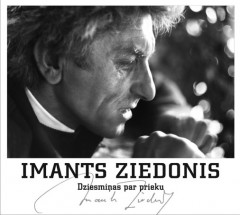
Recognizing this aspect of the poet’s appeal, the Latvian record company Micrec released the collection Dziesmiņas par prieku, a collection of songs all of which share a common thread – their lyrics are by Ziedonis.
The bulk of the songs on this collection are from the 1970s and 1980s, and feature Latvian stars and composers of that era. In fact, it seems like most every significant composer and artist from that era is represented here – composers such as Raimonds Pauls, Imants Kalniņš and Uldis Stabulnieks, and performers such as Viktors Lapčenoks, Nora Bumbiere, Ingus Pētersons, among many others.
It should be no surprise that most of the songs on this collection are by the most popular composer of that era (and still one of the most popular and influential composers today), Raimonds Pauls. Pauls, with a natural ability to write a catchy and memorable melody, used the lyrics of Ziedonis to compose what would become some of his most popular tunes. Songs like “Tāpēc jau, ka nevar zināt kāpēc” (performed by Edgars Liepiņš), “Nenes zvaigznes istabā” (performed by Ingus Pētersons), and “Meitene ar kallu ziediem” (performed by Credo)
One can also see how Ziedonis’ words were essential to the Latvian Reawakening in the 1980s, particularly in songs like “Tautas laiks” (music by Jānis Lūsēns, sung by Zigfrīds Muktupāvels), a memorable anthem from that era and a song that, even today, still gives me chills.
Ziedonis’ poetry also lends itself to choir music, and one such example is on this collection – “Mūžu mūžos būs dziesma” (composed by Valters Kaminskis) and performed by the Song Festival men’s choir. This song, with its basic truth “Mūžu mūžos būs dziesma, un mūžu mūžos alus smēķēs” (Song will live forever, and beer will always be tasty), has resonated with Song Festival audiences for decades now.
Granted, some of the lyrics here could be considered a bit trite. One example would be “Tā es tevi mīlēšu”, with music by Raimonds Pauls and performed by Nora Bumbiere and Viktors Lapčenoks, which is one of those songs that just about every Latvian knows (the chorus, at least), and is usually sung at loud volume after a few drinks. Still, though, the lyrics have given this song a universal appeal.
Packaging is minimal on this collection, though – there is only the list of songs and a photo of Ziedonis. It would have been interesting reading if the artists and composers had contributed some notes about what it was like working with and performing the poetry of Ziedonis. Or, at the very least, it could have provided some minimal biographical information, or perhaps when the songs were recorded. Still though, the most important aspect is the songs, and, in this aspect, the CD delivers admirably.
Dziesmiņas par prieku, besides being a tribute to the wordsmith Ziedonis is also a very detailed snapshot of Latvian popular music in the 1970s and 1980s. Ziedonis’ way with words was a natural fit for composers and performers, and his lyricism made for some memorable popular songs. Not that anyone really needs a reminder of what made Ziedonis’ poetry so exceptional, but this collection of songs, many of which are indelibly part of the national conscience, reconfirm Ziedonis’ place in the annals of Latvian poetry.
Details
Dziesmiņas par prieku – Dziesmas ar Imanta Ziedoņa dzeju
Various artists
Micrec, 2013
MRCD503
Track listing:
1. Visskaistākās ogas pasaulē – Austra Pumpure
2. Un kamēr mazs… – Imants Skrastiņš
3. Tāpēc jau, ka nevar zināt kāpēc -Edgars Liepiņš
4. Rīta stunda – Ieva Akuratere
5. Bizes – Ivars Kalniņš
6. Meitene ar kallu ziediem – Credo
7. Ja ticīgs es būtu – Ojārs Grīnbergs
8. Tā es tevi mīlēšu – Nora Bumbiere un Viktors Lapčenoks
9. Balta pūka – Nora Bumbiere un Viktors Lapčenoks
10. Spītība – Viktors Lapčenoks un Nora Bumbiere
11. Kā svece deg – Aija Kukule
12. Vēja ziedi – Viktors Lapčenoks
13. Latviešu jūrniekiem – Viktors Lapčenoks
14. Mežs – Uldis Stabulnieks
15. Nenes zvaigznes istabā – Ingus Pētersons
16. Upei pāri – Aija Kukule
17. Zvaigžņu zaglis – Uldis Stabulnieks
18. Tu neej prom – Mirdza Zīvere
19. Tautas laiks – Zigfrīds Muktupāvels
20. Straume – Līvi
21. Svētvakars – Andris Bērziņš
22. Buramdziesmiņa – Olga
23. Mūžu mūžos būs dziesma – Dziesmu svētku koris
24. Dziesmiņa par prieku – Viktors Lapčenoks
Egils Kaljo is an American-born Latvian from the New York area . Kaljo began listening to Latvian music as soon as he was able to put a record on a record player, and still has old Bellacord 78 rpm records lying around somewhere.